










Resumindo:
- Slippage is the difference between expected and actual trade prices caused by rapid market price changes. It results from low liquidity, high volatility, and large trade sizes, affecting both positive and negative outcomes. Using limit orders, trading during liquid sessions, and monitoring actual fill prices can reduce slippage risks.
Slippage is defined as the difference between the price you expect when placing a trade and the price at which that trade actually fills. It occurs across every financial market, including Forex, stocks, and cryptocurrencies, and it affects retail and professional traders alike. Slippage is unavoidable in market order execution because prices shift in fractions of a second between the moment you submit an order and the moment it fills. Slippage can work in your favor or against you, and understanding which conditions produce each outcome is the foundation of disciplined execution.
What is slippage and why does it happen?
Slippage is the gap between your intended execution price and your actual fill price. That gap exists because markets are not static. Every market order you send competes against a live order book or liquidity pool that changes constantly. When the price moves before your order fills, you get a different price than you expected.

Positive slippage means your order fills at a better price than you requested. Negative slippage means it fills at a worse price. A buy order that fills below your target price is positive slippage. A buy order that fills above your target is negative slippage. Both happen in real markets, though negative slippage is far more common during fast-moving conditions.
The slippage definition also extends beyond a single price point. A more complete measure compares your average execution price across the entire fill to the midpoint price at the moment you submitted the order. Total market impact) matters more than just the first fill price, especially when large orders consume multiple price levels in the order book.
What causes slippage in Forex, stocks, and crypto?
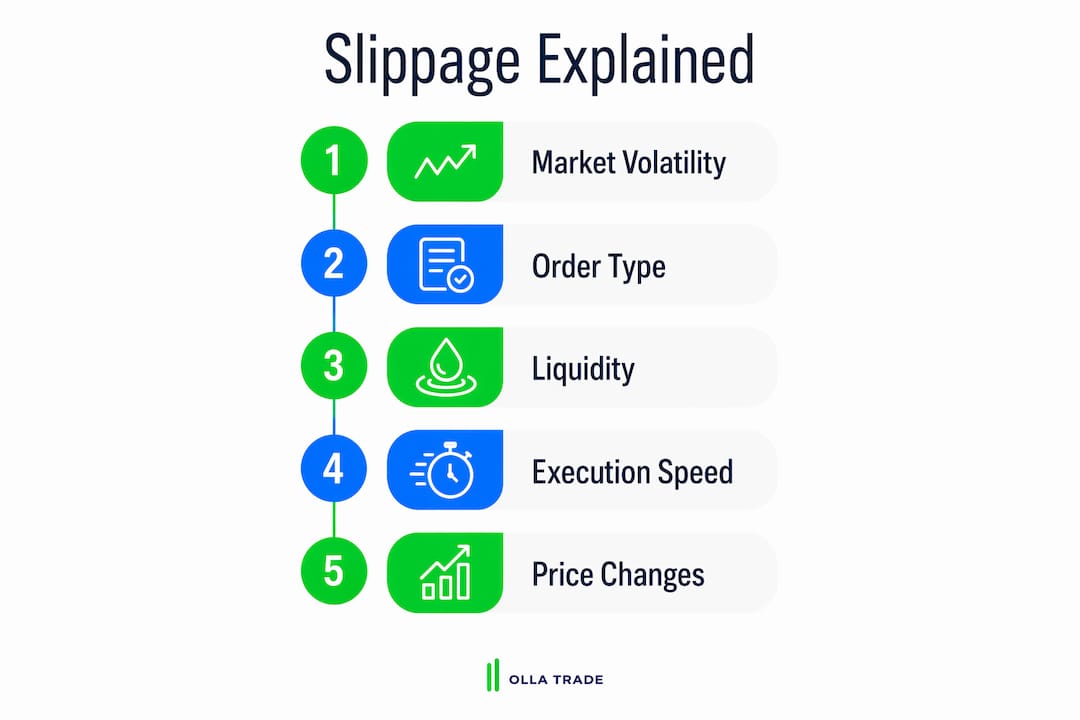
Two forces drive the majority of slippage: low liquidity and high volatility. Low liquidity means fewer resting orders sit at each price level. High volatility means prices move faster than your order can fill. Both conditions force your order to fill at progressively worse prices as it works through the available depth.
The main causes of slippage break down as follows:
- Low liquidity. Thin markets have fewer buyers and sellers at each price. Your order consumes the available supply quickly and fills the remainder at the next available price, which is worse.
- High volatility. News events, economic data releases, and sudden sentiment shifts move prices faster than execution systems can respond. Your order chases a moving target.
- Large trade size. A trade representing 1% of an AMM liquidity pool incurs significantly more slippage than one representing 0.1% of the same pool. Size is a multiplier on every other cause.
- Market impact. Traders often underestimate how their own orders move the market. Trade size relative to order book depth is a principal driver of price changes during execution, not just external volatility.
- Decentralized exchange mechanics. Automated market makers (AMMs) on platforms like Uniswap use mathematical pricing formulas rather than order books. Larger trades shift the formula more aggressively, producing higher slippage on decentralized exchanges than on centralized venues with comparable liquidity.
Dica profissional: Check the order book depth or liquidity pool size before entering a large position. A trade that looks small in dollar terms can still represent a meaningful percentage of available liquidity in thinly traded pairs or tokens.
Forex majors like EUR/USD carry deep liquidity during London and New York sessions, which keeps slippage low. Exotic currency pairs, small-cap stocks, and newer crypto tokens carry far less depth, making slippage a constant concern even on modest trade sizes.
What are the types of slippage and how do order types affect it?
Order type is the single biggest variable you control when managing slippage risk. Different order types carry fundamentally different relationships with slippage.
| Order type | Risco de deslizamento | Trade-off |
|---|---|---|
| Market order | Alto | Guarantees execution, not price |
| Limit order | None if filled | May not fill if price does not reach your level |
| Stop-loss order | Moderado a alto | Becomes a market order when triggered |
| Stop-limit order | Baixo | May not fill in fast markets |
Market orders fill against resting orders at progressively worse prices as they consume available depth. That is the core mechanism of negative slippage. Limit orders eliminate slippage by specifying the maximum price you will accept, but they introduce execution risk. If the market never reaches your limit price, the order sits unfilled and you miss the trade entirely.
Stop-loss orders create a specific and often underappreciated slippage problem. Stop-loss orders become market orders the moment they trigger. In a fast-moving market, the price can gap well past your stop level before the resulting market order fills. Your intended exit at 1.2050 becomes an actual exit at 1.2030. That 20-pip gap is stop-loss slippage.
Guaranteed stops solve this problem by locking in your exit price regardless of market conditions. They typically carry a premium, but guaranteed stops help traders who cannot tolerate exit price uncertainty, particularly around major news events.
Dica profissional: Use limit orders for entries whenever your strategy allows. Reserve market orders for situations where getting into or out of a position immediately is more important than the exact price.
How does slippage affect trading strategy and profitability?
Slippage is not just an occasional nuisance. It is a recurring cost that compounds across every trade you make. Slippage accumulates over many trades and can significantly erode profits, turning strategies that look profitable on paper into break-even or losing systems in live markets.
The impact is especially sharp for high-frequency traders and scalpers. A strategy that targets 5 pips of profit per trade cannot survive consistent 2-pip slippage on entries and exits. The math collapses before market analysis even enters the picture. Execution quality is not secondary to strategy. It is part of strategy.
The cumulative effects of slippage on trading performance include:
- Reduced net profit per trade. Every pip or cent of slippage directly reduces your realized gain or increases your realized loss.
- Strategy invalidation. A system backtested without realistic slippage assumptions will underperform in live markets, sometimes dramatically.
- Risk management distortion. Stop-loss slippage means your actual risk per trade is larger than your planned risk. Position sizing based on clean stop prices becomes inaccurate.
- Psychological pressure. Consistent negative slippage erodes confidence in a system, even when the underlying logic is sound. Traders often abandon good strategies because they attribute slippage losses to strategy failure.
One advanced concept worth knowing is reverse slippage), which occurs when accumulating a large position actually moves the market in a favorable direction. Large institutional traders and market makers sometimes use this deliberately, building positions that create price squeezes and generate profitable exit opportunities. This is not a retail trading technique, but understanding it explains why large players behave differently around liquidity events.
For retail traders, the practical takeaway is simpler. Slippage is a cost of doing business. Measure it, account for it in your strategy, and manage it actively. Ignoring it is the same as ignoring commissions or spreads. You can read more about common execution mistakes that compound slippage costs over time.
What techniques and tools minimize slippage risk?
Managing slippage requires deliberate choices about order type, timing, trade size, and platform selection. No single technique eliminates slippage entirely, but combining several approaches reduces its impact substantially.
-
Use limit orders for entries. Limit orders give you price control. You define the worst acceptable price, and the order either fills at that price or better, or it does not fill at all. This eliminates negative entry slippage at the cost of potential missed trades.
-
Avoid trading during peak volatility windows. Major economic releases, central bank announcements, and geopolitical events spike volatility and widen spreads simultaneously. Slippage during these windows can be multiples of normal levels. Use the Ollatrade economic calendar to identify high-impact events before they hit.
-
Size trades relative to available liquidity. Before entering, assess the order book depth or liquidity pool size. Keep your trade size small enough that it does not meaningfully consume available depth. A good rule of thumb is to avoid trades that represent more than a fraction of a percent of the visible liquidity at your target price.
-
Trade during peak liquidity sessions. Forex liquidity peaks during the London and New York overlap, roughly 8:00 a.m. to 12:00 p.m. Eastern time. Stock liquidity is highest in the first and last hour of the regular session. Crypto markets are global but still show liquidity cycles tied to major financial center hours.
-
Use algorithmic execution tools. Platforms with MetaTrader 4 integration support expert advisors and automated order routing that can split large orders into smaller pieces, reducing market impact. Algorithms execute faster and more consistently than manual order entry, which reduces the time window during which price can move against you.
-
Choose guaranteed stops for critical risk levels. When a specific exit price is non-negotiable for your risk management, a guaranteed stop removes execution uncertainty. The premium is a known, fixed cost. Stop-loss slippage in a volatile market is an unknown and potentially much larger cost.
-
Monitor your actual slippage over time. Compare your expected fill prices to your actual fill prices across a sample of trades. Consistent negative slippage on a specific instrument or session is a signal to adjust your approach to that market. You can refine your overall trading workflow for Forex and crypto by tracking execution quality alongside strategy performance.
Principais conclusões
Slippage is a real, measurable execution cost that compounds across every trade, and managing it through order type selection, timing, and trade sizing is as important as any market analysis technique.
| Apontar | Detalhes |
|---|---|
| Slippage definition | The gap between your expected fill price and your actual fill price on any order. |
| Primary causes | Low liquidity, high volatility, and large trade size relative to available depth. |
| Order type matters | Limit orders prevent slippage; market orders guarantee execution but not price. |
| Cumulative cost | Slippage accumulates across hundreds of trades and can turn profitable strategies into losing ones. |
| Management techniques | Use limit orders, trade during liquid sessions, size positions carefully, and track actual fill quality. |
The cost you are probably not tracking
Slippage is the most underestimated cost in trading. Spreads and commissions appear on every statement. Slippage does not. It hides inside your fill prices, invisible until you compare what you expected to what you actually got.
I have seen traders spend months refining entry signals while their execution bleeds them on every fill. The signal is not the problem. The execution is. A strategy with a 55% win rate and 2:1 reward-to-risk can still lose money if slippage consistently takes 30% of the expected reward on each trade.
The traders who manage slippage best treat it like any other variable in their system. They measure it. They set acceptable thresholds. They change instruments, sessions, or order types when slippage exceeds those thresholds. They do not accept it as random noise.
The professional insight here is counterintuitive. Tighter analysis does not fix a slippage problem. Better execution discipline does. That means choosing limit orders more often, trading during liquid hours, and keeping position sizes proportional to the depth of the market you are trading. It also means accepting that some trades will not fill because you used a limit order. A missed trade costs nothing. A bad fill costs real money.
Slippage management is not glamorous. It does not generate the kind of excitement that a new indicator or a new strategy does. But it is one of the few edges in trading that is entirely within your control. Use it.
— FX
Trade smarter with Ollatrade
Slippage costs are real, but the right platform reduces them significantly. Ollatrade gives Forex and crypto traders access to fast order execution, tight spreads, and MetaTrader 4 integration, which together shrink the window in which price can move against you between order submission and fill.
Ollatrade's Plataforma de negociação Forex supports limit orders, stop-limit orders, and guaranteed stops across major and minor currency pairs, giving you the order type flexibility that slippage management requires. For crypto traders, Ollatrade provides access to liquid markets where execution quality stays consistent even during volatile sessions. Open an account and put execution quality at the center of your trading approach.
Perguntas frequentes
What is slippage in simple terms?
Slippage is the difference between the price you expected when placing a trade and the price at which your order actually filled. It occurs because market prices move between the moment you submit an order and the moment it executes.
Is slippage always bad for traders?
No. Positive slippage occurs when your order fills at a better price than expected, which benefits the trader. Negative slippage, the more common type, fills at a worse price and reduces profit or increases loss.
Which order type has the least slippage risk?
Limit orders carry no slippage risk because they specify the maximum acceptable price. The trade-off is that limit orders may not fill if the market does not reach your specified price level.
When is slippage worst in Forex trading?
Slippage is worst during major economic data releases, central bank announcements, and market open or close periods when volatility spikes and liquidity temporarily thins. Trading during the London and New York overlap generally produces the tightest fills.
How do I reduce slippage on crypto trades?
Use limit orders instead of market orders, trade pairs with deep liquidity, and keep your trade size small relative to the available pool depth. On decentralized exchanges using AMMs, a trade representing even 1% of the liquidity pool produces significantly more slippage than a smaller trade in the same pool.