












TL;DR:
- Most traders fail because of common, repeatable mistakes such as lack of a written plan, poor risk management, and emotional trading after losses. Maintaining discipline through structured rules, journaling, and proper risk controls significantly improves trading consistency and account survival. Avoiding overtrading, understanding leverage, and preparing for market context are essential to long-term success.
Most traders don’t fail because the market is too complex. They fail because of the same repeatable trading mistakes to avoid that have cost countless accounts over decades. Whether you’re managing your first live position or you’ve been trading forex and CFDs for years, the pitfalls are remarkably consistent: no written plan, poor risk control, emotional decisions after losses, and trades made out of boredom rather than conviction. This article walks through the top mistakes in trading with specific, data-backed fixes you can apply immediately.
Table of Contents
- Key takeaways
- 1. Trading without a clear plan or strategy
- 2. Ignoring risk management and position sizing
- 3. Emotional trading and revenge trading after losses
- 4. Overtrading and chasing missed moves
- 5. Misusing leverage without understanding total risk
- 6. Failing to keep a trading journal
- 7. Skipping pre-trade preparation and market context
- My perspective on mastering trading discipline
- Start trading smarter with Ollatrade
- FAQ
Key takeaways
| Point | Details |
|---|---|
| A written plan prevents impulse trades | Documenting your rules for entries, exits, and risk removes emotion from real-time decisions. |
| Cap risk at 1% per trade | Limiting exposure per position protects your account through inevitable losing streaks. |
| Hard loss limits beat willpower | Setting a daily max loss enforced by your platform stops revenge trading more reliably than self-control. |
| Journals reveal behavioral patterns | Logging 20 to 30 trades exposes the emotional triggers and habits quietly draining your performance. |
| Overtrading costs more than you think | Excessive trade frequency raises transaction costs and lowers decision quality as fatigue sets in. |
1. Trading without a clear plan or strategy
The most common beginner trading blunder is also the most preventable. Without a written trading plan, traders default to gut feelings, market noise, and the emotional state of the moment. That combination produces inconsistent decisions and inconsistent results.
A trading plan is not a vague intention to “buy low, sell high.” It’s a documented set of rules that defines your entry criteria, exit criteria, stop-loss placement, maximum risk per trade, and the market conditions required before you even consider a setup. It should also include what you will not trade: specific times, instruments, or setups outside your edge.
Traders who skip this step often feel confident in the moment but struggle to explain afterward why they took a trade. That’s the red flag. If you can’t articulate the rules before entering, you’re speculating without a process, not trading with one.
Pro Tip: Build your plan before the market opens. If a setup doesn’t match your documented criteria during the session, it doesn’t exist for you that day. Ollatrade’s beginner trading workflow guide walks through exactly how to structure this process from scratch.
2. Ignoring risk management and position sizing
Risk management is not a suggestion. It’s the survival condition for every trader’s account. Neglecting these rules is what turns a rough week into a blown account.
The most cited standard across 2026 trader education sources is the 1% rule. Risk capped at 1% per trade allows a trader to absorb 20 consecutive losses and still have 80% of their capital intact. Oversizing to 5% or 10% per trade compresses that runway dramatically. Three bad trades in a row can cripple your account before you’ve had time to correct course.
Here’s a practical breakdown of how position sizing works:
| Account Size | 1% Risk | 2% Risk | Stop Distance (pips) | Position Size |
|---|---|---|---|---|
| $10,000 | $100 | $200 | 20 | 0.5 lots |
| $10,000 | $100 | $200 | 50 | 0.2 lots |
| $25,000 | $250 | $500 | 30 | 0.83 lots |
The formula is straightforward: account risk divided by your stop distance gives you the correct position size. What traders skip is the buffer. Adding a 20% buffer to your stop distance accounts for gap risk, particularly on instruments like indices and crypto that can jump through levels overnight.
The other half of this mistake is moving your stop loss after entry. Moving stops further away when a trade goes against you is not managing risk. It’s increasing it. Your original stop was set for a reason. If the trade invalidates that level, the trade is wrong.
Pro Tip: Use Ollatrade’s risk management strategies guide to build a position sizing template you apply to every single trade, without exception.
3. Emotional trading and revenge trading after losses
Every trader has been there. A stop gets hit, the position closes at a loss, and within minutes there’s an urge to get back in and “recover” what was just lost. That impulse is revenge trading, and it’s one of the most destructive patterns in the business.
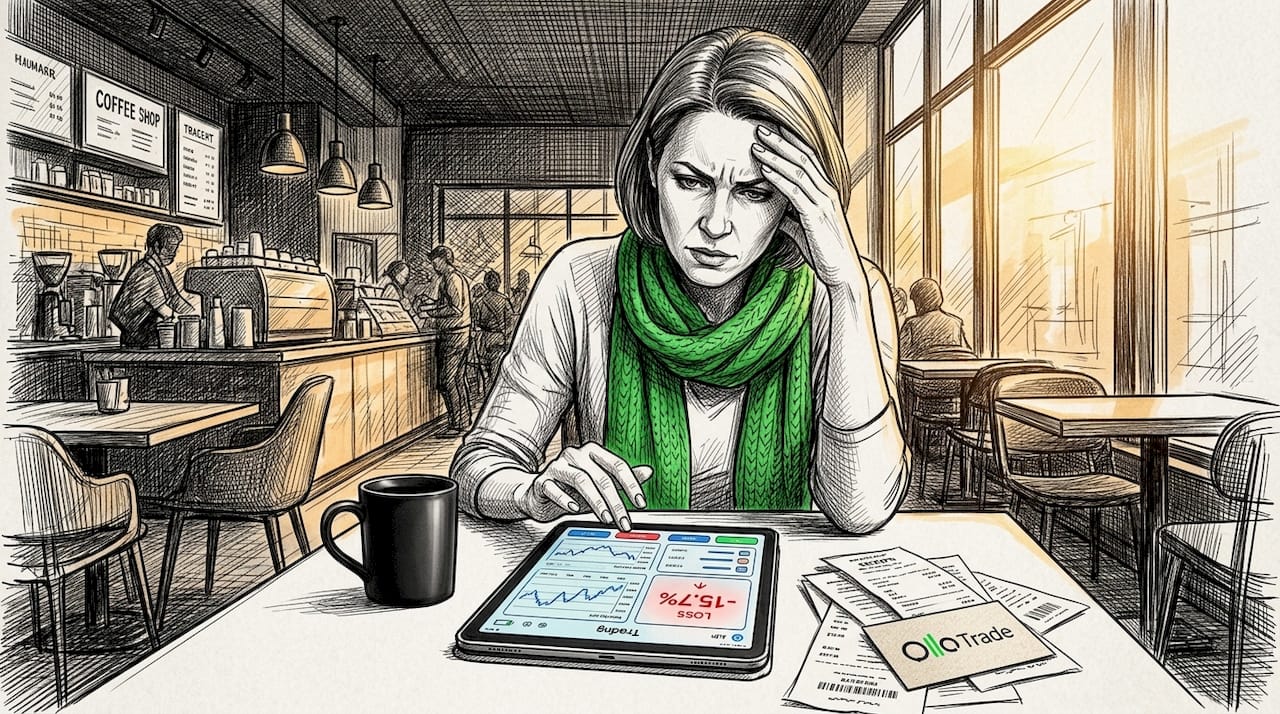
The mechanics are predictable. A loss triggers frustration or anxiety. Those emotions generate a need for immediate action. The trader enters the next trade with elevated position size, reduced analysis, and a psychological need to win rather than a genuine edge. The result is almost always a second, larger loss.
Cognitive biases make this worse. Recency bias convinces you the next trade will reverse your luck. Confirmation bias makes you see setups that aren’t there. Overconfidence after a winning streak amplifies your position sizing right before a drawdown. These are predictable errors, not character flaws, and they respond to structural solutions.
The fix is not trying harder to stay calm. It’s building rules that remove the choice:
- Set a hard daily loss limit of 2 to 3% of account equity. When you hit it, trading stops for the day. Not after one more trade. Done.
- Add a mandatory cooling-off period after two consecutive losses. Step away for 30 to 60 minutes before reviewing the session.
- Embed circuit breakers in your platform where possible. Platform-enforced loss limits prevent emotional override far more reliably than personal discipline under stress.
“The market will be open tomorrow. Protecting your capital today is more profitable than trying to recover today’s losses tonight.”
4. Overtrading and chasing missed moves
More trades do not produce more profits. Past a certain threshold, overtrading destroys accounts through a combination of transaction costs, decision fatigue, and setups taken below your own quality standards.
The psychology behind overtrading is partly biological. Action bias, the human tendency to prefer doing something over doing nothing, pushes traders toward entries when patience is the better choice. Add decision fatigue from a long session and the quality of your analysis drops significantly by trade seven or eight.
Follow these steps to break the cycle:
- Review your journal and calculate your average performance by trade count per day. Most traders find their fifth and sixth trades underperform significantly compared to their first three.
- Set a maximum trade count for each session. Start with three to five depending on your strategy. If that limit is reached, the session is over.
- Create a rule about missed entries. If a setup triggered while you were away from the screen, it’s gone. Chasing a move that has already extended 80% without you is a separate, lower-probability trade. Treat it as such.
- Avoid low-liquidity windows. The midday window in major forex sessions and the first 15 minutes after a major data release are notorious for erratic price behavior.
Pro Tip: Track your trade entry times alongside outcomes in your journal. You may find a clear pattern showing your best trades happen in specific windows. That data is worth more than any indicator.
5. Misusing leverage without understanding total risk
Leverage is the feature most traders notice first and understand last. It amplifies gains, yes. But it amplifies losses at exactly the same rate, and it does so against your total dollar exposure rather than the margin you deposited.
Trading leveraged positions without knowing your liquidation price and total risk in dollar terms is one of the most common stock trading mistakes to avoid across both forex and crypto markets. A trader using 50:1 leverage on a $1,000 account controls $50,000 in exposure. A 2% adverse move wipes the account entirely before the stop is even reached in many cases.
The fix: calculate your total dollar risk before entry, not just your margin requirement. Make sure your position size, combined with your stop distance, keeps the actual loss within your 1 to 2% account risk limit regardless of leverage.
6. Failing to keep a trading journal
A trading journal is the closest thing to an objective mirror your trading will ever have. Most traders avoid it because it takes time and because the data is often unflattering. Both of those are exactly why it matters.
After 20 to 30 logged trades, patterns become visible that would otherwise stay hidden. Maybe your long trades outperform your shorts by a wide margin. Maybe your Monday trades lose money consistently. Maybe you exit winners too early when you’re up for the week and hold losers too long when you’re down. None of this shows up in your memory. It does show up in a journal.
What to log for each trade:
- Setup type and the reasoning behind the entry
- Emotional state before, during, and after the trade
- Planned versus actual exit and the reason for any deviation
- Result in dollars and as a percentage of account
- Lesson or observation after closing
The real value isn’t the record itself. Journals convert emotional P&L variance into objective data you can analyze systematically. Set aside time every weekend to review the past week’s trades. Look for clusters of mistakes and compare your rule-following rate to your win rate. The correlation will tell you more than any indicator.
| Without a journal | With a journal |
|---|---|
| Mistakes repeat without awareness | Patterns identified and corrected |
| P&L variance feels random | Behavioral causes become clear |
| Gut feelings drive decisions | Data-backed adjustments guide strategy |
| Emotional memory distorts performance | Objective records track real results |
7. Skipping pre-trade preparation and market context
Entering a trade without knowing the broader market context is one of the top trading mistakes to avoid, and one of the least discussed. A technically valid setup on a 15-minute chart can still be the wrong trade if there’s a central bank decision releasing in 20 minutes or if the daily trend is running hard in the opposite direction.
Pre-trade preparation means checking the economic calendar before each session to flag scheduled high-impact events. It also means identifying the higher timeframe direction and key levels before drilling into your entry timeframe. Setups that align across multiple timeframes carry statistically better odds than those that exist only on your preferred chart.
This step takes 15 minutes before the open. Skipping it can cost much more.
My perspective on mastering trading discipline
I’ve watched traders with solid strategies blow accounts not because their system was flawed, but because they couldn’t follow it when it mattered. And I’ve seen traders with unremarkable strategies build consistent track records purely through discipline. That gap between knowing what to do and actually doing it is where most trading careers are won or lost.
What I’ve learned is that willpower is not the answer. The traders who perform most consistently don’t rely on being mentally strong in the moment. They design their environment so that the right behavior is the easiest option. Hard loss limits in their platform. Maximum trade counts written into their plan. Journals reviewed every Sunday without exception. They treat their trading rules the way a pilot treats a pre-flight checklist: not optional, not subject to how confident they feel today.
The other thing I’d say is this: your mistakes are the most valuable data you have right now. They’re not failures. They’re the clearest signal of where your system, your psychology, or your preparation needs work. Traders who embrace that framing and build structured reviews around their losses tend to improve faster than those who treat mistakes as things to move past quickly.
Be honest about your patterns. Build rules that account for your worst days, not your best ones. That’s where real improvement starts.
— FX
Start trading smarter with Ollatrade
If this article surfaced mistakes you recognize in your own trading, the next step is putting better systems in place before your next session. Ollatrade gives retail and professional traders access to forex, CFDs on metals, indices, stocks, and cryptocurrencies through a platform designed for serious execution. Tight spreads, MetaTrader 4 integration, and advanced charting give you the technical foundation. The educational resources take care of the rest.
Start with Ollatrade’s forex trading step by step guide to structure your approach from entry to exit with proper risk controls built in. When you’re ready to trade, the Ollatrade forex platform connects you to major and minor currency pairs with the execution speed and tools professional traders expect. The 9 proven ways to manage risk guide is another practical resource worth bookmarking before your next session.
FAQ
What is the single biggest trading mistake beginners make?
Trading without a written plan is the most widespread beginner mistake. Without documented entry, exit, and risk rules, decisions default to emotion and impulse, which produces inconsistent and costly results.
How much should I risk per trade to protect my account?
Most trader education sources in 2026 recommend capping risk at 1% of account equity per trade. This limit allows a trader to absorb a string of losses without catastrophic damage to the account.
What is revenge trading and how do I stop it?
Revenge trading is the impulse to re-enter the market immediately after a loss to recover it, usually with poor analysis and oversized positions. Setting a hard daily loss limit of 2 to 3% and stopping all trading when you hit it is the most reliable structural solution.
Do I really need a trading journal?
Yes. After 20 to 30 logged trades, journals reveal behavioral patterns that are invisible without the data, including emotional triggers, setup biases, and exit timing errors that directly impact your bottom line.
How does overtrading hurt performance?
More trades per session increase transaction costs and decision fatigue, which lowers the quality of entries later in the day. Structural limits on daily trade count, backed by journal data, are the most effective way to reduce overtrading.