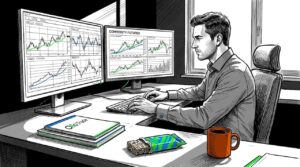












Most beginners who open a forex account lose money within the first few months. That’s not a scare tactic. 70 to 85% of retail traders lose money, and fewer than 10% stay profitable long term. But here’s the thing: the traders who survive and grow aren’t necessarily smarter. They follow a structured, risk-aware process from day one. This guide walks you through every step, from understanding the market to placing your first trade and protecting your capital, so you can build real skills instead of expensive habits.
Table of Contents
- Understanding forex trading basics
- What you need before trading: accounts, tools, and brokers
- Forex trading step by step: a simple process for beginners
- Essential strategies and setups for new traders
- Risk management: how to protect your capital
- Common mistakes and expert tips for consistent progress
- Ready to apply your forex step-by-step process?
- Frequently asked questions
Key Takeaways
| Point | Details |
|---|---|
| Follow a proven process | A step-by-step approach helps you avoid costly mistakes when learning forex trading. |
| Practice and risk control | Use demo accounts and risk only 1-2% per trade to protect your capital from common pitfalls. |
| Start with simple strategies | Trend-following and range setups are effective and manageable for new traders. |
| Continuous learning is vital | Journaling, reviewing trades, and ongoing education improve your trading discipline and results. |
Understanding forex trading basics
Before diving into the concrete steps, you need to understand what makes forex unique and which concepts guide every decision you’ll make.
Forex, short for foreign exchange, is the global market where currencies are bought and sold. According to BabyPips, the forex market runs 24 hours a day, five days a week, and processes $7.5 trillion in daily volume, making it the largest financial market on earth. You can get a complete forex overview to see how it all fits together.
Here are the core terms every beginner must know:
- Pip: The smallest price movement in a currency pair (usually 0.0001)
- Spread: The difference between the buy and sell price, which is your transaction cost
- Leverage: Borrowed capital that amplifies both gains and losses
- Lot: A standardized unit of currency (standard lot = 100,000 units)
- Margin: The deposit required to open a leveraged position
You can explore all key forex terms in one place to avoid confusion later.
The four main trading sessions:
- Sydney (opens the week)
- Tokyo (Asian liquidity)
- London (highest volume)
- New York (overlaps with London for peak volatility)
| Feature | Forex | Stocks | Futures |
|---|---|---|---|
| Daily volume | $7.5 trillion | ~$500 billion | ~$400 billion |
| Trading hours | 24/5 | Exchange hours | Nearly 24/5 |
| Asset type | Currency pairs | Company shares | Contracts |
| Leverage available | High | Moderate | High |
The sheer size and speed of forex means structure isn’t optional. It’s survival.
What you need before trading: accounts, tools, and brokers
With the basics clarified, it’s time to gather and set up what you’ll need to trade safely and with confidence.
Choosing a regulated broker is your first real decision. In the US, look for brokers registered with the CFTC and NFA. In the UK, the FCA regulates brokers. FOREX.com and OANDA are frequently recommended for beginners because of their low minimum deposits, strong educational resources, and regulatory standing.
For hardware and software, you need a reliable computer or smartphone and a trading platform. MetaTrader 4 (MT4) remains the industry standard for beginners. Many brokers also offer web-based platforms and mobile apps.
| Feature | Demo account | Live account |
|---|---|---|
| Real money | No | Yes |
| Market conditions | Simulated | Real |
| Emotional pressure | Low | High |
| Best for | Learning, testing | Executing real trades |
Pro Tip: Spend at least four to eight weeks on a demo account before going live. Most beginners rush this step and pay for it with real losses.
Before funding any account, check these five things:
- Spreads and commissions (lower is better for beginners)
- Deposit and withdrawal fees
- Customer support quality and response time
- Educational resources and tutorials
- Platform stability and execution speed
You can also read our online trading setup guide for a broader look at getting started, or check out how to start with $100 if you’re working with a small budget.
Forex trading step by step: a simple process for beginners
Once you’re set up, here’s exactly how to move from zero knowledge to your first live trade and ongoing improvement.
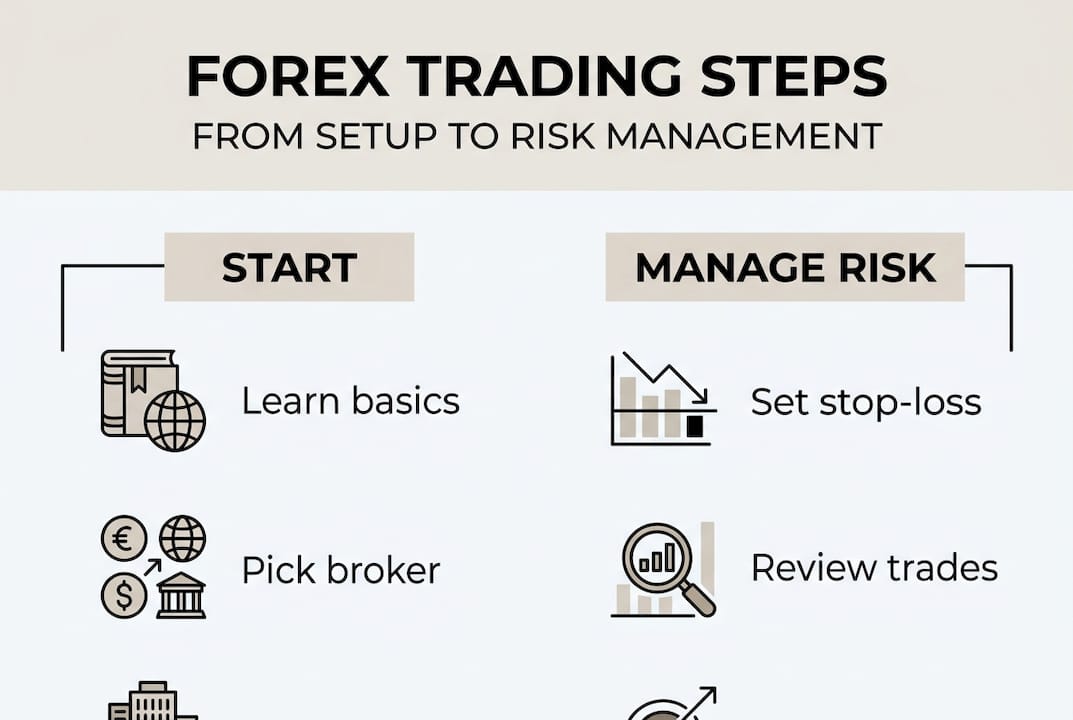
Following a clear sequence, as outlined by Investopedia’s forex guide, dramatically reduces the chance of costly early mistakes.
| Step | Action | Common pitfall |
|---|---|---|
| 1 | Learn key terms and market structure | Skipping fundamentals |
| 2 | Choose a regulated broker, open demo | Picking unregulated brokers |
| 3 | Practice order types on demo | Moving to live too fast |
| 4 | Build a simple trading plan | Trading without rules |
| 5 | Fund live account, risk 1 to 2% per trade | Overleveraging early |
| 6 | Place trades, log results in a journal | Ignoring trade reviews |
Step 1: Learn the basics. Know your pips, leverage, and major pairs before anything else.
Step 2: Choose a regulated broker. Verify CFTC or NFA registration in the US. Open a demo account immediately.
Step 3: Practice on demo. Get comfortable with market orders, limit orders, and stop-loss placement. Learn using demo accounts the right way.
Step 4: Create a trading plan. Define your risk per trade, your target pairs, your entry rules, and your exit rules. No plan means no consistency.
Step 5: Fund your live account cautiously. Start small. Risk only 1 to 2% of your balance per trade. This keeps you in the game long enough to learn.
Step 6: Trade, journal, and review. Log every trade with your reasoning, outcome, and emotional state. BabyPips research shows that process-focused goals consistently outperform pure profit targets for new traders.
Pro Tip: Set a weekly review session every Sunday. Look at what worked, what didn’t, and what you’ll adjust. This habit alone separates improving traders from stagnant ones.
For more actionable guidance, check out these smarter trading tips.
Essential strategies and setups for new traders
With your process in place, it’s time to trade using simple, research-backed strategies that don’t require advanced skills.
Three strategies work well for beginners, each with different market conditions where they shine. Research on beginner forex strategies highlights trend following, range trading, and breakout trading as the most accessible starting points.
When each strategy works best:
- Trend following (moving average crossover): Works in strong directional markets. Use the 50-period and 200-period moving averages to spot momentum.
- Range trading (support and resistance): Works when price bounces between clear levels. RSI helps confirm overbought or oversold conditions.
- Breakout trading: Works when price breaks through a key level with volume. Best used around major news events or after consolidation periods.
| Strategy | Difficulty | Win rate (approx.) | Key tools |
|---|---|---|---|
| Trend following | Beginner | 40 to 55% | Moving averages |
| Range trading | Beginner | 45 to 60% | RSI, S/R levels |
| Breakout | Intermediate | 35 to 50% | Volume, price levels |
No strategy guarantees profits. Win rates above 50% mean nothing without proper risk management. A 40% win rate with a 2:1 reward-to-risk ratio is more profitable than a 60% win rate with a 1:1 ratio. Explore smart trading strategies to see how these setups look in practice.
Risk management: how to protect your capital
Having a strategy is good, but safeguarding your account is even more important. Here’s how to avoid being part of the majority who lose money.
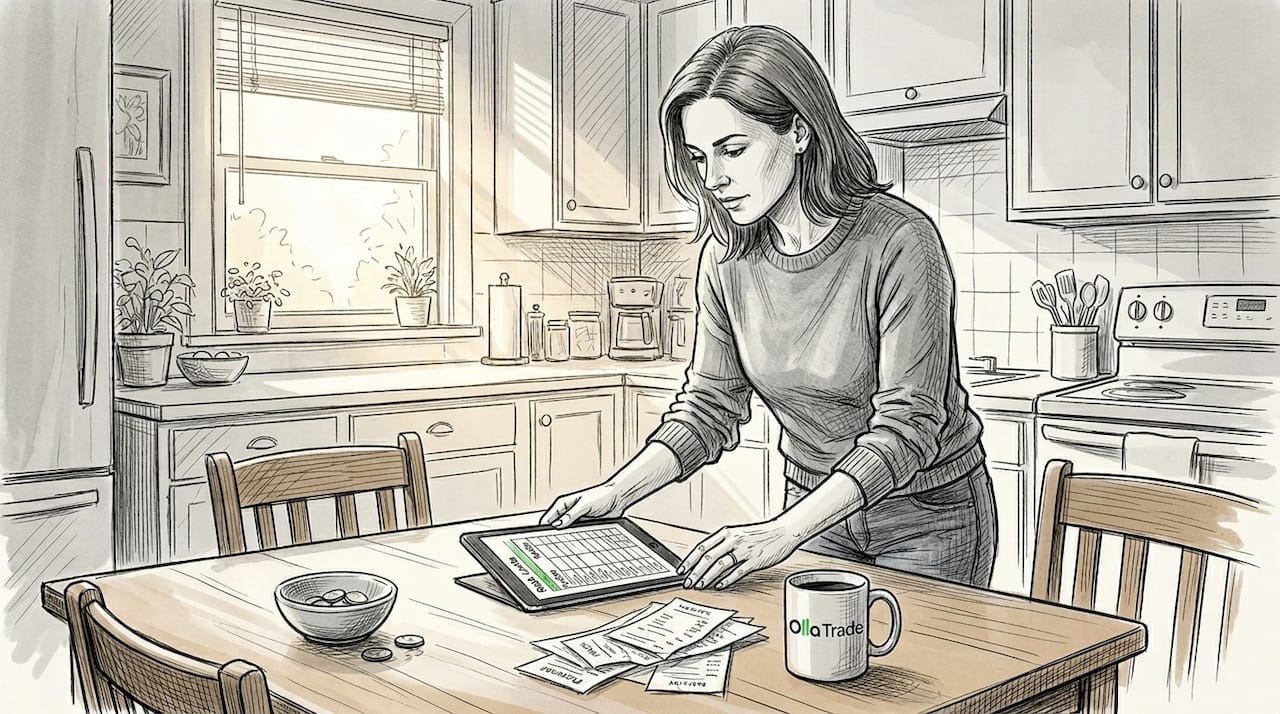
Proper risk management means following specific rules every single trade, not just when you feel nervous.
Core risk rules to follow:
- Never risk more than 1 to 2% of your account on a single trade
- Never have more than 5% of your account at risk across all open trades
- Always use a hard stop-loss, set before you enter the trade
- Reduce your position size after a 2% weekly drawdown
- Use ATR (Average True Range) to size positions based on current volatility
Pro Tip: If you hit a 2% drawdown in a single week, cut your position sizes in half for the rest of that week. This prevents one bad stretch from wiping out a month of gains.
Most trading losses don’t come from bad strategies. They come from poor risk control and emotional decisions after a losing trade.
Also check portfolio correlation. If you’re long EUR/USD and long GBP/USD at the same time, you’re essentially doubling your exposure to the US dollar. That’s hidden risk most beginners miss. Visit our risk control tips page for a deeper breakdown.
During losing streaks, the instinct is to trade more to recover. Do the opposite. Trade less, review your journal, and wait for high-confidence setups.
Common mistakes and expert tips for consistent progress
To wrap up the educational section, let’s focus on how to sidestep common traps, apply expert shortcuts, and build the daily habits that set top traders apart.
The most common beginner mistakes:
- Overleveraging positions to chase bigger returns
- Skipping the demo account phase entirely
- Trading without a written plan or defined rules
- Revenge trading after a loss to recover quickly
- Ignoring correlations between currency pairs
Expert analysis shows that experienced traders adjust their position sizing and stop-loss distances based on the current market regime. A trending market requires wider stops. A ranging market requires tighter ones. Beginners who use the same settings in every condition get punished.
Avoid trading during major news releases like Non-Farm Payrolls or central bank decisions unless you have a specific news-trading strategy. Spreads widen, slippage increases, and price moves become unpredictable.
Surviving year one is winning. Consistent growth follows once you’ve protected your capital long enough to learn.
Forex trading statistics confirm that beating the 70% loss rate requires strict risk management above all else. No strategy, no matter how sophisticated, replaces discipline.
Pro Tip: Set process goals, not profit goals. “I will follow my plan on every trade this week” is a goal you control. “I will make $500 this week” is not. Review your forex trading pitfalls regularly to stay sharp.
Ready to apply your forex step-by-step process?
If you’re committed to structured improvement, the right tools and broker can make a real difference in how fast you grow as a trader.
Olla Trade gives you everything you need to put this process into action. You can open a forex account and access tight spreads, fast execution, and MetaTrader 4 integration from day one. Use the forex glossary to keep your terminology sharp as you learn new concepts. And stay ahead of market-moving events with the economic calendar, which helps you plan your trades around key data releases. Whether you’re still on demo or ready to go live, Olla Trade’s platform is built to support every stage of your trading journey.
Frequently asked questions
How much money do I need to start forex trading?
You can start forex trading with as little as $100, though many regulated brokers offer low minimum deposits. Practicing on a demo account first is strongly recommended before committing real funds.
What is the 1% risk rule in forex trading?
The 1% rule means you only risk 1% of your account balance on any single trade. This position sizing approach keeps losses manageable and protects your capital during losing streaks.
How can beginners avoid losing money trading forex?
Beginners can reduce losses by starting on a demo account, using strict stop-losses, and never risking more than 2% per trade. Most retail traders lose because they skip these fundamentals, not because the market is impossible.
Which forex trading strategy is best for beginners?
Trend following and range trading are the most beginner-friendly strategies because they use clear rules and common indicators. Both strategies work best when combined with solid risk management.
Why is journaling trades important for forex traders?
Journaling helps you spot patterns in your mistakes and track what setups actually work for you. Process-focused journaling consistently produces better long-term results than chasing profit targets alone.