












TL;DR:
- Metals are valuable portfolio diversifiers with low correlation to stocks and bonds, especially during inflation.
- Investing in gold and other precious metals provides risk mitigation and wealth preservation amid economic uncertainty.
Metals get dismissed as a niche investment — something for preppers stacking gold bars or speculators chasing commodity spikes. That framing costs investors real money. Whether you’re trying to understand why invest in metals for the first time or reassessing your portfolio in a year defined by sticky inflation and geopolitical stress, the case for metals is more nuanced and more compelling than most financial media admits. This guide covers precious and industrial metals, the real benefits of investing in metals, and what you need to watch out for before you put a dollar in.
Table of Contents
- Key takeaways
- Why invest in metals: the core investment case
- Industrial metals and the electrification opportunity
- Metals as a hedge against inflation and volatility
- Physical metal vs. paper exposure: what you need to know
- My perspective on metals in 2026
- Trade metals on Ollatrade today
- FAQ
Key takeaways
| Point | Details |
|---|---|
| Metals diversify portfolios | Metals have low or negative correlation to stocks and bonds, reducing overall portfolio volatility. |
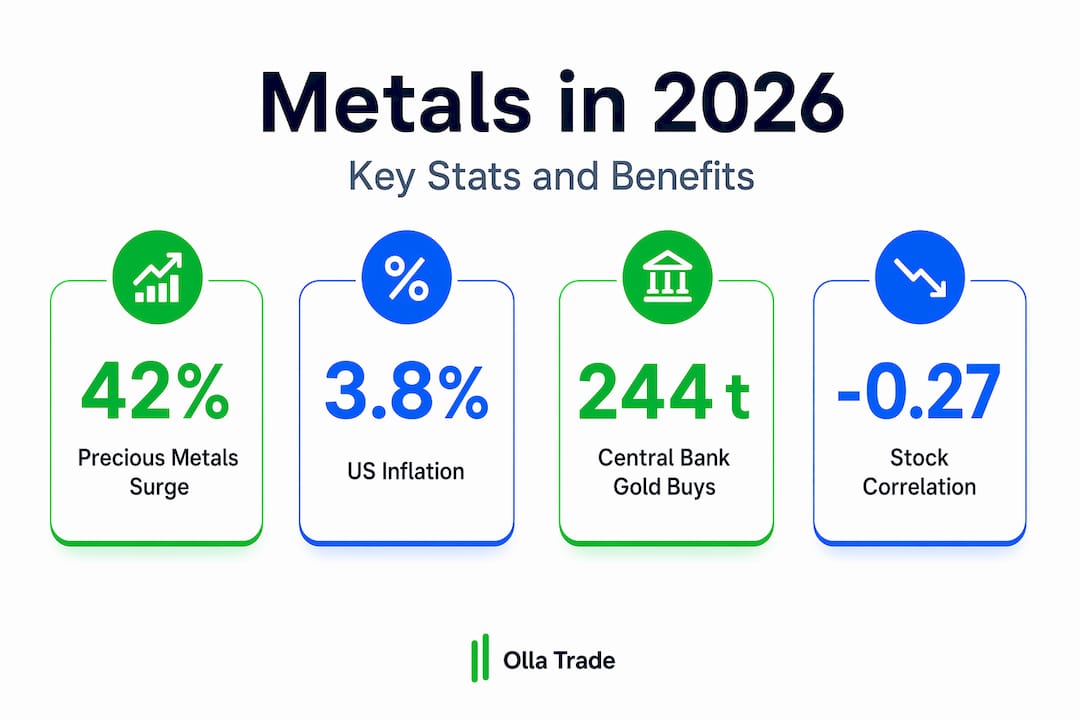
| Gold anchors against inflation | Central banks bought 244 tonnes of gold in Q1 2026 alone, signaling institutional confidence in gold’s protective role. |
| Industrial metals offer growth upside | Copper, nickel, and aluminum are driven by electrification and AI infrastructure trends, not just safe-haven demand. |
| Physical vs. paper exposure differs greatly | Physical metals carry zero counterparty risk, while ETFs and futures introduce fees, liquidity risk, and intermediary dependency. |
| Costs matter more than most realize | Storage and insurance fees of roughly 1% annually can quietly erode returns on physical metal holdings over time. |
Why invest in metals: the core investment case
Gold is the oldest form of savings on earth. That’s not sentiment. It’s a track record that predates every stock exchange, every central bank, and every fiat currency in circulation today. The reasons to invest in precious metals start with that durability, but they don’t end there.
Gold as a wealth preservation tool
Gold’s primary role in a modern portfolio is risk mitigation. Investors increasingly view gold as a portfolio risk mitigator rather than merely an inflation hedge, particularly in the uncertain 2026 macroeconomic environment. That shift in framing matters. When you hold gold, you’re not betting on a price surge. You’re buying an asset that tends to hold value when everything else falls apart.
The numbers reinforce this. Central banks purchased 244 tonnes of gold in Q1 2026, a 3% year-on-year increase, against U.S. inflation running at 3.8% in April 2026. These are not retail investors chasing momentum. These are sovereign institutions making long-term strategic calls.
Silver, platinum, and palladium: different risk profiles
Silver sits in an interesting position. It functions as both a monetary metal and an industrial commodity, which makes it behave differently from gold under different market conditions. As of early 2026, gold’s spot price was roughly 4,600% higher than silver’s, making silver a far lower barrier of entry for individual investors. The trade-off is volatility. Silver’s volatility runs about 10% higher than gold’s over six decades, so the upside potential comes with sharper drawdowns.

Platinum is worth considering as a portfolio stabilizer. It has genuine industrial demand in automotive catalytic converters and hydrogen fuel cell technology, and it tends to trade at a premium to gold during periods of manufacturing expansion. Palladium tells a different story entirely. It is highly volatile, supply constrained, and driven primarily by automotive demand, making it better suited to short-term speculative positions than long-term wealth preservation.
| Metal | Primary use | Volatility | Liquidity | Investor role |
|---|---|---|---|---|
| Gold | Store of value, reserves | Low | Very high | Wealth preservation, hedge |
| Silver | Industry + monetary | Medium-high | High | Growth + hedge |
| Platinum | Automotive, hydrogen tech | Medium | Moderate | Stabilizer, growth |
| Palladium | Automotive (catalytic) | Very high | Lower | Speculation, short-term |
Pro Tip: If you’re new to precious metals, start with gold or silver before considering platinum or palladium. The liquidity is deeper and the price discovery is more transparent.
Industrial metals and the electrification opportunity
Precious metals get most of the attention, but some of the most compelling metal investment strategies in 2026 are built around industrial metals. Copper, nickel, and aluminum are not safe-haven assets. They are demand-driven commodities tied directly to the global build-out of electric vehicles, renewable energy infrastructure, and AI data centers.
Electrification and AI investment trends are reshaping demand dynamics for industrial metals in ways that create a fundamentally different investment thesis than precious metals offer. You’re not hedging against collapse. You’re positioning for structural growth in industries that require massive quantities of physical raw materials.
That opportunity comes with real risks you need to price in:
- Supply chain concentration. China controls 65% of mining and 90% of processing for rare earth metals, which means geopolitical events can severely disrupt supply and spike prices without warning.
- Cyclicality. Industrial metal prices track the global economic cycle closely. A slowdown in manufacturing output hits copper and nickel harder than it hits gold.
- Longer price discovery cycles. Unlike gold, which trades around the clock on deeply liquid markets, some industrial metals have thinner markets and wider bid-ask spreads.
The advantages of metal investments in the industrial category are real, but they reward investors who understand the demand-supply structure of each specific metal rather than those making broad commodity bets.
Pro Tip: Mining stocks offer a way to gain indirect exposure to industrial metals without the logistics of physical ownership. They tend to carry higher volatility than the metals themselves but can provide dividends and portfolio diversification that direct commodity positions cannot.
Metals as a hedge against inflation and volatility
Here is where the benefits of investing in metals become hardest to argue against. Stocks and bonds move together more often than most investors realize, especially during inflationary downturns. Metals, particularly gold, tend to move differently. That low or negative correlation is exactly what a well-constructed portfolio needs.
Gold has historically served as a portfolio efficiency improvement tool during volatile and uncertain periods. That’s not marketing language. It reflects decades of data showing that gold’s inclusion in a mixed portfolio reduces the standard deviation of returns without proportionally reducing expected gains.
The 2022 period is a useful real-world example. When both equity markets and bond markets sold off simultaneously, a condition called correlation breakdown that devastated 60/40 portfolios, gold held its value relative to the broader market. Investors who had a 5% to 10% allocation in metals experienced materially less drawdown than those who did not.
“Precious metals remain among the few asset classes that can genuinely improve portfolio efficiency in environments where traditional diversification fails.”
The data from 2026 reinforces this. With U.S. inflation at 3.8% and precious metals surging 42% year-on-year, the correlation between real asset performance and inflation protection is playing out in real time. Whether you are tracking silver prices or monitoring gold futures, the inflation hedge thesis is backed by current market behavior, not just historical theory.
Physical metal vs. paper exposure: what you need to know
Knowing why choose metals for investment is only half the decision. How you hold metals matters just as much as whether you hold them. The two main categories are physical ownership and paper exposure through ETFs, futures, or mining stocks, and they carry meaningfully different risk and cost profiles.
Physical metals are the purest form of ownership. They carry zero counterparty risk and can be held privately outside the financial system. If a bank fails, your gold bar does not go with it. That is a genuine structural advantage that paper instruments cannot replicate.
The costs, however, are real and often underestimated:
- Buy-sell spreads can range from 1% to 5% depending on the dealer and the form of metal (coins carry wider spreads than bars).
- Storage and insurance fees of roughly 1% annually compound quietly and can significantly reduce net returns over a decade.
- Liquidity varies. Selling physical metal quickly at a fair price requires a reliable dealer network.
Paper exposure, through ETFs or CFDs on metals, solves the liquidity and storage problem but reintroduces counterparty risk. You are trusting the issuer and custodian to back your position. In normal market conditions that risk is manageable. In systemic crises, the exact scenarios where metals matter most, it becomes material.
Pro Tip: If you choose allocated storage for physical metals, verify that your specific bars or coins are legally titled to you. Allocated storage means your metal is individually identified and segregated. Unallocated pooled storage means you have a claim on a pool, not ownership of specific metal, which reintroduces a form of counterparty risk.
For most retail investors, a combination of physical gold for core preservation and metal CFDs or ETFs for tactical exposure gives you the best of both worlds. Explore metal trading strategies to find the right balance for your risk tolerance and time horizon.
My perspective on metals in 2026
I’ve spent years watching investors treat metals as an afterthought. They buy gold after markets crash and sell it once equities recover, which is precisely backwards. The investors who benefit most from metals are those who build the allocation before they need it.
What I’ve learned is that the real value of metals is not in their price appreciation. It’s in what they don’t do. They don’t default. They don’t dilute. They don’t get revised down in an earnings report. That negative utility, the absence of risk rather than the presence of return, is what makes them worth holding at all times and not just in crisis.
My contrarian view: most investors underweight metals not because the case is weak but because metals are boring when stocks are running. Volatility in palladium or silver feels exciting for about a quarter, then people move on. The investors I respect most treat 5% to 15% in metals as a permanent structural allocation, not a trade. That discipline is what separates wealth preservation from speculation.
In 2026 specifically, with central banks loading up on gold, industrial metals tied to multi-decade infrastructure buildouts, and paper currency credibility being stress-tested globally, the reasons to invest in precious metals and industrial metals have never been more structurally sound.
— FX
Trade metals on Ollatrade today
If this article has clarified why invest in metals and you’re ready to act on it, Ollatrade gives you direct access to metals trading with tight spreads, fast execution, and full MetaTrader 4 integration across all your devices. Whether you want to trade gold, silver, or industrial metal CFDs, the platform gives you the tools to execute your strategy without the storage headaches of physical ownership.

Ollatrade also provides market news, economic calendars, and research tools that help you track what is moving metals markets in real time. If you want to go broader, forex trading and other CFD instruments are available on the same platform, letting you manage a truly diversified portfolio in one place. Getting started takes minutes, and the educational resources are there whether you’re placing your first metals trade or refining a more advanced approach.
FAQ
What are the main reasons to invest in metals?
Metals provide portfolio diversification, protection against inflation, and a store of value that holds up when stocks and bonds decline together. Gold in particular has historically improved portfolio efficiency during volatile periods.
Is physical gold safer than a gold ETF?
Physical gold carries zero counterparty risk since you own the asset directly, while ETFs depend on an issuer and custodian. However, physical gold involves storage and insurance costs of roughly 1% annually that ETFs avoid.
How much of my portfolio should be in metals?
Most financial professionals suggest a 5% to 15% allocation in metals as a strategic holding, with the exact amount depending on your risk tolerance, time horizon, and how much inflation protection you need.
What is the difference between precious and industrial metals as investments?
Precious metals like gold and silver serve primarily as safe-haven assets and inflation hedges. Industrial metals like copper and nickel are tied to economic activity and structural growth themes like electrification, which means they perform differently across market cycles.
Can I trade metals without owning them physically?
Yes. CFDs, ETFs, futures, and mining stocks all provide exposure to metal prices without requiring physical ownership or storage. These instruments offer higher liquidity but introduce varying degrees of counterparty risk.