











Staying consistently profitable in fast-moving markets is one of the hardest challenges any trader faces. Whether you trade forex, indices, metals, or crypto, the odds are stacked against you from day one. 70-80% of retail traders lose money, not because markets are random, but because most traders lack a repeatable process. The good news is that the gap between losing and winning comes down to a handful of proven habits. This article walks you through the best practices that separate disciplined, consistent traders from the crowd.
Table of Contents
- Set clear goals and establish your trading style
- Master risk management and capital preservation
- Test, measure, and adapt your strategies consistently
- Upgrade your tools and leverage professional practices
- Navigate market specifics: Forex, indices, metals, and crypto
- Avoid common pitfalls and stay disciplined
- Take your trading further with Olla Trade
- Frequently asked questions
Key Takeaways
| Point | Details |
|---|---|
| Clarify your trading style | Match your approach to your goals, personality, and market schedule to increase success. |
| Prioritize risk management | Limiting per-trade risk and using stop-loss orders protect your capital and reduce losses. |
| Continuously adapt strategies | Regularly track, analyze, and improve your trading methods for long-term performance. |
| Use professional-grade tools | Access to top platforms and analytics gives you an edge in execution and decision-making. |
| Maintain discipline | Consistent habits and emotional control are more important than market predictions. |
Set clear goals and establish your trading style
Every successful trader starts with a clear answer to one question: what am I trying to achieve? Without a defined financial goal, you are just reacting to price moves instead of executing a plan. Your goals shape everything, from how much capital you risk to which markets you trade and how long you hold positions.
Matching your trading style to your personality and schedule is equally important. A full-time professional with hours to monitor charts may thrive as a day trader. A retail trader with a demanding job might find swing trading or position trading a better fit. Developing a consistent strategy with clear entry and exit points, suited to your risk tolerance and style, is a foundational requirement, not an optional extra.
Here is a quick breakdown of the three main styles:
- Day trading: Open and close positions within a single session. High intensity, requires constant attention, suits traders who thrive under pressure.
- Swing trading: Hold positions for days to weeks. Balances analysis time with flexibility, suits part-time traders.
- Position trading: Hold for weeks to months. Lower frequency, relies on macro trends, suits patient, long-term thinkers.
“The best trading style is the one you can execute consistently without second-guessing yourself.”
Pro Tip: Before committing real capital, test your chosen style using a demo account. You will quickly discover whether your temperament matches the pace and pressure of that approach. Exploring CFD trading strategies can also help you compare day and swing approaches side by side.
Master risk management and capital preservation
After you have matched your style, protecting your capital is the next non-negotiable. Risk management is not a defensive afterthought. It is the engine that keeps you in the game long enough to profit.
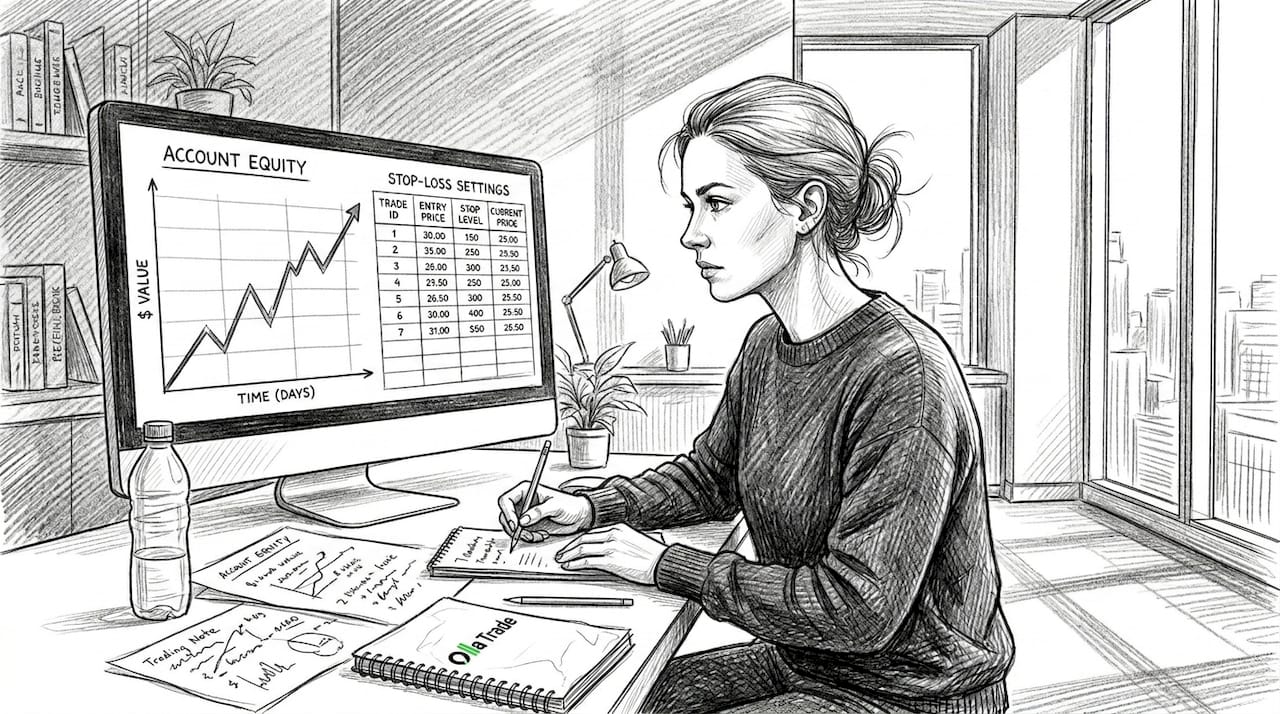
The core rule is simple: never risk more than 1-2% of your total capital on a single trade, and always use stop-loss orders. Pair that with a disciplined risk-reward ratio. A 1:2 ratio means you target twice the profit of your potential loss. A 1:3 ratio is even stronger. Over time, even a modest win rate becomes profitable when your winners consistently outpace your losers.
Here is a practical risk management checklist:
- Define your maximum risk per trade before entering any position.
- Set a stop-loss order at the time of entry, not after.
- Calculate your position size based on your stop distance and account size.
- Use trailing stops to lock in profits as a trade moves in your favor.
- Review your overall portfolio exposure daily to avoid correlated risk.
Leverage amplifies both gains and losses. Many retail traders blow up accounts by treating leverage as free money. It is not. Reading up on leveraged instruments risks before sizing up positions can save you from costly mistakes. For a broader view of market-specific risk controls, the top forex market tips resource covers practical rules you can apply immediately.
Pro Tip: Automate your stop orders wherever possible. Removing the manual decision to exit a losing trade eliminates one of the most destructive emotional impulses in trading.
Test, measure, and adapt your strategies consistently
With risk managed, ongoing improvement sets winning traders apart. The best traders treat their strategy like a business, tracking every trade and measuring outcomes with precision.
Start with a trade journal. Log your entry, exit, position size, market conditions, and the reasoning behind each trade. Over time, patterns emerge. You will see which setups work, which markets suit your style, and where your discipline breaks down.
Next, calculate your strategy’s expectancy. The formula is straightforward: expectancy equals (Win Rate multiplied by Average Win) minus (Loss Rate multiplied by Average Loss). A positive expectancy means your strategy is profitable over a large sample of trades.
Here is a simple example:
| Metric | Value |
|---|---|
| Win rate | 50% |
| Average win | $300 |
| Loss rate | 50% |
| Average loss | $150 |
| Expectancy per trade | $75 |
A $75 expectancy per trade means that, on average, every trade you take adds $75 to your account. That is the power of measuring your edge.
Steps to refine your system over time:
- Review your journal weekly and identify your three best and three worst trades.
- Isolate the variables that led to losses and test adjustments in a demo environment.
- Run at least 50 trades on any modified strategy before drawing conclusions.
- Track expectancy monthly to confirm your edge is holding.
- Adapt to changing market conditions without abandoning your core rules.
For a structured approach to improving your workflow, optimize your trading process with tools designed for forex and CFD traders.
Upgrade your tools and leverage professional practices
Having a repeatable process only works with the right tools. One major reason professionals outperform retail traders is access to better technology, faster execution, and lower transaction costs. The gap is narrowing, but retail traders still need to be intentional about their platform and toolset.
Here is what your trading toolkit should include:
- Advanced charting: Multi-timeframe analysis with customizable indicators.
- Real-time news feeds: Market-moving events require instant awareness.
- Economic calendars: Know when high-impact data releases are scheduled.
- Automated alerts: Price and indicator alerts so you never miss a setup.
- Expert advisors or bots: For systematic strategies that remove emotional execution.
| Feature | Retail traders | Professional traders |
|---|---|---|
| Execution speed | Standard | Ultra-low latency |
| Data access | Delayed or basic | Real-time, institutional |
| Cost per trade | Higher spreads | Negotiated, lower |
| Automation | Limited | Fully systematic |
| Risk tools | Manual | Automated, integrated |
“Discipline and systematic methods are not optional extras for serious traders. They are the foundation everything else is built on.”
Choosing the right platform matters enormously. Reviewing best trading software options helps you identify platforms that close the gap between retail and professional capabilities. You should also explore best trading tools for forex, CFD, and crypto strategies, and understand the key platform features that directly impact your results.
Navigate market specifics: Forex, indices, metals, and crypto
Not all practices work everywhere. Each market has its own rhythm, risk profile, and toolset requirements. Tailoring your approach by asset class is a mark of a mature trader.
Here are actionable do’s and don’ts by market:
- Forex: Do use carry trades for longer-term positions in high-interest-rate currency pairs. Buy-and-hold is viable for experienced traders using this approach. Don’t overtrade during low-liquidity sessions.
- Indices: Do align your trades with broader economic trends and earnings cycles. Don’t ignore correlation with bond markets and central bank policy.
- Metals: Do monitor gold-to-silver ratios and use relative value trading during volatility. Don’t ignore geopolitical risk, which drives sharp moves in gold.
- Crypto: Do use futures or options for hedging during high-volatility periods. Don’t size positions as aggressively as you would in more liquid markets.
Hedging is a skill worth developing across all four markets. When volatility spikes, having an offsetting position can protect your portfolio without forcing you to exit your core trades. The tools for different markets resource breaks down which instruments and analytics work best for each asset class.
Avoid common pitfalls and stay disciplined
Even with top tools and a smart strategy, your results depend on avoiding classic errors and keeping your composure under pressure.
The biggest trap is overconfidence after a winning streak. A few good trades can make you feel invincible, leading to oversized positions and ignored stop-losses. Retail traders who prioritize discipline over prediction consistently outperform those chasing the next big call.
Mistakes to avoid and how to fix them:
- Overtrading: More trades do not mean more profit. Set a daily trade limit and stick to it.
- Ignoring costs: Spreads, commissions, and swap fees erode returns. Calculate your break-even point before entering a trade.
- Revenge trading: Trying to recover a loss immediately leads to bigger losses. Walk away after a losing session.
- Skipping the plan: Entering a trade without a defined stop and target is gambling, not trading.
- Misusing leverage: Understand the full risk before increasing position size. Review leverage in trading to build a solid foundation.
“The market rewards patience and punishes impulsiveness. Your edge is not just your strategy. It is your ability to execute it without deviation.”
Discipline is a skill, not a personality trait. You build it through routine, journaling, and honest self-assessment after every session.
Take your trading further with Olla Trade
Putting these best practices into action requires a platform built for serious traders. Olla Trade gives you access to forex markets, CFDs on indices, metals, energies, and crypto, all through a fast, multi-device platform with MetaTrader 4 integration and advanced charting tools.
Whether you are refining your risk management, testing a new strategy, or tracking market events, Olla Trade has the infrastructure to support your process. Use the economic calendar to stay ahead of high-impact data releases, and learn about CFDs to understand exactly how these instruments work before you trade them. Tight spreads, fast execution, and a full suite of analytical tools mean you spend less time fighting your platform and more time executing your edge.
Frequently asked questions
What is the most important best practice for new traders?
Risk management is the foundation. Never risk more than 1-2% of your capital on any single trade and always set a stop-loss order before entering a position.
How do professional traders protect themselves during volatility?
They rely on advanced tools and execution, disciplined position sizing, and hedging strategies using instruments like futures or options to offset exposure during sharp market moves.
Is buy-and-hold a good approach in volatile markets?
Buy-and-hold works in forex for experienced traders using carry trade strategies, but it requires strong risk controls and should not be applied blindly during high-volatility periods.
Should I use the same tools as professional traders?
Yes, where possible. Professionals outperform partly because of better technology and execution. Retail traders who adopt advanced analytics and automation close that gap significantly.
Why do most retail traders lose money?
The primary causes are excessive leverage, emotional decision-making, and the absence of structured risk controls. 70-80% of retail traders lose money, and most of those losses are preventable with the right process in place.