











TL;DR:
- Expert advisors are automated trading programs that execute trades based on predefined rules, providing emotion-free, speedy, and consistent order placement within platforms like MetaTrader. They analyze market data, apply decision logic, and manage orders continuously, but require careful selection, testing, and active monitoring to mitigate risks such as overfitting and technological failures. Combining EAs with human oversight and proper infrastructure enhances their effectiveness in disciplined, systematic trading strategies.
Expert advisors (EAs) are automated software programs that execute trades on your behalf based on predefined rules, running continuously inside platforms like MetaTrader 4 and MetaTrader 5 without any emotional interference. The role of expert advisors in modern trading goes far beyond simple automation. EAs handle everything from market analysis to order placement, giving traders a consistent, disciplined edge that manual execution rarely achieves. Households working with professional financial advisors report an average net worth of $800,000 versus $388,000 without one, a gap that reflects the compounding power of systematic, guided decision-making. This article breaks down how EAs work, what they deliver, where they fall short, and how to use them effectively.
How do expert advisors work in automated trading?
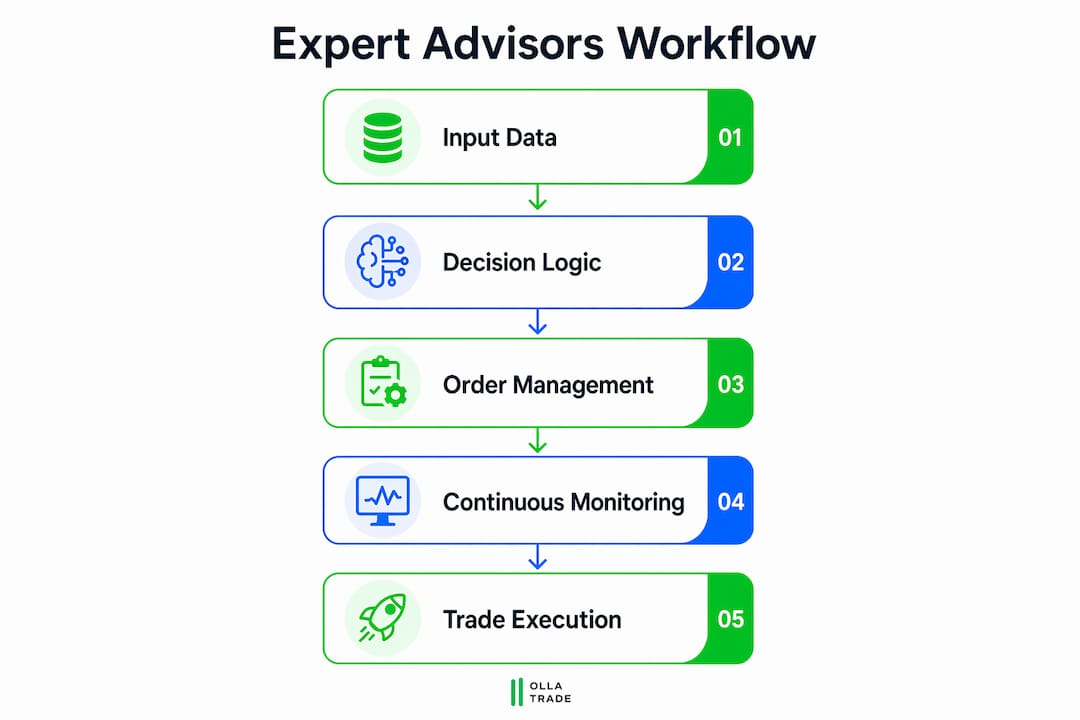
The function of expert advisors rests on three core pillars: input data, decision logic, and order management. Understanding each one tells you exactly what an EA can and cannot do for your trading.

Input data is the raw material. EAs analyze price, volume, and indicators as inputs, pulling live and historical market data from the platform feed. This includes candlestick patterns, moving averages, RSI readings, Bollinger Bands, and any other technical signal you program in. The EA sees the market exactly as you would on a chart, but it processes that data in milliseconds.
Decision logic is the brain. Traders write this logic in MQL4 (for MetaTrader 4) or MQL5 (for MetaTrader 5), defining precise conditions for entering and exiting trades. For example: “Buy EUR/USD when the 50-period EMA crosses above the 200-period EMA and RSI is below 60.” Every rule is explicit. There is no guessing, no second-guessing, and no hesitation.
Order management is the execution layer. Once the logic fires, the EA sends buy or sell orders directly through the platform’s API, sets stop-loss and take-profit levels, and manages position sizing according to your risk parameters. The entire sequence from signal to filled order takes a fraction of a second.
EAs run 24 hours a day, five days a week, which means they catch setups during Asian, European, and American sessions whether you are awake or not. Many traders host their EAs on a Virtual Private Server (VPS) to keep them running even when their personal computer is off.
Pro Tip: A VPS close to your broker’s server can reduce execution latency from 50 milliseconds or more down to under 1 millisecond. For scalping strategies where entry price matters by fractions of a pip, that difference is the strategy working or failing.
What are the key benefits of using expert advisors?
The importance of expert advisors becomes clearest when you examine what they protect you from, not just what they do for you. Most retail traders lose money not because their strategy is wrong, but because they cannot execute it consistently.
Here is what EAs deliver that manual trading cannot reliably replicate:
- Emotion-free execution. EAs remove fear and greed by executing trades strictly per programmed rules. A trader watching a position move against them might close early out of panic. An EA does not panic.
- Speed. Order execution happens in milliseconds, capturing price levels that a human clicking a mouse would miss entirely.
- Backtesting capability. You can run an EA against years of historical data before risking a single dollar live, giving you a statistical picture of how the strategy performs across different market conditions.
- Continuous market presence. An EA monitors every tick across every session without fatigue, boredom, or distraction.
- Scalability. One EA can simultaneously manage positions across EUR/USD, GBP/JPY, gold, and crude oil. A human trader managing four instruments at once is stretched thin. An EA is not.
“Investors benefit most from advisors who provide knowledge, time, temperament, and continuity, mitigating behavioral risk as the primary threat to long-term success.”
That quote applies directly to algorithmic trading. The behavioral risk of impulsive decisions, revenge trading after a loss, and overtrading during volatile sessions is the single biggest account killer for retail traders. EAs neutralize that risk by design. Pairing automation with a clear risk management strategy compounds this advantage further.
What are the common risks and challenges of expert advisors?
No EA is a guaranteed profit machine. Understanding the risks is what separates traders who use EAs successfully from those who blow accounts with them.
- Overfitting and curve-fitting. Over-optimization to historical data causes EAs to fail in live markets because the strategy was tuned to past noise, not real market structure. An EA that returns 300% in backtesting but loses money live is almost always a victim of curve-fitting.
- Technical failures. Connectivity drops, software bugs, and platform downtime can leave positions open without management. An EA that cannot connect to the broker cannot close a losing trade either.
- Changing market conditions. An EA built for trending markets will underperform or lose money in ranging, choppy conditions. Markets shift regimes, and most EAs do not adapt automatically.
- Hidden high-risk strategies. Martingale and grid trading strategies can produce consistent small gains but expose accounts to catastrophic losses during strong directional moves. Many commercially sold EAs use these methods without disclosing it clearly.
- Marketplace scams. The EA market is full of products with fabricated backtest results and misleading performance claims. Trusting a vendor’s numbers without independent verification is a fast path to losses.
There is also a deeper issue around trust. Epistemic trust and recommendation trust are distinct: believing that a strategy’s historical data is accurate is different from deciding to act on it. Traders who conflate the two skip the critical step of evaluating whether the strategy’s underlying logic aligns with their own risk tolerance and market view.
Pro Tip: Before deploying any EA live, run it on a demo account for at least four to eight weeks across different market conditions. Avoid common trading mistakes like skipping this step because the backtest looked impressive.
How can traders effectively select and use expert advisors?
Selecting an EA is not about finding the one with the highest backtest return. It is about finding one whose logic you understand, whose risk profile you can tolerate, and whose performance you can verify independently.
- Demand strategy transparency. If a vendor will not explain how the EA generates signals, that is a red flag. You need to understand whether it uses trend-following, mean-reversion, breakout, or another approach before you commit capital.
- Run your own backtests. Do not rely on vendor-supplied results. Use MetaTrader’s Strategy Tester with your broker’s tick data and realistic spread settings to generate your own performance numbers.
- Use a demo account first. Forward testing on a demo account for several weeks reveals how the EA behaves in live market conditions, including slippage and requotes that backtests do not capture.
- Invest in proper infrastructure. A VPS hosted near your broker’s servers keeps the EA running and minimizes latency, which matters for any strategy that depends on precise entry timing.
- Build in risk management rules. Set maximum drawdown limits, daily loss caps, and position sizing rules directly inside the EA’s parameters. Automation without risk controls is just faster losing.
- Monitor actively. Automation does not mean abandonment. Review EA performance weekly and be ready to disable it if market conditions shift significantly.
The benefits of hiring expert advisors, whether human or algorithmic, come from the discipline they enforce. An EA running a flawed strategy with no oversight is worse than manual trading because it fails faster and at scale. Pairing your EA with a solid understanding of financial security principles creates a more durable trading operation.
Expert advisors vs. manual trading: which is right for you?
Both approaches have legitimate use cases. The choice depends on your strategy type, available time, and psychological profile.
| Characteristic | Expert Advisors | Manual Trading |
|---|---|---|
| Execution speed | Milliseconds, no delay | Seconds to minutes, human-dependent |
| Emotional control | Complete, rule-based | Variable, trader-dependent |
| Adaptability | Limited to coded logic | High, discretionary judgment |
| Scalability | Manages multiple instruments simultaneously | Difficult beyond 2-3 instruments |
| Learning curve | Requires coding or vendor vetting | Requires chart reading and discipline |
| Best suited for | Systematic, rules-based strategies | Discretionary, news-driven trading |
Manual trading offers something EAs cannot: the ability to read context. A skilled discretionary trader can recognize that a setup forming during a major central bank announcement carries different risk than the same setup on a quiet Tuesday morning. An EA treats both identically unless you code that distinction in explicitly.
Pro Tip: The strongest trading operations combine both. Use an EA for systematic execution of your core strategy and reserve manual oversight for high-impact news events where coded logic is insufficient.
Key takeaways
Expert advisors deliver their greatest value when traders treat them as disciplined execution tools within a broader, actively monitored trading plan.
| Point | Details |
|---|---|
| Core function | EAs analyze data, apply coded logic, and execute orders automatically in MetaTrader 4/5. |
| Primary benefit | Emotion-free execution eliminates fear and greed, the leading causes of retail trading losses. |
| Biggest risk | Over-optimization to historical data causes EAs to fail in live market conditions. |
| Infrastructure matters | A VPS near your broker’s server reduces latency to under 1 ms, critical for scalping strategies. |
| Human oversight required | Continuous monitoring and readiness to disable EAs when market regimes shift protects capital. |
Why I think most traders misuse expert advisors
Most traders approach EAs as a shortcut. They buy a product with a polished sales page, drop it on a live account, and expect the equity curve to climb. That is not how this works, and the market is efficient enough to punish that thinking quickly.
What I have observed is that the traders who get real, sustained value from EAs treat them the way a good engineer treats a machine: they understand the mechanics, they test before deploying, they monitor for failure modes, and they know when to shut it down. The EA is not the strategy. The EA is the execution layer for a strategy that the trader already understands deeply.
The behavioral risk angle is the one most people underestimate. Behavioral risk is often the most significant threat to investor success, and EAs address it directly by removing the human from the trigger. But they introduce a different behavioral risk: the temptation to over-optimize, to keep tweaking parameters until the backtest looks perfect, and then to trust that result with real money. That is just emotional decision-making wearing a technical disguise.
The traders I respect most use EAs for what they are genuinely good at: consistent, tireless execution of a clearly defined edge. They do not expect the EA to think. They do the thinking, and the EA does the doing. That division of labor, when respected, is where the real advantage lives.
— FX
Start trading with expert advisors on Ollatrade
Ollatrade gives you direct access to MetaTrader 4 with full EA compatibility, tight spreads, and fast execution across forex, metals, indices, and cryptocurrencies. Whether you are deploying your first automated strategy or refining an existing system, the platform is built to support every stage of that process.
Ollatrade’s forex trading platform supports EA integration out of the box, with infrastructure designed for the execution speeds that automated strategies demand. If you are new to automation, the step-by-step forex guide walks you through account setup, instrument selection, and risk management in one place. For traders who want to understand the MetaTrader 4 environment before deploying an EA, the MetaTrader 4 guide covers the platform’s tools, charting features, and automation capabilities in detail.
FAQ
What is the role of expert advisors in forex trading?
Expert advisors automate trade execution in forex by applying predefined rules to market data without human intervention. They run continuously inside platforms like MetaTrader 4, executing entries, exits, and risk controls based on coded logic.
How do expert advisors work technically?
EAs use price data, volume, and technical indicators as inputs, process that data through decision logic written in MQL4 or MQL5, and send orders through the platform’s API. The entire process from signal detection to order execution takes milliseconds.
What are the biggest risks of using expert advisors?
The two most significant risks are over-optimization, where an EA is tuned so tightly to historical data that it fails in live markets, and hidden high-risk strategies like martingale or grid trading that can wipe accounts during strong market moves.
Do expert advisors work without human oversight?
EAs execute trades without human input, but they require active monitoring. Market conditions change, technical failures occur, and strategies that worked in one regime can lose in another. Disabling an EA when conditions shift is a critical part of responsible automation.
What is the difference between backtesting and live trading performance for EAs?
Backtesting runs an EA against historical data under idealized conditions, while live trading introduces slippage, requotes, and changing market dynamics. Strong backtest results do not guarantee live performance, particularly when curve-fitting errors are present in the strategy’s development.