












TL;DR:
- Interpreting market news involves filtering headlines through structured frameworks to identify genuine surprises and clear trade signals. It requires validation against technical charts and macro context, focusing on residual surprises that impact prices significantly. Consistent analysis and patience in the second move post-news enhance trading accuracy and risk management.
Interpreting market news is the process of extracting actionable trading insights from financial reports and headlines by understanding the context, timing, and technical confirmation behind each story. Raw news is not a trade signal. It becomes one only after you filter it through a structured framework that separates genuine market-moving surprises from noise that has already been priced in. Frameworks like Phil Stock World’s four-question check and StockCharts’ narrative-to-setup methodology give traders a repeatable process for finance news analysis that removes guesswork and emotional reaction from the equation.
How to interpret market news: the four-question framework
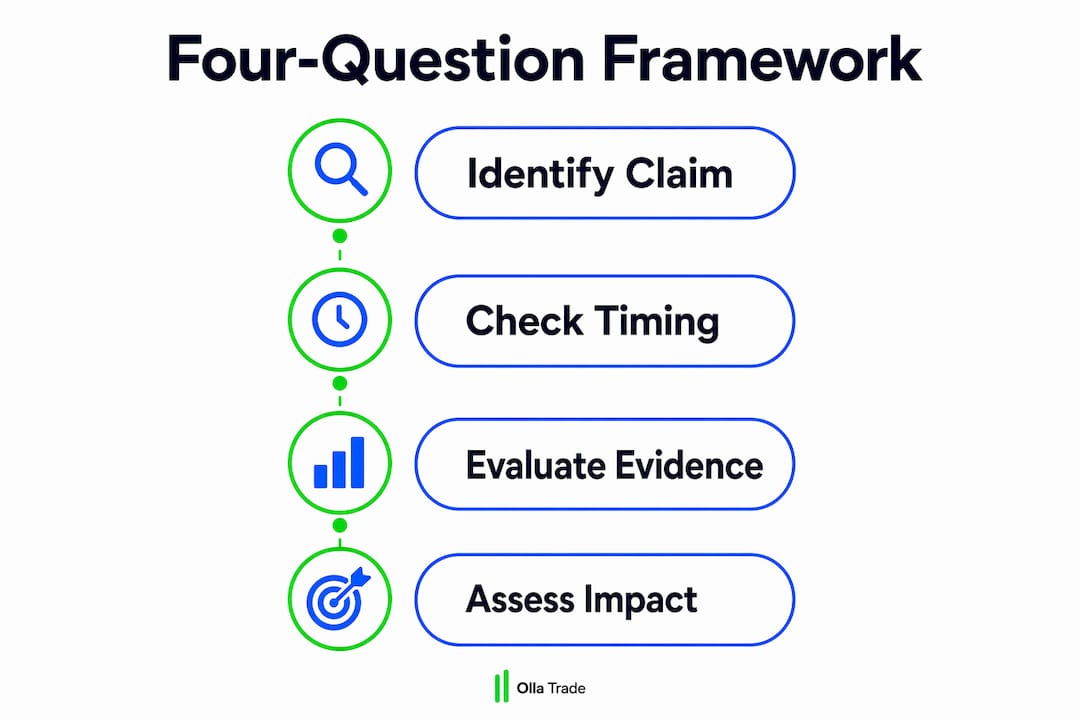
The fastest way to cut through market commentary is to apply four questions the moment you read a headline. Phil Stock World’s framework structures this process into a check that filters noise and prevents the emotional overreaction that destroys trading accounts.
Ask these four questions in sequence:
- What is the core claim? Strip the headline to its single factual assertion. “Fed signals pause” is a claim. “Markets are nervous” is not.
- Why does it matter now? Timing determines relevance. A rate commentary published three days after a Fed meeting carries far less weight than one published the morning of.
- What market evidence supports it? Price action, volume, and sector rotation either confirm or contradict the narrative. A bullish article on energy stocks means little if crude oil is breaking support.
- What trade or portfolio implication follows? If you cannot name a specific instrument, direction, and time frame, the news has not yet produced a signal.
The distinction between explanation and prediction is where most traders lose focus. Explanation describes what already happened. Prediction stakes a claim on what comes next. Only prediction requires a trading response, and only when it is supported by evidence. Matching news to your time frame is equally non-negotiable. Using long-term macro commentary to justify a short-term scalp trade is one of the most common timing errors in retail trading.
Pro Tip: Apply the same four-question check to both bullish and bearish commentary. Ask what evidence would falsify each thesis. The thesis with fewer falsification conditions is the fragile one.
How to translate news narrative into technical context
Reading the news story is step one. Validating it against the chart is step two. StockCharts advocates translating every news narrative into technical and fundamental context before committing to a setup, because headline reactions frequently reverse within the same session.
The validation process works like this:
- Identify the driver and transmission mechanism. Ask what the news changes: Fed expectations, sector leadership, or risk appetite. A jobs report that beats estimates shifts Fed rate expectations, which moves the U.S. dollar, which reprices gold and emerging market currencies simultaneously.
- Check technical structure. Map the narrative to trend direction, RSI readings, and key support or resistance levels. A bullish earnings surprise on a stock trading below its 200-day moving average and with RSI above 70 is a poor risk-reward setup regardless of the headline.
- Use StockCharts Technical Rank and earnings dates. These tools tell you where a security sits in its sector’s relative strength hierarchy and whether a catalyst event is approaching. Both factors affect how much weight to give the current news.
- Monitor the second move. Follow-through price action after the initial headline reaction reveals actual trader conviction. A stock that gaps up on news and holds gains through the afternoon session signals genuine buying. One that fades within two hours signals a sentiment spike, not a trend change.
Cross-asset reasoning adds another layer of confirmation. Crude oil moves ripple into inflation expectations, corporate margins, and transport sector stocks at the same time. A trader reading an oil supply story in isolation misses two-thirds of the trade implications.
| Validation step | What to check | Signal quality |
|---|---|---|
| Trend direction | Price above or below 200-day MA | Confirms or contradicts narrative |
| RSI reading | Overbought above 70, oversold below 30 | Flags timing risk |
| Sector rank | StockCharts Technical Rank percentile | Measures relative strength |
| Second move | Price action 2 to 4 hours post-headline | Confirms or denies conviction |

Pro Tip: Cross-check news with technical analysis tools like trend lines and moving averages before sizing any position. Narrative without chart confirmation is speculation, not analysis.
Surprising news vs. priced-in information: why the difference matters
Not all news moves markets equally. CEPR research establishes that only the residual, surprising component of news carries meaningful predictive power for future returns. Predictable news, the kind that matches consensus expectations, has almost no market impact because it is already reflected in current prices.
The numbers make this concrete. A long-short portfolio built on residual news surprises produces a Sharpe ratio of approximately 3.1, compared to the S&P 500’s approximately 0.4. That gap quantifies exactly how much edge traders leave on the table by reacting to expected news rather than genuinely new information.
| News type | Market impact | Trading implication |
|---|---|---|
| Predictable news | Minimal, already priced in | Low signal value, high overtrading risk |
| Residual surprise news | Strong, repricing required | High signal value, warrants position sizing |
| Ambiguous high-attention news | Overreaction risk | Fade the initial move, wait for confirmation |
| Dense numerical negative news | Underreaction risk | Delayed repricing creates follow-through opportunity |
Markets underreact to dense numerical or negative news and overreact to ambiguous, high-attention stories. This asymmetry is exploitable. When a complex economic release with multiple data points hits the wire, the initial market reaction frequently undershoots the true implication. When a vague geopolitical headline dominates financial media, the initial reaction frequently overshoots.
The practical filter is simple. Before acting on any news, ask whether the information genuinely changes the market’s expectation or simply confirms what was already known. Splitting analysis into expectation change versus market repricing removes confirmation bias from the process. If the answer is “this confirms what everyone already knew,” the trade is likely a low-probability one.
How macroeconomic indicators shape market interpretation
Macro events are the highest-stakes category of market news because they affect entire asset classes simultaneously. The April 2025 jobs report illustrates the process well. Moderate job gains with stable unemployment shifted Fed rate expectations without triggering a decisive policy signal, leaving traders to interpret the data through the lens of ongoing inflation trends. That ambiguity created different implications for equities, bonds, and the U.S. dollar at the same time.
Interpreting macro news requires mapping the data to the Fed’s reaction function. The Federal Reserve responds to labor market strength, inflation readings, and growth signals in a sequence that traders can anticipate. A strong payrolls number in a high-inflation environment signals delayed rate cuts, which pressures growth stocks and supports the dollar. The same number in a low-inflation environment signals economic health, which supports equities broadly.
Key principles for macro news interpretation:
- Map data to instruments. A Consumer Price Index beat affects Treasury yields, the dollar, gold, and rate-sensitive sectors like utilities and real estate investment trusts in distinct ways. Know the transmission chain before the number drops.
- Respect time horizons. Macro commentary operates on weeks-to-months time frames. Using a Federal Reserve speech to justify a same-day forex scalp misaligns the signal with the trade.
- Track sentiment shifts, not just data points. The Fed’s language around future policy often moves markets more than the underlying data. A single word change in a Federal Open Market Committee statement can reprice the entire yield curve.
- Sector mapping matters. Rising energy prices hit airline stocks and benefit oil producers. A single macro input produces sector-level winners and losers that require separate analysis.
“Event-driven trading requires a hypothesis about macro or expectation changes and then waiting for market confirmation via price action and order flow before sizing positions.” NexusFi
Understanding market news implications at the macro level means treating each data release as a hypothesis test, not a trigger. The data either confirms or challenges your existing market view. Position sizing follows confirmation, not the headline itself.
Key takeaways
Interpreting market news requires combining a structured question framework, technical chart validation, surprise filtering, and macro context mapping to convert raw headlines into high-probability trade setups.
| Point | Details |
|---|---|
| Apply the four-question check | Filter every headline by claim, timing, evidence, and trade implication before acting. |
| Validate narrative with charts | Confirm news signals using RSI, trend direction, and StockCharts Technical Rank before entering. |
| Filter for genuine surprises | Only residual, unexpected news carries strong predictive power; predictable news is already priced in. |
| Monitor the second move | Post-headline price action over two to four hours reveals true trader conviction. |
| Map macro data to instruments | Connect labor reports and Fed signals to specific asset classes and sectors before sizing positions. |
What I’ve learned from years of reading market news
Most traders read market news to feel informed. The ones who profit from it read it to find where the market’s current expectation is wrong.
The single biggest mistake I see is treating volume of news consumption as a proxy for analytical quality. Reading fifteen financial articles before the open does not produce better trades than reading three with a structured framework. It produces more noise, more conflicting signals, and more reasons to overtrade. Combining narrative with technical confirmation before acting is the discipline that separates profitable news readers from reactive ones.
The second mistake is applying bullish and bearish commentary asymmetrically. Traders tend to scrutinize bearish commentary more skeptically than bullish commentary when they are already long. The market does not care about your existing position. Disciplined skepticism applied equally to both sides of the argument is what keeps you from holding a losing trade because you only read the confirming headlines.
The third mistake is ignoring the second move. The first fifteen minutes after a major news release are theater. Algorithms, stop hunts, and retail panic dominate that window. The real signal comes from what price does in the two hours that follow. I have passed on dozens of trades that looked compelling at the open and watched them reverse completely by midday. Patience at that stage is not timidity. It is risk management.
The framework in this article is not theoretical. It is the actual process that converts market commentary from background noise into a structured input for trading decisions.
— FX
Put your market news analysis to work with Ollatrade

Understanding how to read market reports is only half the equation. The other half is having a platform that gives you the tools to act on your analysis with precision. Ollatrade provides traders with access to forex markets, real-time economic calendars, MetaTrader 4 integration, and technical charting tools that connect directly to the news interpretation process described in this article. Whether you trade currencies, indices, metals, or CFDs, Ollatrade’s platform supports the full workflow from news to setup to execution. Explore CFD trading strategies that align with the macro and technical frameworks covered here, and start applying structured news analysis to live market conditions.
FAQ
What does it mean to interpret market news?
Interpreting market news means converting raw financial headlines and reports into specific trade or portfolio implications by filtering for surprise value, technical confirmation, and time frame alignment. It is the process of separating signal from noise in daily financial commentary.
How do I know if news is already priced in?
News is likely priced in when it matches consensus expectations. CEPR research shows that only the residual, surprising component of news carries meaningful predictive power, while predictable news produces minimal market movement.
What is the second move in news trading?
The second move refers to price action two to four hours after the initial headline reaction. StockCharts identifies this follow-through as the more reliable signal of trader conviction, distinguishing temporary sentiment spikes from genuine trend changes.
How do macroeconomic reports affect different asset classes?
Macro data like jobs reports and inflation readings affect bonds, currencies, equities, and commodities through the Federal Reserve’s reaction function. A strong labor report in a high-inflation environment signals delayed rate cuts, which pressures growth stocks and supports the U.S. dollar simultaneously.
How many news sources should I read before trading?
Quality of analysis matters more than quantity of sources. Applying Phil Stock World’s four-question framework to three well-sourced articles produces better trading decisions than reading fifteen articles without a structured filter.