












TL;DR:
- Withdrawing trading profits involves converting gains into accessible funds while adhering to platform-specific procedures and tax rules. Different asset classes, such as stocks, forex, and crypto, each have distinct withdrawal timelines and considerations, especially regarding settlement and fees. Proper recordkeeping, timely tax reserves, and strategic scheduling help traders optimize profit management and ensure compliance with IRS regulations.
Withdrawing trading profits is the process of converting realized gains from a trading account into accessible funds, either to a bank account, digital wallet, or another financial instrument. Knowing how to withdraw trading profits correctly matters as much as knowing how to generate them. The steps vary significantly depending on whether you trade forex, stocks, cryptocurrency, or operate through a funded prop trading account. Tax timing rules, platform-specific withdrawal limits, and asset settlement periods all affect when and how you can cash out. This guide covers the full trading profit withdrawal process, including asset-specific procedures, IRS tax obligations, and strategic planning to protect your earnings.
How to withdraw trading profits: the step-by-step process
The standard trading profit withdrawal process follows a consistent sequence across most platforms, though the specific interface and timing differ by broker. Understanding each step prevents delays, rejected requests, and compliance issues.
Here is the core process for withdrawing trading earnings from most retail and professional trading accounts:
- Log into your trading account. Access your broker’s client portal or trading platform. For MetaTrader 4 users on platforms like Ollatrade, this is typically a separate client area from the trading terminal itself.
- Confirm your account balance reflects realized profits. Open positions do not count as withdrawable funds. You must close trades first to crystallize gains into your cash balance.
- Navigate to the withdrawal or funds section. Most platforms label this “Withdraw Funds,” “Cash Out,” or “Payment.” Review the withdrawal conditions for your specific broker before proceeding.
- Select your preferred withdrawal method. Common options include bank wire transfer, credit or debit card reversal, and e-wallets such as Skrill or Neteller. Crypto platforms may offer stablecoin transfers. The role of payment options in your trading setup directly affects how quickly funds arrive.
- Enter the withdrawal amount. Some brokers require a minimum balance to remain in the account. Check whether your broker enforces a minimum margin or account balance threshold before submitting.
- Verify your identity if prompted. Brokers operating under KYC (Know Your Customer) regulations may require document verification for first-time withdrawals or amounts above a threshold.
- Submit and confirm the request. You will typically receive an email confirmation. Processing times range from same-day for e-wallets to five business days for international wire transfers.
Pro Tip: Always withdraw to the same payment method you used for your deposit. Most regulated brokers enforce this anti-money-laundering rule, and attempting to withdraw to a new method without prior approval will delay your request by days.
Keeping a record of every withdrawal confirmation is not optional. Good records help substantiate income and deductions if tax authorities question your filings, which is a real risk for active traders with frequent payouts.

How do withdrawals differ across stocks, forex, crypto, and prop accounts?
The asset class you trade determines the mechanics of cashing out. Treating all accounts the same is one of the most common and costly mistakes retail traders make.
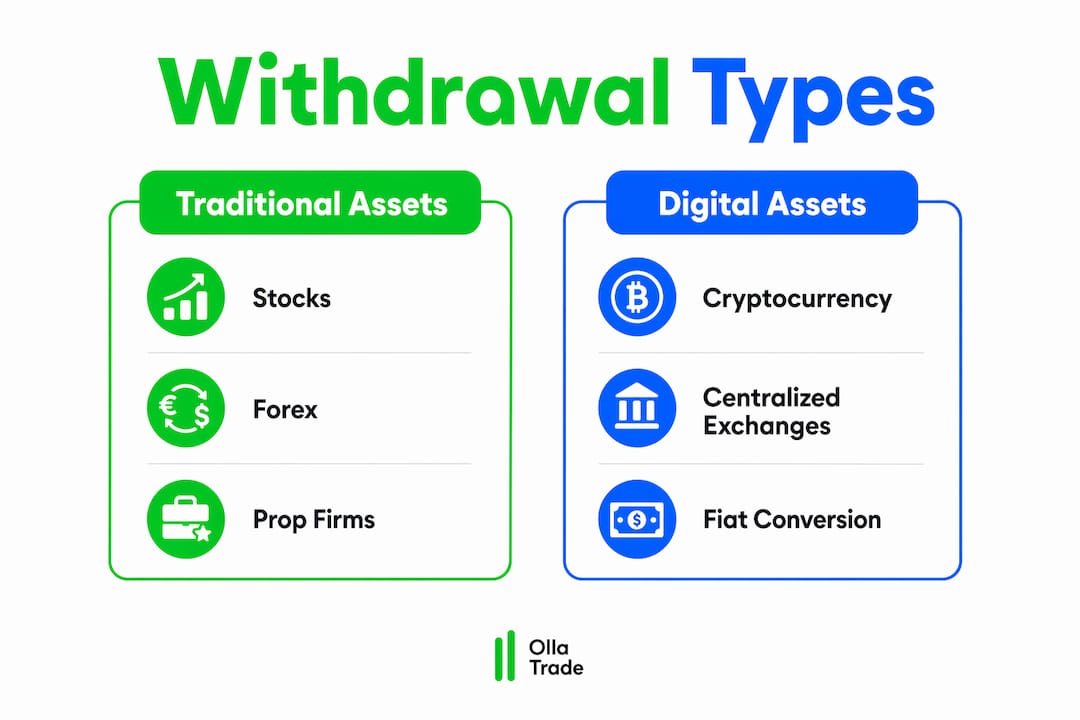
Stocks
Selling stocks is the standard way to access cash for withdrawal, with proceeds settling in your brokerage cash account first. Settlement timing under the SEC’s T+1 rule means most U.S. stock trades settle the next business day, after which funds become withdrawable. Brokers like Fidelity and Charles Schwab then allow ACH transfers to a linked bank account, typically within one to three additional business days.
Forex
Forex accounts generally allow withdrawals of free margin at any time, provided open positions do not consume the full account balance. Most forex brokers process withdrawals within one to three business days. Ollatrade, for example, supports multiple withdrawal methods with clear processing timelines outlined in its client portal.
Cryptocurrency
Crypto cash-out via centralized exchanges involves selling your holdings to fiat currency, then initiating a bank withdrawal. Fees on centralized exchanges typically run 0.1% to 1.5% of the transaction value, plus a separate flat withdrawal fee. That fee structure means a $10,000 crypto withdrawal could cost between $10 and $150 in exchange fees alone, before any bank charges. Peer-to-peer transfers and crypto debit cards offer alternatives, but each carries its own fee and tax event implications.
Prop and funded trading accounts
Prop firm withdrawals require using the firm’s specific payout process, not a standard fund transfer. This is a policy and workflow matter, not a simple bank transfer. Firms like FTMO and The Funded Trader operate on defined payout cycles, often bi-weekly or monthly, with profit splits typically ranging from 70% to 90% in the trader’s favor. Missing a payout request window means waiting for the next cycle.
| Asset type | Withdrawal method | Typical timeline | Key consideration |
|---|---|---|---|
| Stocks | Sell shares, ACH or wire transfer | 2 to 4 business days | T+1 settlement before withdrawal |
| Forex | Withdraw free margin via broker portal | 1 to 3 business days | Open positions reduce withdrawable balance |
| Cryptocurrency | Sell on CEX, bank transfer | 1 to 5 business days | Fees of 0.1% to 1.5% plus flat withdrawal fee |
| Prop/funded accounts | Firm payout request portal | Per firm cycle (bi-weekly or monthly) | Profit split applies; firm sets payout schedule |
What are the tax rules when you withdraw trading profits?
Tax liability on trading profits does not begin when money hits your bank account. The IRS constructive receipt rule means income is taxable in the year it is credited or made available to you, even if you choose not to withdraw it. Delaying a bank transfer does not delay your tax obligation if the funds are already accessible in your account.
This distinction catches many traders off guard, particularly those using prop firms. Traders often under-report prop firm income because they assume taxes apply only when cash lands in their personal bank account. The IRS does not agree.
Key tax considerations for traders withdrawing profits:
- Business income vs. capital gains. Prop firm payouts are typically classified as self-employment income, not capital gains. This means they are subject to both federal income tax and self-employment tax, which can push your effective rate significantly higher than a standard capital gains rate.
- Quarterly estimated tax payments. Prop trading payouts are classified as self-employment income requiring quarterly estimated tax payments if your total tax owed exceeds $1,000 for the year. Missing these payments triggers IRS underpayment penalties, which compound over time.
- Recordkeeping. Save every payout confirmation, trade log, and crypto wallet history. These documents substantiate your income figures and any deductions you claim.
- Crypto tax events. Selling cryptocurrency to fiat is a taxable disposal event, separate from any subsequent bank withdrawal. The gain or loss is calculated from your cost basis at the time of purchase.
“The most expensive tax mistake a trader can make is assuming that money sitting in a trading account is not yet income. Under constructive receipt, if you can withdraw it, the IRS considers it yours.” — Prop Firm Taxes: A 2026 Guide for Funded Traders
Working with a tax advisor familiar with trader classification, such as those at SmileTax, can prevent the kind of underpayment surprises that derail otherwise profitable trading operations.
What are the best practices for managing withdrawals strategically?
Knowing the steps to withdraw trading profits is only half the equation. How you manage withdrawal frequency, amounts, and tax reserves determines whether your trading income actually builds long-term wealth.
Practical best practices for withdrawing trading earnings:
- Set a withdrawal schedule, not a withdrawal impulse. Withdrawing every time you hit a profit creates erratic cash flow and makes tax tracking harder. Monthly or quarterly withdrawals align better with estimated tax payment cycles.
- Separate your tax reserve immediately. Set aside 25% to 35% of every payout into a dedicated savings account the moment it arrives. This prevents the common mistake of spending tax money before the quarterly deadline.
- Maintain operating capital in your trading account. Withdrawing too aggressively reduces your margin buffer and forces you to trade smaller position sizes, which limits your earning potential. Review your risk management approach before setting withdrawal amounts.
- Track profit withdrawal limits per platform. Some brokers cap daily or monthly withdrawal amounts. Knowing these limits in advance prevents situations where you need funds urgently but cannot access them.
- Align withdrawal timing with tax events. If you are near a year-end and have significant unrealized gains, consider whether closing positions and withdrawing before December 31 or after January 1 changes your tax bracket exposure for that year.
Pro Tip: Open a dedicated business checking account for all trading income and withdrawals. This single step makes tax preparation dramatically faster, reduces the risk of mixing personal and trading funds, and creates a clean paper trail if you are ever audited.
Building a withdrawal system that integrates with your profit maximization strategy is what separates traders who grow their accounts from those who drain them.
Key takeaways
Successful profit withdrawal requires matching the right process to your asset class, respecting IRS constructive receipt rules, and building a tax reserve before you spend a single dollar of your payout.
| Point | Details |
|---|---|
| Follow the platform process | Each broker and prop firm has specific withdrawal steps; confirm requirements before submitting. |
| Asset class determines timeline | Stocks settle T+1, forex withdraws free margin, crypto carries fees, prop firms run on payout cycles. |
| Constructive receipt triggers tax liability | Income is taxable when available, not when deposited. Delaying withdrawal does not delay taxes. |
| Reserve 25% to 35% for taxes | Transfer tax reserves to a separate account immediately after every payout to avoid underpayment penalties. |
| Recordkeeping is non-negotiable | Save all payout confirmations, trade logs, and crypto histories to substantiate income during audits. |
Why most traders get withdrawals wrong before they get them right
The traders I see struggle most with withdrawals are not struggling because the process is complicated. They struggle because they treat withdrawals as an afterthought rather than a system. They pull money out when they feel like it, mix it with personal funds, and then face a tax bill they did not plan for.
The constructive receipt rule is the single most misunderstood concept in trader taxation. I have spoken with profitable prop traders who genuinely believed that leaving money in their payout account meant they did not owe taxes yet. That belief is wrong and expensive. The IRS does not care whether you moved the money. It cares whether you could have.
The fix is not complicated. Build a withdrawal schedule. Open a separate tax account. Document every transaction. Treat your trading operation like the business it is, because the IRS already does. Traders who adopt this mindset in their first year of consistent profitability avoid the painful catch-up that hits those who figure it out in year three after an audit notice.
The best practices for traders who sustain long-term profitability are almost always the ones who manage the business side of trading with the same discipline they apply to their charts.
— FX
Start trading and withdrawing with confidence on Ollatrade

Ollatrade is built for retail and professional traders who need a platform that handles both execution and fund management without friction. With access to forex markets, CFDs on metals, indices, stocks, energies, and cryptocurrencies, Ollatrade combines MetaTrader 4 integration with multiple deposit and withdrawal options designed for speed and compliance. Tight spreads, fast execution, and a straightforward client portal mean you spend less time managing logistics and more time trading. Whether you are setting up your first withdrawal or optimizing a recurring payout schedule, Ollatrade’s infrastructure supports the full trading lifecycle. Visit Ollatrade to open an account and put this guide into practice.
FAQ
Can I withdraw trading profits at any time?
You can withdraw realized profits at any time, subject to your broker’s processing schedule and minimum balance requirements. Open positions reduce your withdrawable free margin, so you may need to close trades first.
How long does a trading profit withdrawal take?
Withdrawal timelines range from same-day for e-wallets to five business days for international wire transfers. Prop firm payouts follow firm-specific cycles, often bi-weekly or monthly, regardless of when you submit the request.
Do I owe taxes before I withdraw my trading profits?
Yes. The IRS constructive receipt rule makes profits taxable in the year they are credited and available, not when you physically transfer them to your bank account. Leaving funds in your trading account does not defer your tax liability.
How much should I set aside for taxes on trading withdrawals?
Set aside 25% to 35% of every payout to cover federal income tax and, for prop traders, self-employment tax. Transfer this amount to a separate savings account immediately after each withdrawal.
What is the difference between withdrawing from a prop firm vs. a standard broker?
Standard brokers allow withdrawals of free margin on demand through the client portal. Prop firm withdrawals follow a defined payout process with scheduled cycles, profit splits, and firm-specific approval workflows that function more like payroll than a standard fund transfer.