












สรุปโดยย่อ:
- Margin in trading refers to borrowed capital secured by your deposited funds, enabling leverage on larger positions.
- It differs from business profit margin, which measures profitability as a percentage of revenue, and requires careful risk management.
Margin in trading is collateral or borrowed capital that allows you to control a position larger than your actual cash balance. Brokerage firms lend you the difference, using your deposited funds and existing securities as security. This is fundamentally different from the margin you see on an income statement. In business accounting, margin measures profitability as a percentage of revenue. In trading, margin is leverage. Confusing the two is one of the most common barriers to financial literacy for new traders, according to financial educators at AccountingTools.
What is margin in a trading account?
Margin in trading is defined as the minimum deposit required to open and maintain a leveraged position, with the broker lending the remaining capital. Under US Regulation T, the standard initial margin requirement for stocks is 50%, meaning you put up half the trade value and borrow the rest. A $10,000 stock position requires $5,000 of your own capital. The broker funds the other $5,000.

To open a margin account, most brokers require a minimum deposit of $2,000. Once funded, you gain access to 2:1 leverage on stocks eligible under Regulation T. Forex and CFD markets, which Ollatrade specializes in, often offer significantly higher leverage ratios, which amplifies both the opportunity and the risk.
Beyond the initial margin, brokers impose a maintenance margin, typically between 25% and 40% of the total position value. This is the floor your account equity must stay above to keep positions open. If your account drops below that threshold, you receive a margin call.
Interest on margin loans runs between approximately 6% and 12% annually in 2026, accruing monthly based on the outstanding balance. Larger loan balances often attract lower rates. This cost is real and ongoing. A trader holding a $20,000 margin loan at 9% annual interest pays roughly $150 per month just to keep the position open, before any market movement.
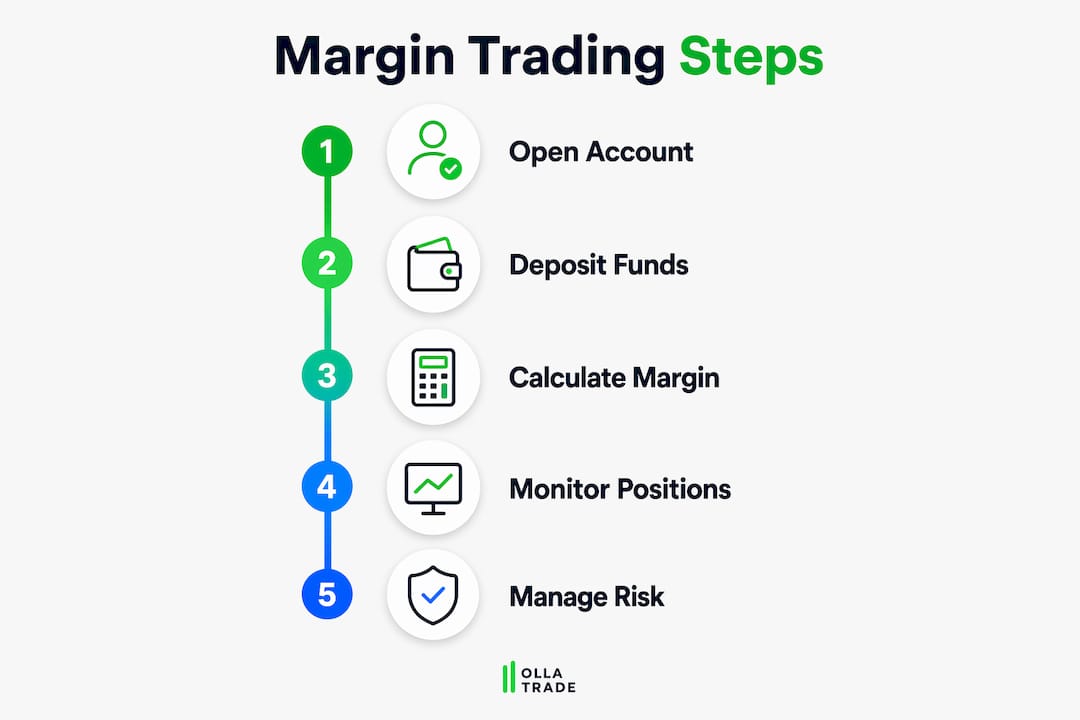
- Open a margin account and meet the minimum $2,000 deposit requirement.
- Place a trade using borrowed funds up to the broker’s leverage limit.
- Monitor your account equity against the maintenance margin threshold daily.
- Pay monthly interest on the borrowed balance regardless of trade performance.
- Close or reduce the position to repay the loan and lock in your net result.
เคล็ดลับสำหรับมืออาชีพ: Calculate your total interest cost before entering any margin trade. A position that earns 5% while costing 9% in annual margin interest is a net loss. Use Ollatrade’s เครื่องคำนวณฟอเร็กซ์ to model your real cost of carry before committing capital.
What are margin calls and why do they matter?
A margin call is a broker’s demand that you deposit additional funds or liquidate positions because your account equity has fallen below the maintenance margin requirement. It is not a suggestion. It is a contractual obligation with a tight deadline.
Here is a concrete scenario. You deposit $5,000 and borrow $5,000 to buy $10,000 worth of stock. The stock drops 30%, leaving your position worth $7,000. Your equity is now $2,000 ($7,000 minus the $5,000 loan). If the broker’s maintenance margin is 25% of the position value, you need $1,750 in equity. You are still above the threshold here, but a further 5% drop would trigger the call.
The consequences of ignoring a margin call are severe:
- Brokers typically allow 2 to 5 business days to meet a margin call with new funds.
- If you fail to respond, the broker can liquidate your positions without further notice.
- Forced liquidation happens at market prices, which may be the worst possible moment to sell.
- You can lose more than your initial deposit if the position moves sharply against you.
- Your credit relationship with the broker may be damaged, affecting future account access.
Failing to understand maintenance margin is one of the most common and costly beginner mistakes in leveraged trading. The broker’s priority is recovering the loan, not protecting your capital.
เคล็ดลับสำหรับมืออาชีพ: Set price alerts at levels 10% to 15% above your maintenance margin threshold. This gives you time to add funds or reduce exposure before a forced liquidation. Ollatrade’s คู่มือการบริหารความเสี่ยง covers position sizing strategies that keep margin calls off the table.
How is margin different from markup and profit margin in business?
The word “margin” carries two completely different meanings depending on context, and mixing them up causes real financial errors. In trading, margin is leverage collateral. In business accounting, margin represents profitability as a percentage of revenue. A net profit margin of 35% means the business keeps $0.35 from every $1.00 of revenue after all expenses.
Markup is a third concept that gets tangled in the same conversation. Margin and markup use different calculation bases, which is why they produce different numbers from the same transaction. Consider a product that costs $80 to produce and sells for $100. The profit is $20. Margin is calculated as profit divided by revenue: $20 / $100 = 20%. Markup is calculated as profit divided by cost: $20 / $80 = 25%. Same transaction, different percentages.
| Term | Formula | Based on | Example ($80 cost, $100 price) |
|---|---|---|---|
| Trading margin | Collateral / position value | ขนาดตำแหน่ง | $5,000 deposit on $10,000 trade = 50% |
| Profit margin | Profit / revenue × 100 | Selling price | $20 / $100 = 20% |
| มาร์กอัป | Profit / cost × 100 | Cost base | $20 / $80 = 25% |
For traders who also run a business or work as self-employed professionals, this distinction is not academic. A freelancer who prices services using markup logic while reporting margin figures to an accountant will consistently underestimate profitability. A trader who reads “margin” in a broker agreement and interprets it as a profitability metric will misunderstand their actual leverage exposure entirely.
Distinguishing margin from markup is vital because margin measures profitability relative to the sales price, while markup relates to the cost base. These two metrics serve different decisions. Use margin for profitability analysis and investor reporting. Use markup for pricing strategy and cost recovery planning.
What are the practical benefits and risks of using margin?
Margin trading is a tool for experienced investors that carries higher risk and must be understood before use. The leverage effect works in both directions with equal force.
Consider a trader who deposits $5,000 and uses 2:1 leverage to control a $10,000 forex position. If the currency pair moves 10% in their favor, the position gains $1,000. That is a 20% return on the $5,000 deposited, not 10%. Without margin, the same $5,000 trade would return $500, or 10%. Margin doubled the gain. The same math applies to losses. A 10% adverse move wipes out $1,000, a 20% loss on the deposited capital.
Benefits of trading on margin:
- Increased buying power without liquidating existing holdings.
- Ability to take positions in high-value instruments like forex pairs, indices, and commodities.
- Potential for returns that exceed what cash-only trading allows.
- Flexibility to act on short-term opportunities without waiting to accumulate full capital.
Risks that demand equal attention:
- Losses are amplified at the same rate as gains.
- Interest costs erode returns on positions held for extended periods.
- Margin calls can force liquidation at the worst possible price.
- Emotional decision-making under margin pressure leads to compounding losses.
Risk mitigation starts with position sizing. Never allocate more than 1% to 2% of total account equity to a single leveraged trade. Stop-loss orders are non-negotiable when trading on margin. They cap your downside before a position reaches margin call territory. Ollatrade’s leveraged instruments guide details how to structure positions across forex, metals, and indices while keeping leverage exposure manageable.
เคล็ดลับสำหรับมืออาชีพ: Margin is not suitable for every trader. If a 20% loss on a single trade would materially affect your financial stability, reduce your leverage ratio or trade cash-only until your risk tolerance and account size align with the demands of leveraged trading.
ประเด็นสำคัญ
Margin in trading is borrowed capital secured by your deposited funds, and its mechanics, costs, and risks are entirely separate from the profit margin concept used in business accounting.
| จุด | รายละเอียด |
|---|---|
| Trading margin defined | Margin is collateral that lets you control positions larger than your cash balance. |
| Initial and maintenance thresholds | US Regulation T sets 50% initial margin; maintenance margin ranges from 25% to 40%. |
| Margin call consequences | Falling below maintenance margin triggers forced liquidation within 2 to 5 business days. |
| Margin vs. profit margin | Business margin measures profitability as profit divided by revenue, not leverage. |
| Interest cost is real | Margin loans cost 6% to 12% annually in 2026 and accrue monthly regardless of trade outcome. |
Why most traders misread margin until it costs them
The single biggest mistake I see among traders entering leveraged markets is treating margin as free money. It is not. It is a loan with a clock running and a broker who will act before you do if your equity drops too far.
The terminology confusion makes this worse. Traders who come from a business background hear “margin” and think profitability. They open a margin account expecting a straightforward tool and get blindsided by maintenance thresholds and interest charges they never modeled. The fix is simple but requires discipline: read the margin agreement in full before depositing a dollar.
My honest recommendation is to start with the smallest leverage ratio your broker offers and hold that position through at least one volatile market session before scaling up. Watching a leveraged position move against you in real time teaches risk management faster than any article can. Pair that experience with a clear leverage risk framework and you will develop the instincts that keep margin working for you rather than against you.
The traders who use margin well are not the ones chasing the biggest leverage ratios. They are the ones who understand exactly what they owe, at what price their broker steps in, and how much of their capital they are genuinely willing to lose. That clarity is the real edge.
— เอฟเอ็กซ์
Start trading on margin with Ollatrade
Ollatrade gives retail and professional traders direct access to forex, CFDs on metals, indices, stocks, energies, and cryptocurrencies through a platform built for leveraged trading. MetaTrader 4 integration, tight spreads, and fast execution mean your margin positions are managed with precision, not guesswork.
Ollatrade’s educational resources cover margin trading basics, leverage mechanics, and risk management strategies for every experience level. Whether you are opening your first forex trading account or refining a professional strategy, the platform provides the tools, calculators, and market data to trade margin with confidence. Visit Ollatrade to explore account options and start building your leveraged trading knowledge today.
คำถามที่พบบ่อย
What is the definition of margin in trading?
Margin in trading is the collateral deposited with a broker to open and maintain a leveraged position. It represents a fraction of the total trade value, with the broker lending the remainder.
How does a margin call work?
A margin call occurs when your account equity falls below the broker’s maintenance margin threshold, typically 25% to 40% of the position value. You must deposit additional funds or close positions within 2 to 5 business days, or the broker liquidates your holdings.
What is the difference between margin and profit margin?
Trading margin is borrowed capital used to increase position size. Profit margin is a business accounting metric calculated as profit divided by revenue. The two terms share a word but measure entirely different things.
How do you calculate margin in trading?
Divide your deposited capital by the total position value. A $5,000 deposit on a $10,000 trade equals a 50% margin rate, which corresponds to 2:1 leverage. Use a margin calculator to model exact requirements before entering a trade.
Is margin trading suitable for beginners?
Margin trading carries amplified risk and is best approached after mastering cash-only trading. Beginners should start with the lowest available leverage ratio, use stop-loss orders on every position, and study risk management rules before committing real capital to leveraged trades.