











TL;DR:
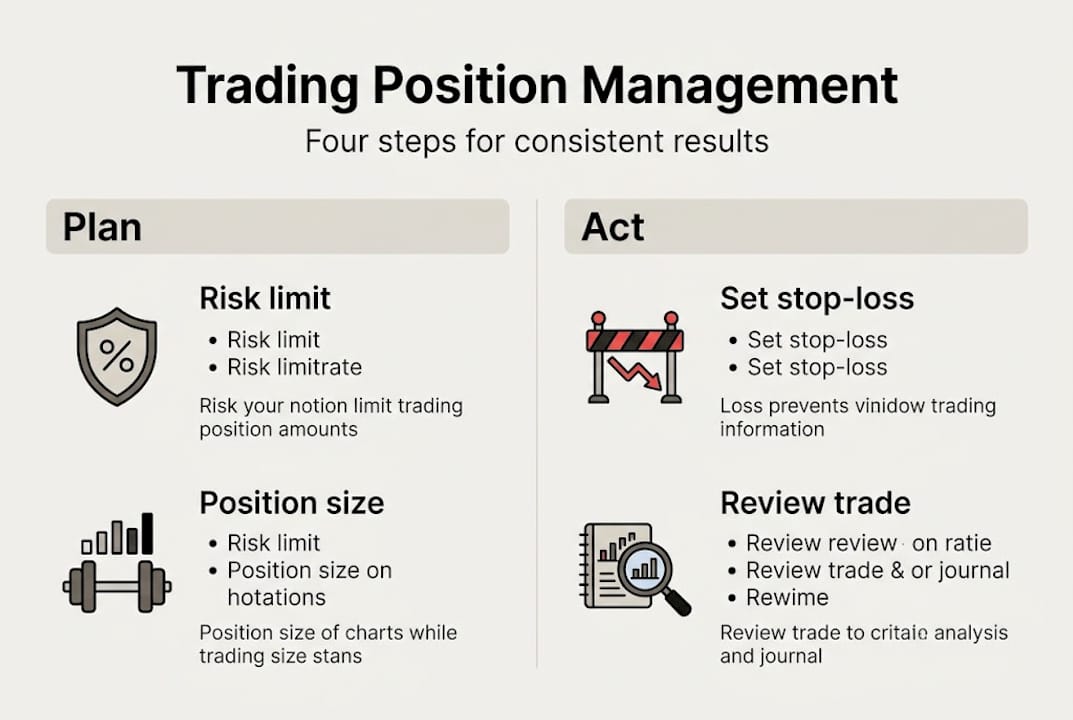
- Effective position management bridges strategy and consistent trading profits by controlling risk and exits.
- Proper sizing, stop-loss placement, and disciplined review prevent account drain and emotional mistakes.
- Emotional biases and poor discipline, not market knowledge, are the main barriers to trading success.
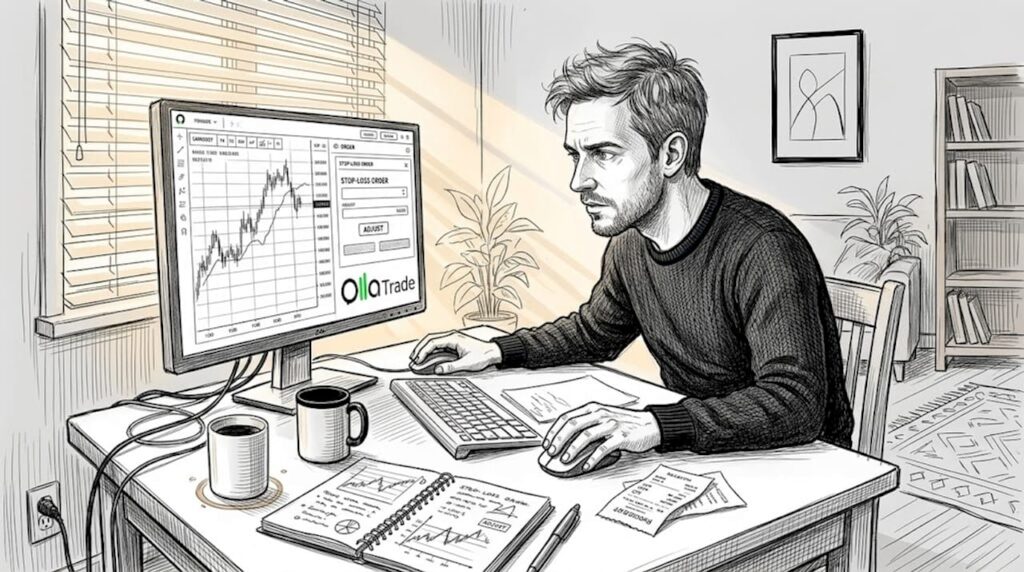
You execute a solid setup, the chart looks perfect, and then the trade goes sideways for no obvious reason. Sound familiar? For most retail traders, the real problem is not the entry signal. It is what happens after the trade is open. Poor position management quietly drains accounts while traders keep searching for a better indicator or a smarter strategy. This guide breaks down four practical steps to manage your trading positions with discipline, from sizing your risk correctly to reviewing your results and improving over time. Each step is grounded in real data and built for traders who want steady, repeatable performance.
Table of Contents
- Why managing positions matters for every trader
- Step 1: Determine position size and risk per trade
- Step 2: Set stop-losses and use exits strategically
- Step 3: Monitor, adjust, and avoid common mistakes
- Step 4: Review results and improve your process
- The uncomfortable truth about managing trading positions
- Take your trading to the next level with Olla Trade
- Frequently asked questions
Key Takeaways
| Point | Details |
|---|---|
| Always control risk | Never risk more than 2% of your trading capital on a single position. |
| Plan your exits | Use stop-losses and profit targets based on market structure or volatility, not guesswork. |
| Review and improve | Analyze each trade to ensure you’re following your management process—not just chasing results. |
| Conquer emotions | Stick to your rules to avoid overtrading and random decision-making. |
Why managing positions matters for every trader
Position management is the bridge between having a good strategy and actually making money from it. You can have a 60% win rate and still blow your account if you risk too much on losers and too little on winners. That gap between strategy and results is where position management lives.
Research on retail trading performance in China found that small retail accounts posted an average annual net return of negative 5.61%, largely due to poor stock selection and transaction costs. Larger, more sophisticated accounts predicted returns better. The pattern is consistent globally: undisciplined position practices hurt small traders the most.
Here is what separates disciplined traders from undisciplined ones:
| Factor | Disciplined trader | Undisciplined trader |
|---|---|---|
| Risk per trade | Fixed 1-2% of equity | Random, emotion-driven |
| Stop-loss use | Always set before entry | Often skipped or moved |
| Position sizing | Formula-based | Based on gut feeling |
| Post-trade review | Consistent habit | Rarely done |
The three pillars that disciplined traders focus on are:
- Capital preservation: Never risk more than you can afford to lose on a single trade
- Controlled risk: Know your maximum loss before you enter
- Steady growth: Compound small, consistent gains over time
“The goal of a successful trader is to make the best trades. Money is secondary.” — Alexander Elder
Learning to protect your capital is not just about avoiding losses. It is about staying in the game long enough for your edge to play out. Combine that with essential trading strategies and you have a foundation worth building on.
Step 1: Determine position size and risk per trade
Every trade starts with a number, not a feeling. Before you click buy or sell, you need to know exactly how many units or lots to trade based on how much you are willing to lose if the trade goes wrong.
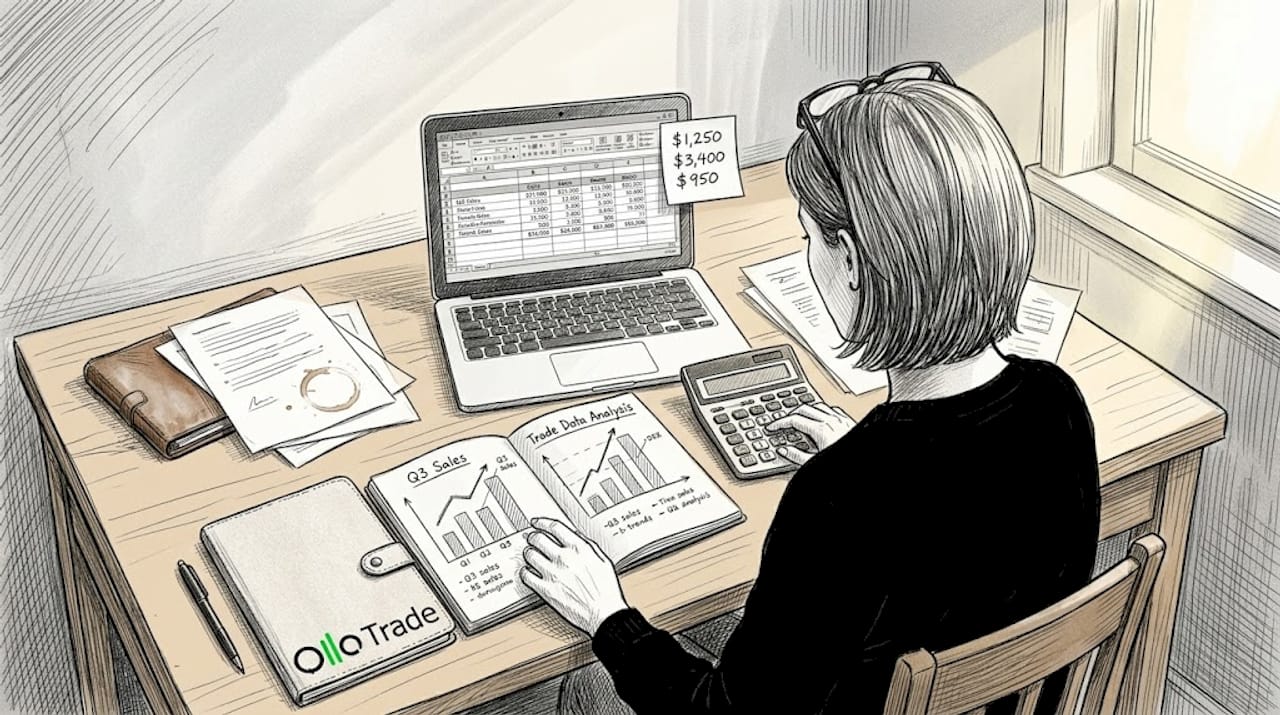
The formula is straightforward. Position sizing is calculated as your account risk per trade divided by your stop-loss distance in dollar terms. For example, if you have a $10,000 account and you risk 1%, that is $100 per trade. If your stop-loss is 50 pips and each pip is worth $1, you trade 2 standard mini lots. Simple math, massive impact.
Here is how different risk levels affect a $10,000 account:
| Risk per trade | Dollar at risk | Trades to lose 20% |
|---|---|---|
| 0.5% | $50 | 40 trades |
| 1% | $100 | 20 trades |
| 2% | $200 | 10 trades |
| 5% | $500 | 4 trades |
The numbers make it obvious. Risking 5% per trade means four consecutive losses wipe out 20% of your account. Risking 1% gives you 20 chances to recover.
Here is a step-by-step approach to sizing every position:
- Decide your maximum risk per trade (start at 0.5% to 1% if you are new)
- Identify your stop-loss level based on chart structure
- Calculate the pip or point distance to your stop
- Divide your dollar risk by the stop distance to get your lot size
- Set a daily loss limit at 3 to 3.5 times your per-trade risk to avoid catastrophic days
Pro Tip: Start at 0.1% risk per trade if you are new or testing a strategy. Scale up only after 20 to 30 profitable trades in a row. Consistency earns the right to size up.
For more on protecting your account, check out these risk management tips and learn how leverage management plays into your overall exposure.
Step 2: Set stop-losses and use exits strategically
With your risk per trade defined, the next job is controlling the trade while it is open. A stop-loss is not optional. It is the mechanism that enforces your plan when emotions try to take over.
Here is a practical process for setting stops and managing exits:
- Identify a logical stop level based on price structure, such as below a swing low for a long trade or above a swing high for a short
- Add a small buffer to avoid being stopped out by normal market noise, typically 5 to 10 pips beyond the structure level
- Calculate your R-multiple by dividing your target profit by your risk. Aim for at least 2R, meaning you target twice what you risk
- Scale out partial profits at 1R by closing half the position, then let the rest run toward 2R or beyond
- Move your stop to breakeven once the trade reaches 1R profit to eliminate downside risk on the remaining position
For volatile markets, ATR-based stops (Average True Range) are highly effective. The ATR measures recent price movement, so your stop adjusts to actual market conditions rather than a fixed pip number.
Pro Tip: Use a trailing stop in strong trending markets. Set it at 2x ATR behind price and let the market do the work. This keeps you in winning trades longer without second-guessing every candle.
“Cut your losses short and let your profits run” is not just a saying. It is a mechanical rule you enforce with your exit strategy.
For more context on navigating volatile conditions, these forex market tips are worth reviewing before your next session.
Step 3: Monitor, adjust, and avoid common mistakes
Opening a trade is the easy part. Managing it over hours or days is where most traders lose discipline. Position management does not stop at entry.
Here are the most common mistakes traders make after a trade is open:
- Moving stops in the wrong direction: Widening a stop-loss because you do not want to accept a loss is one of the fastest ways to turn a small loss into a large one
- Overtrading: Adding positions without a plan, especially after a winning streak, inflates your risk exposure without a matching edge
- Ignoring your process: Skipping your checklist because you are confident in a trade is how behavioral biases creep in
- Closing winners too early: Fear of giving back gains often causes traders to exit before reaching their target, crushing their reward-to-risk ratio
- Checking charts too often: Watching every tick increases emotional decision-making and leads to premature exits
Behavioral biases explain between 43% and 63% of excess returns in retail trading research from Indian markets. That is not a small number. It means emotional mistakes, not lack of knowledge, drive most underperformance.
Pro Tip: Create a simple trade monitoring checklist. Before touching an open position, ask yourself: Is this adjustment part of my plan? If the answer is no, do not touch it.
Understanding the difference between trading vs gambling comes down to exactly this kind of process discipline. And if you want to go deeper on the mental side, a solid trading psychology guide will help you recognize your own patterns before they cost you money.
Step 4: Review results and improve your process
Most traders skip this step entirely. That is a costly mistake. Reviewing your trades is how you separate a lucky streak from a genuine edge.
Here is a structured review process to follow after every trade:
- Log the trade immediately after closing it. Record entry, exit, stop-loss, position size, and the reason you entered
- Compare execution to your plan. Did you follow your rules or improvise? Deviation from the plan is a red flag regardless of outcome
- Measure your R-multiple. Did you achieve at least 2R on winners? Did you cut losers at 1R?
- Review over 20 to 30 trades, not just one. A single trade tells you nothing. A sample of 30 tells you whether your process has an edge
Here is a sample post-trade review checklist:
| Review item | Target | Your result |
|---|---|---|
| Followed entry rules | Yes | |
| Stop-loss set before entry | Yes | |
| Position size matched plan | Yes | |
| Exit at planned level | Yes | |
| R-multiple achieved | 2R minimum |
The key insight from position sizing research is that a fixed 1% risk per trade ensures survival through inevitable drawdowns, and prioritizing process over win rate is what builds a long-term edge. One losing trade means nothing. Consistently breaking your rules means everything.
Exploring different trading account types can also help you match your review process to the right trading environment for your current skill level.
The uncomfortable truth about managing trading positions
Here is what most trading guides will not tell you: the traders who struggle most are rarely struggling because they lack market knowledge. They struggle because they refuse to accept that process beats prediction every single time.
The fantasy is finding a perfect system that tells you exactly when to buy and sell. The reality is that no such system exists. What does exist is a repeatable process that limits damage when you are wrong and maximizes gains when you are right. That is position management.
We have seen traders with deep technical knowledge blow accounts repeatedly while traders with average setups but iron discipline compound steadily over years. The difference is never the chart pattern. It is always the behavior around risk, sizing, and exits.
Most retail traders underperform not because markets are too complex, but because emotions override their plans at the worst possible moments. Mastering your trading psychology is not a soft skill. It is the hardest and most important skill in trading. Surviving drawdowns and growing an account depend far more on your process discipline than on your ability to predict the next move.
Take your trading to the next level with Olla Trade
Putting position management principles into practice requires more than knowledge. It requires the right tools, real-time data, and a platform built for serious traders.
At Olla Trade, you get access to a full trading ecosystem designed to support every step of your process. From tight spreads and fast execution to MetaTrader 4 integration and advanced charting, everything is built to help you trade with discipline and confidence. Whether you are just starting to explore forex trading or looking to sharpen your edge with a forex trading step-by-step framework, Olla Trade gives you the infrastructure to turn your position management skills into consistent results. Open your account today and trade with a platform that takes your performance seriously.
Frequently asked questions
How much should I risk on each trade?
Most traders should risk 0.5% to 2% of their account equity on each trade to survive drawdowns and stay in the game long enough for their edge to work.
What is the best way to set a stop-loss?
Base your stop-loss on price structure or ATR to filter out normal market noise, and move it to breakeven once the trade reaches 1R profit to protect your gains.
Why do most retail traders underperform?
Small retail accounts consistently underperform because of poor position sizing, high transaction costs, and emotional decision-making, as shown by annual net losses averaging negative 5.61% in research on Chinese retail traders.
How do I monitor my positions without over-managing?
Set predefined rules for any adjustment, use price alerts instead of watching charts constantly, and avoid making changes based on short-term moves. Behavioral biases are the primary driver of over-management.
What process should I use to review my trading performance?
Log every trade immediately after closing it and evaluate whether you followed your position management rules. Focus on process over win rate across a sample of at least 20 to 30 trades before drawing conclusions.