











Many traders believe trading and gambling are identical, just dressed in different clothes. This misconception stems from overlapping behaviors like risk taking, uncertain outcomes, and emotional highs and lows. Yet disciplined trading and gambling differ fundamentally in approach, strategy, and long term results. Trading relies on analysis, risk management, and skill, while gambling depends on chance and fixed odds. This guide clarifies these differences with research backed insights, helping you improve trading discipline and avoid gambling pitfalls that cost retail traders billions annually.
Table of Contents
- Key takeaways
- Understanding gambling and trading: foundational differences
- Risk management: the crucial divide between trading and gambling
- Behavioral patterns: why retail traders often mimic gambling
- Trading apps and gamification: the blurred line between skill and chance
- Drawing clear distinctions: How discipline and skill transform trading
- Discover smart trading tools and resources at Olla Trade
- Frequently asked questions
Key Takeaways
| Point | Details |
|---|---|
| Trading relies on analysis | Traders use research, price patterns, and market data to form a disciplined edge rather than leaving outcomes to chance. |
| Systematic risk management | Stop losses, position sizing, and risk reward ratios limit losses and preserve capital over time. |
| Gambling rests on fixed odds | Casino games and bets depend on chance with predictable house edges and no systematic downside control. |
| No inherent market edge | Markets do not guarantee profits, but skilled traders cultivate an edge through discipline and adaptive strategies. |
Understanding gambling and trading: foundational differences
Gambling centers on games of chance where outcomes depend on random events with fixed, predetermined odds. Casino games, lotteries, and sports betting fall into this category. The house edge ensures the operator profits over time, regardless of individual wins. Players have limited ability to influence results through skill or analysis. Each bet stands alone, with no opportunity to adjust strategy based on changing conditions.
Trading operates differently. Trading involves analytical approaches, research, historical data, technical and fundamental analysis, and ongoing adjustment, while gambling relies on static odds and chance. Traders examine price patterns, economic indicators, company financials, and market sentiment to make informed decisions. They adapt strategies as market conditions evolve, responding to news, trends, and technical signals. Unlike gambling’s fixed odds, market prices fluctuate based on supply, demand, and countless variables.
Risk management separates these activities fundamentally. Traders control position sizes, set stop losses, and calculate risk reward ratios before entering trades. They limit exposure to preserve capital for future opportunities. Gamblers face predetermined odds with no systematic way to manage downside risk. The house edge in casino games ranges from 1% to 15%, guaranteeing long term losses for players. Markets have no built in house edge, though transaction costs and spreads affect profitability.
Understanding forex vs CFDs differences illustrates how trading instruments offer varied risk profiles and strategic approaches. Traders choose instruments matching their analysis and risk tolerance, while gamblers accept fixed game rules.
Key distinctions include:
- Gambling relies on chance with fixed odds and minimal skill impact
- Trading uses analysis, research, and dynamic strategy adjustment
- House edge ensures gambling losses over time
- Markets offer no inherent edge, but skilled traders create advantages
- Risk management is systematic in trading, absent in gambling
- Trading adapts to changing conditions, gambling operates on static rules
Risk management: the crucial divide between trading and gambling
Risk management defines professional trading. Risk management is core to trading, including stop losses, position sizing, and risk reward ratios, typically limiting losses to 1% per trade. Stop loss orders automatically exit positions when prices move against traders, capping potential losses. Position sizing determines how much capital to risk on each trade based on account size and risk tolerance. Risk reward ratios compare potential profit to potential loss, ensuring favorable odds over many trades.
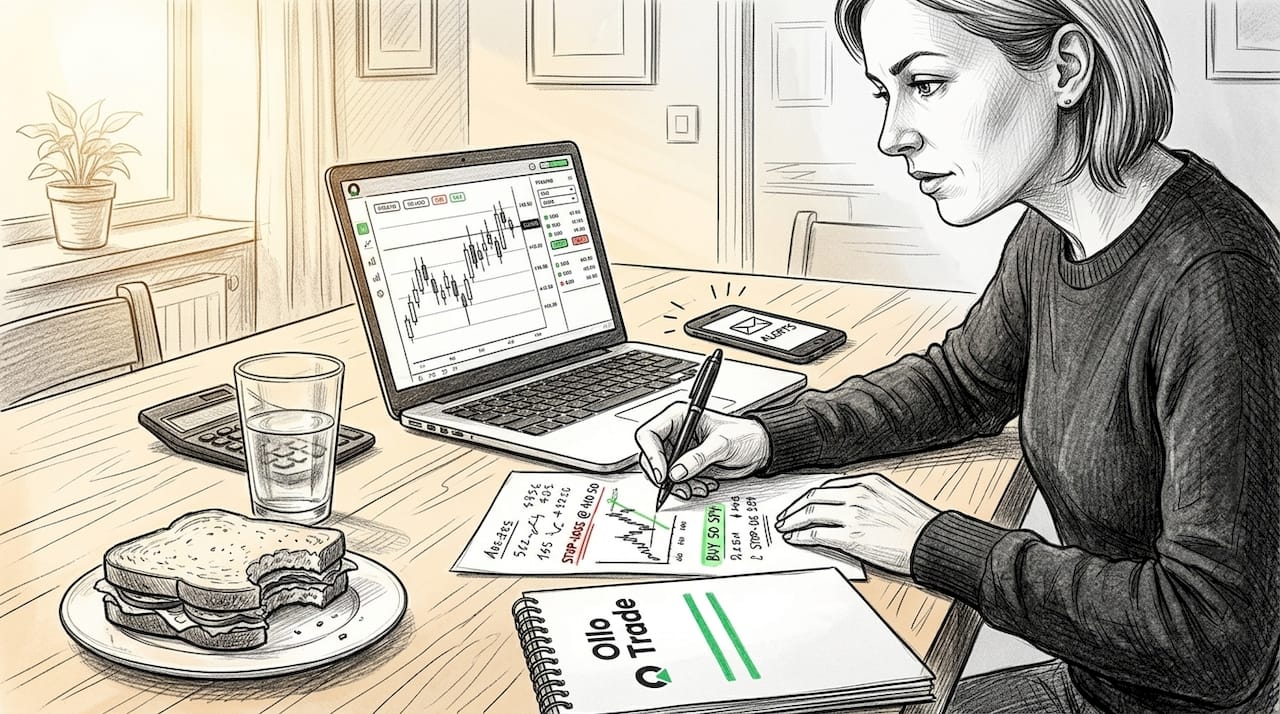
Traders calculate these metrics before entering positions. A common rule limits risk to 1% of account value per trade. On a $10,000 account, this means risking no more than $100 on any single position. If a trade requires a 50 pip stop loss, position size adjusts accordingly. This systematic approach prevents catastrophic losses and preserves capital during losing streaks.
Gambling offers no equivalent framework. Casino players cannot set stop losses on roulette spins or limit downside on slot machines. The house edge operates continuously, grinding down bankrolls over time. A 5% house edge means players lose $5 for every $100 wagered on average. No amount of bet sizing or money management overcomes this mathematical disadvantage.
Professional traders monitor risk metrics constantly. They track win rates, average wins versus losses, maximum drawdowns, and overall expectancy. These statistics reveal whether strategies maintain positive edges. Adjustments follow when metrics deteriorate, preventing gambling like behavior from creeping into trading routines.
Professional traders risk 1% per trade, use stop losses religiously, and maintain risk reward ratios of at least 1:2, ensuring long term profitability even with win rates below 50%.
Exploring forex market risk tips provides practical frameworks for implementing these principles. Understanding trading psychology importance helps maintain discipline when emotions threaten risk management protocols.
Pro Tip: Review your risk metrics weekly, tracking win rate, average risk reward, and maximum drawdown to ensure trading discipline remains intact and gambling behaviors stay out.
Essential risk management elements:
- Stop loss orders cap potential losses on every trade
- Position sizing limits risk to 1-2% of account per trade
- Risk reward ratios ensure favorable odds over time
- Regular metric reviews maintain discipline
- Capital preservation enables long term participation
Behavioral patterns: why retail traders often mimic gambling
Retail traders frequently exhibit gambling like behaviors that lead to consistent losses. Retail traders show gambling-like behaviors, with 74-89% losing money, and over 90% of day traders engaging in traditional gambling behaviors. These patterns include chasing momentum, overtrading, ignoring risk management, and letting emotions drive decisions. The statistics paint a sobering picture of retail trading outcomes.
Momentum chasing represents a classic gambling trap. Retail traders buy assets after significant price increases, hoping trends continue indefinitely. They enter positions based on fear of missing out rather than analytical reasoning. Professional traders often take contrarian positions, selling when retail enthusiasm peaks and buying when pessimism dominates. This behavioral difference creates the edge professionals exploit.
Overconfidence compounds problems. After a few winning trades, retail traders increase position sizes and take excessive risks. They attribute success to skill rather than luck, ignoring the role of favorable market conditions. Gamblers exhibit identical patterns, increasing bets after wins despite unchanged odds. Both groups eventually face reality when losing streaks arrive.
| Trader type | Average annual return | Win rate | Risk management | Emotional control |
|---|---|---|---|---|
| Retail traders | -15% to -40% | 35-45% | Inconsistent or absent | Poor, emotion driven |
| Professional traders | 10% to 30% | 45-55% | Systematic and disciplined | Strong, rule based |
Loss chasing destroys accounts. After losing trades, retail traders increase position sizes attempting to recover quickly. This gambling behavior, known as the martingale strategy, leads to catastrophic losses when losing streaks extend. Professional traders accept losses as business costs, maintaining consistent position sizing regardless of recent outcomes.
Comparing brokerage accounts comparison helps traders choose platforms supporting disciplined approaches. Learning CFD trading strategies provides frameworks for systematic decision making.
Pro Tip: Track every trade in a journal, noting entry reasoning, emotions, and outcomes to identify gambling like patterns before they destroy your account.
Common retail gambling behaviors:
- Chasing momentum instead of analyzing value
- Overtrading due to boredom or excitement
- Increasing position sizes after wins or losses
- Ignoring stop losses and risk management rules
- Making impulsive decisions based on emotions
- Attributing wins to skill and losses to bad luck
Trading apps and gamification: the blurred line between skill and chance
Modern trading platforms increasingly incorporate gamification elements that encourage gambling like behavior. Trading apps use gamification and poor risk warnings that mimic gambling, leading to at-risk trading behaviors in about 3.75% of users. These design choices prioritize engagement over investor protection, creating environments where impulsive trading flourishes.
Gamification features include achievement badges, leaderboards, confetti animations celebrating trades, and push notifications encouraging action. These elements trigger dopamine responses similar to slot machines, reinforcing frequent trading regardless of profitability. Users compete on leaderboards, chasing status rather than returns. Animations celebrate order execution, not profitable outcomes, conditioning users to associate trading with entertainment.
Social features amplify risks. Copy trading allows users to replicate others’ positions automatically, removing analytical thinking from the process. Social feeds display top performers, encouraging followers to chase returns without understanding strategies. This creates herding behavior where users pile into crowded trades, often at peaks before reversals.
Poor risk warnings compound problems. Many apps bury leverage explanations, margin requirements, and loss statistics in lengthy disclosures. New users access high leverage without understanding how quickly accounts can be wiped out. Simplified interfaces hide complexity, making trading feel easier than it is. One tap execution removes friction that might prompt reconsideration.
Regulators increasingly scrutinize these practices. Studies show gamification correlates with increased trading frequency, higher losses, and addiction like behaviors. About 3.75% of app users exhibit at-risk trading patterns similar to problem gambling, including inability to stop, chasing losses, and trading beyond financial means.
Trading apps with gamification features see 40% higher trade frequency but 25% lower average returns compared to traditional platforms, suggesting engagement tactics harm investor outcomes.
Reviewing trading software review helps identify platforms prioritizing tools over entertainment.
Gamification features mimicking gambling:
- Achievement badges and rewards for trading frequency
- Leaderboards creating competition divorced from profitability
- Confetti animations and celebratory sounds on execution
- Push notifications encouraging impulsive action
- Simplified interfaces hiding risk and complexity
- Social features promoting herding behavior
Drawing clear distinctions: How discipline and skill transform trading
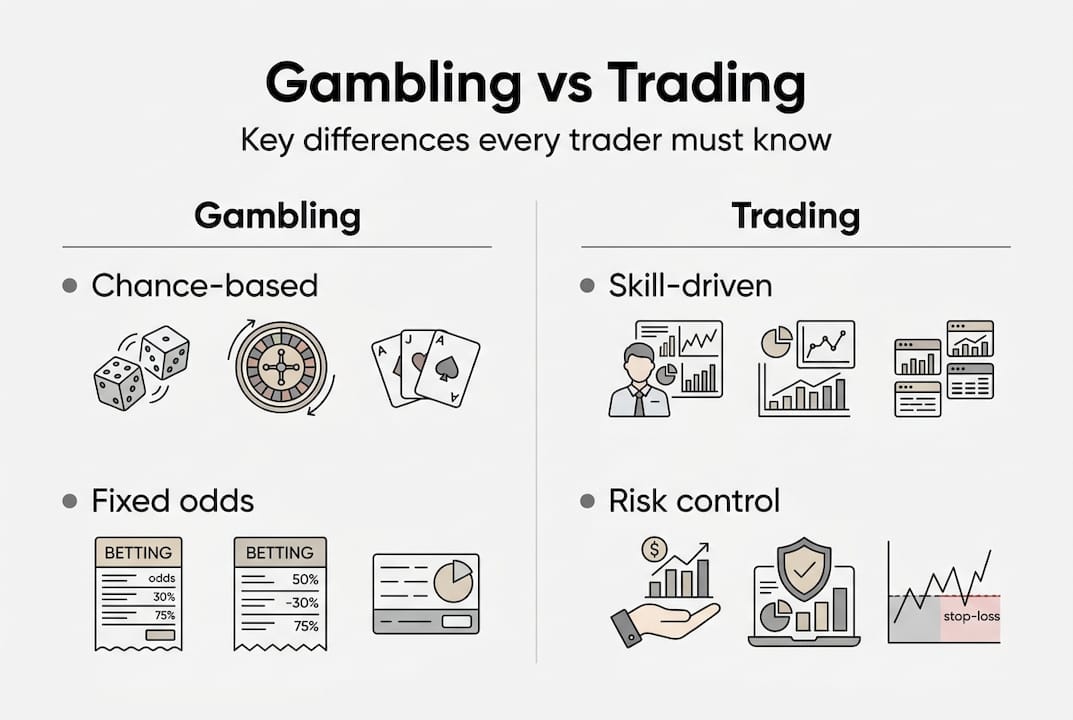
Discipline and skill separate trading from gambling definitively. Without discipline, trading becomes gambling; only verified positive expectancy over many trades ensures an edge. Positive expectancy means average wins exceed average losses over sufficient sample sizes. This mathematical advantage, combined with disciplined execution, produces consistent profits.
| Criteria | Gambling | Disciplined trading |
|---|---|---|
| Expectancy | Negative due to house edge | Positive when edge verified |
| Strategy | None or superstition based | Systematic, tested, and documented |
| Emotional control | Minimal, impulse driven | Strong, rule based execution |
| Analysis | Absent or irrelevant | Technical and fundamental research |
| Risk management | No systematic approach | Stop losses, position sizing, ratios |
| Outcome driver | Chance and luck | Skill, discipline, and edge |
Calculating expectancy requires tracking many trades. The formula multiplies win rate by average win, then subtracts loss rate multiplied by average loss. A trader with 40% win rate, $200 average wins, and $100 average losses has positive expectancy: (0.40 × $200) – (0.60 × $100) = $20 per trade. Over 100 trades, this edge produces $2,000 profit despite losing more often than winning.
Discipline maintains this edge. Traders follow entry and exit rules regardless of emotions or recent outcomes. They avoid revenge trading after losses and don’t overtrade after wins. Position sizing remains consistent, and risk management rules apply universally. This systematic approach removes gambling’s emotional volatility.
Psychological control matters enormously. Fear and greed drive poor decisions in both gambling and undisciplined trading. Professional traders recognize these emotions and override them with predetermined rules. They accept losses without emotional attachment, viewing them as statistical inevitabilities rather than personal failures.
Strategy development involves rigorous testing. Traders backtest ideas on historical data, forward test on demo accounts, and gradually scale live positions. They document everything, creating playbooks for various market conditions. This contrasts sharply with gambling’s reliance on luck, superstition, or hunches.
Understanding trading psychology provides frameworks for maintaining discipline. Exploring advanced trading strategies offers systematic approaches for building verified edges.
Pro Tip: Calculate your expectancy every 30 trades to verify your edge remains positive; if expectancy turns negative, stop trading and reassess your strategy before continuing.
Elements transforming trading from gambling:
- Positive expectancy verified over sufficient sample size
- Systematic strategy tested and documented thoroughly
- Disciplined execution regardless of emotions
- Risk management applied consistently to every trade
- Psychological control overriding fear and greed
- Continuous improvement based on performance data
Discover smart trading tools and resources at Olla Trade
Now that you understand the critical differences between gambling and trading, putting these insights into practice requires the right platform and resources. Olla Trade offers a comprehensive trading ecosystem designed to support disciplined, skill based trading across forex, CFDs, indices, metals, and cryptocurrencies. The platform emphasizes tight spreads, fast execution, and advanced tools like MetaTrader 4 integration, helping you implement the risk management and analytical approaches that separate trading from gambling.
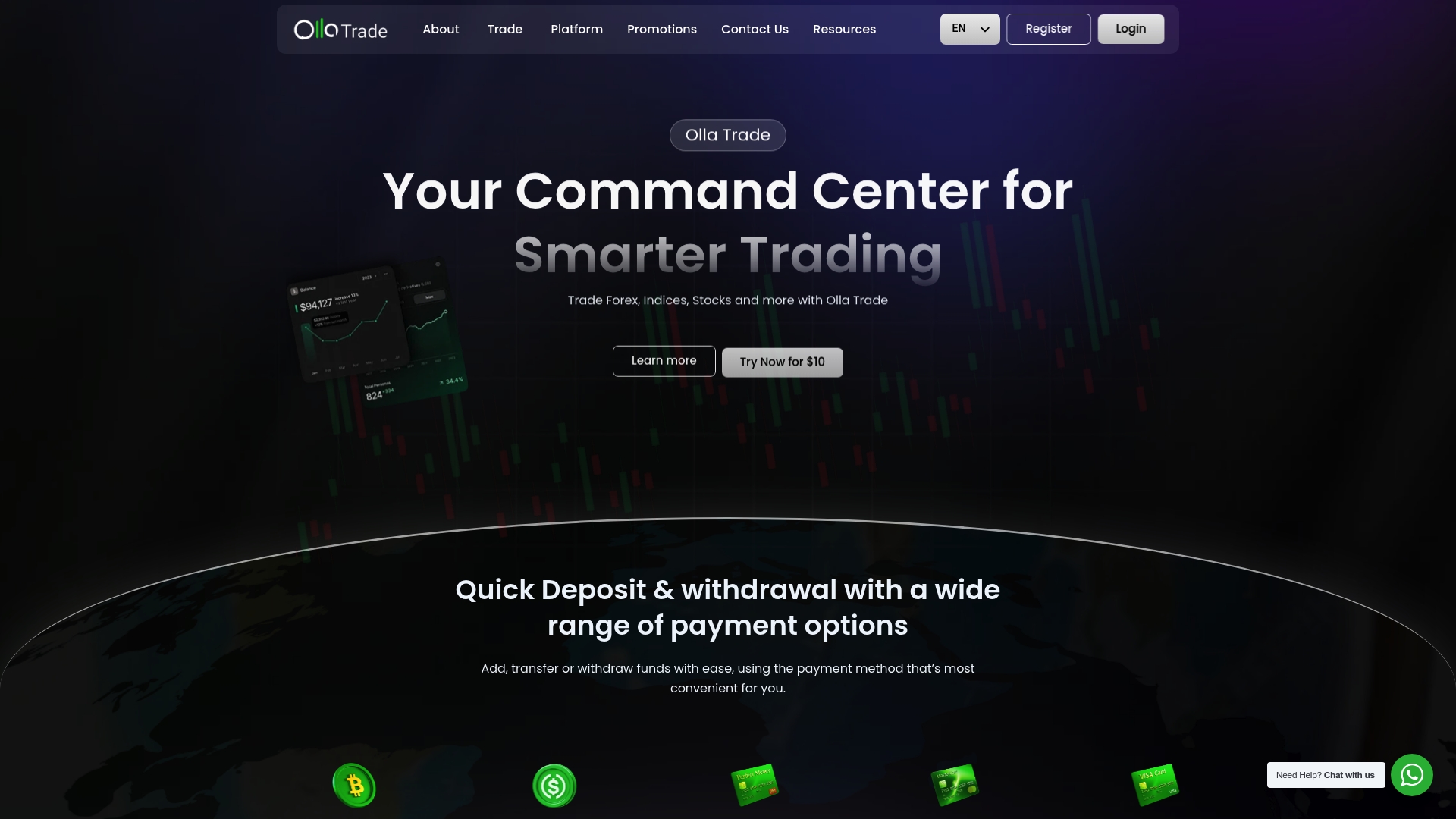
Whether you’re refining your approach to forex trading platform strategies or exploring systematic CFD trading strategies, Olla Trade provides educational guides and market research tools that reinforce the principles discussed in this article. The platform’s focus on trading psychology guide resources helps you maintain the emotional control and discipline necessary for long term success. With multiple account types, robust security, and customer support, Olla Trade creates an environment where you can develop verified edges rather than relying on chance.
Frequently asked questions
What makes trading skill based and gambling chance based?
Trading allows systematic analysis of market data, technical patterns, and fundamental factors to create positive expectancy through disciplined strategy execution. Gambling operates on fixed odds with house edges that ensure long term losses regardless of player decisions. Traders control risk through stop losses and position sizing, while gamblers cannot systematically limit downside exposure.
Can experienced traders still lose money?
Yes, even professional traders experience losing trades and drawdown periods, but their positive expectancy and risk management ensure profitability over sufficient sample sizes. Individual trades carry uncertainty, but systematic approaches with verified edges produce consistent returns across hundreds of trades. The difference lies in overall expectancy, not individual outcomes.
How do trading apps contribute to gambling like behavior?
Apps use gamification features like achievement badges, leaderboards, confetti animations, and push notifications that encourage frequent, impulsive trading divorced from analytical reasoning. These design elements trigger dopamine responses similar to slot machines, reinforcing trading as entertainment rather than disciplined investing. About 3.75% of users develop at risk behaviors resembling problem gambling.
What practical steps help avoid turning trading into gambling?
Implement systematic risk management with stop losses on every trade, limit risk to 1% of account value per position, calculate risk reward ratios before entering, and maintain a trading journal documenting reasoning and emotions. Test strategies thoroughly before live trading, track expectancy over 30 trade samples, and avoid impulsive decisions driven by fear or greed.
How does risk management protect traders?
Risk management caps potential losses through stop loss orders, limits position sizes to preserve capital during losing streaks, and ensures favorable risk reward ratios that produce profits even with sub 50% win rates. By risking 1% per trade with 1:2 risk reward ratios, traders can lose 60% of trades and still profit. This systematic approach prevents the catastrophic losses that destroy gambling accounts. Consult the forex glossary for definitions of key risk management terms.