











สรุปโดยย่อ:
- A risk management workflow is a structured process that helps traders identify, assess, prioritize, and control risks to protect capital effectively. Automating and continuously monitoring this process ensures traders respond promptly to high-priority risks, reducing potential losses and improving resilience. Building layered mitigation strategies and regular reviews sustains risk discipline and supports consistent trading performance.
A risk management workflow is a structured, repeatable process that helps traders and investors identify, assess, prioritize, and control trading risks before they damage capital. The industry standard term for this process is the risk management lifecycle, formalized in frameworks like ISO 31000:2018 and the PMI PMBOK Guide. Every trader needs a working version of this process, whether they trade forex, CFDs, metals, or crypto. Without it, position sizing becomes guesswork, losses compound without warning, and recovery from drawdowns takes far longer than it should. This guide breaks down each stage of the risk management workflow, shows you how to automate and monitor it, and flags the mistakes that quietly undermine even experienced traders.
What are the core steps of a risk management workflow?
เดอะ ISO 31000:2018 lifecycle defines the standard stages as: identify, categorize, assess likelihood and impact, decide on treatment, implement controls, monitor, and report. That sequence is not arbitrary. Each step feeds the next, and skipping one creates blind spots that compound over time.
Step 1: Identify risks
Risk identification means listing every threat that could affect your trading capital or execution. For traders, that includes market volatility, leverage exposure, liquidity gaps, platform outages, and behavioral risks like overtrading after a loss. Write them down. A risk you have not named is a risk you cannot control.

Step 2: Assess and score each risk
Quantitative assessment assigns each risk a score based on two factors: likelihood (how probable is this event?) and impact (how much capital or performance would it cost?). A simple 1–10 scale on each factor gives you a combined risk score. A risk scoring 9 on impact and 7 on likelihood demands immediate attention. A risk scoring 2 on both can sit lower on your list.
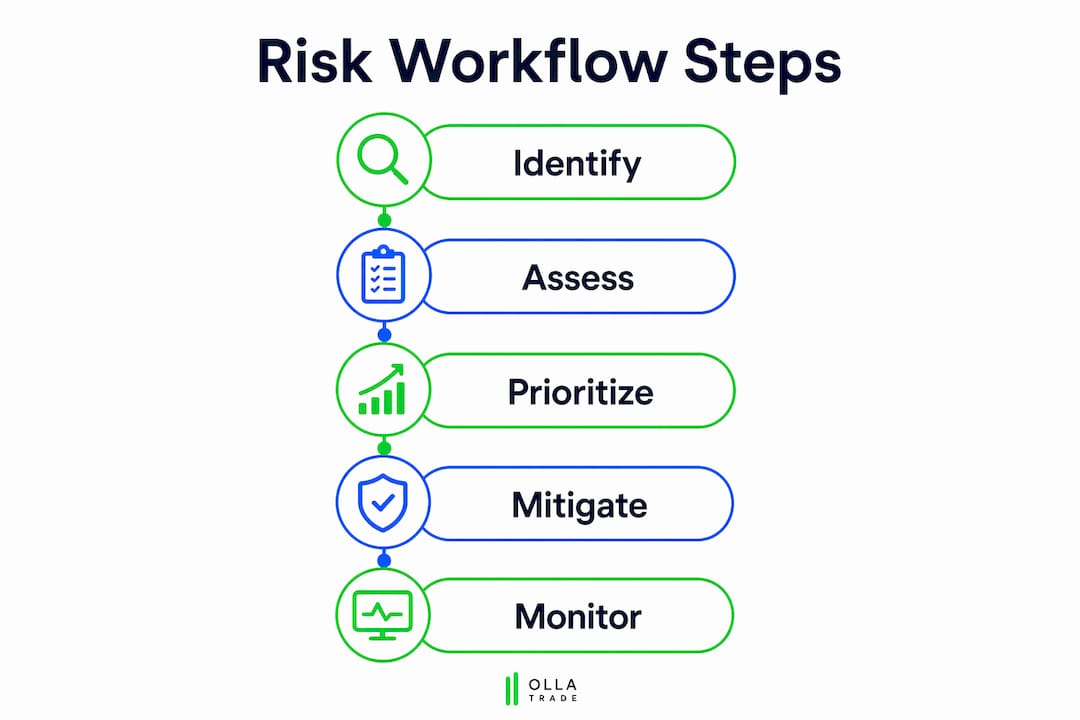
Step 3: Prioritize using a risk matrix
A risk matrix plots likelihood against impact on a grid. Risks in the top right quadrant (high likelihood, high impact) get treated first. This step stops traders from spending time on minor risks while ignoring the ones that can wipe out a week of gains.
| Workflow step | Trading example | Action required |
|---|---|---|
| Identify | Overnight gap risk on EUR/USD | Log in risk register |
| Assess | Score: likelihood 7, impact 8 | Priority: high |
| Prioritize | Top-right quadrant on matrix | Treat immediately |
| Mitigate | Set stop-loss, reduce position size | Implement before entry |
| Monitor | Track drawdown daily via dashboard | Review weekly |
| ทบทวน | Quarterly plan update | Refine based on outcomes |
Step 4: Plan and implement controls
Mitigation planning means deciding what you will do about each identified risk before it materializes. For a high-scoring risk, that means a written plan with a named owner, a deadline, and a defined action. Visual risk workflows reduce missed threats and duplicated effort by mapping each step with clear escalation points.
เคล็ดลับสำหรับมืออาชีพ: Build your risk register as a living document, not a one-time spreadsheet. Update it after every significant trade or market event.
How can traders optimize their workflow with automation and escalation rules?
Automation turns a good risk process into a consistent one. Manual workflows break down under pressure. When markets move fast, traders skip steps, miss alerts, and make decisions without checking their own rules. Automated workflows remove that failure point.
Standardized workflows include automated escalation that requires a response to high-priority risks within 30 days for risks scoring above 8 on a 1–10 scale. That kind of rule forces action before a manageable risk becomes a crisis.
Key automation features to build into your process:
- Automatic risk scoring: Set rules that calculate a risk score the moment a new position or market condition is logged.
- Routing to owners: Assign each risk category to a specific decision maker. In solo trading, that is you, but the rule still creates accountability.
- Deadline enforcement: Flag any high-priority risk that has not been addressed within your defined window.
- KRI traffic-light alerts: Key Risk Indicators with Green, Amber, and Red thresholds trigger predefined corrective actions before a risk fully materializes.
Automated workflows integrated into daily tools improve consistency and reduce the chance of missed escalation steps. Platforms that connect your trading activity to a risk dashboard give you real-time visibility without manual data entry.
เคล็ดลับสำหรับมืออาชีพ: Codify your decision logic in writing. “If drawdown exceeds 5% in a single session, reduce position size by half” is a rule. “Be careful when losing” is not.
What are effective mitigation strategies traders should include?
Mitigation does not eliminate risk. True mitigation reduces the impact or likelihood of a risk to an acceptable residual level. That distinction matters because traders who believe a stop-loss eliminates risk often ignore what happens after the stop is hit.
Layering multiple mitigation strategies reduces operational disruption and improves resilience. No single tactic covers every scenario. The goal is to build overlapping defenses so that when one layer fails, another catches the loss.
Core mitigation tactics for traders
- Position sizing: Limit each trade to a fixed percentage of total capital. A common rule is risking no more than 1–2% of account equity per trade.
- Stop-loss orders: Define your maximum acceptable loss before entering a position. Place the stop at a level that reflects market structure, not just a round number.
- Diversification: Spread exposure across uncorrelated instruments. A portfolio heavy in a single currency pair or sector amplifies drawdown during targeted market moves.
- Risk transfer: For traders running larger accounts, instruments like options or hedging strategies transfer some downside to a counterparty.
- Education and training: Behavioral risk is real. Traders who understand cognitive biases like loss aversion and overconfidence make fewer impulsive decisions.
- Contingency plans: Define in advance what you will do if your platform goes offline, your broker has a margin call, or a major news event gaps the market past your stop.
เคล็ดลับสำหรับมืออาชีพ: Review your layered mitigation approach after every significant drawdown. Stress-test each layer against the scenario that just happened.
Mitigation plans without monitoring are ineffective. Projects that name owners, track KRIs, and monitor residual risk consistently outperform those that treat mitigation as a one-time setup task.
How should traders monitor and review risks continuously?
Continuous monitoring is the step most traders skip. Setting a stop-loss and walking away is not a monitoring process. Markets change, correlations shift, and risks that scored low last month can score high today.
Key Risk Indicators are the foundation of any monitoring system. A KRI is a measurable signal that a risk is trending toward materialization. For traders, KRIs include daily drawdown percentage, win/loss ratio over a rolling 20-trade window, average slippage per trade, and overnight exposure as a percentage of account equity.
Setting up a continuous monitoring routine:
- Define your KRIs. Choose 3–5 metrics that directly signal risk in your trading style. Fewer is better. Too many indicators create noise.
- Set thresholds. Assign Green, Amber, and Red levels to each KRI. Green means normal. Amber means review. Red means stop and reassess.
- Build a dashboard. Use your trading platform’s reporting tools or a simple spreadsheet to track KRIs daily. Visibility is the point.
- Schedule reviews. Quarterly reviews for high-velocity risks and annual reviews for broader plans keep your process current. For active traders, weekly reviews of high-priority risks are more appropriate.
- Run after-action analyses. After any significant loss or unexpected event, document what happened, why your mitigation did or did not work, and what you will change.
เคล็ดลับสำหรับมืออาชีพ: Treat your weekly review as a non-negotiable trading session. Block the time, follow the same checklist every time, and record your findings. Consistency here compounds over months.
Monitoring tools with traffic-light alerts automate early detection and route issues to the right decision maker before they escalate. For solo traders, that means your dashboard tells you when to act, not your gut.
What are common pitfalls when implementing a risk management workflow?
Most traders do not fail at identifying risks. They fail at sustaining the process after the first few weeks. These are the mistakes that quietly erode risk discipline over time.
- Confusing mitigation with elimination. A stop-loss reduces your loss on a single trade. It does not eliminate the risk of a losing streak, a platform outage, or a gap open. Failing to track residual risk leads to prematurely closing monitoring on threats that are still active.
- No named owner or deadline. Every mitigation action needs a responsible party and a completion date. Without both, the action stays on the list indefinitely.
- Treating risk management as a compliance task. Organizations that build repeatable, auditable workflows shift from reactive firefighting to proactive prevention. Traders who review their risk register only after a bad month are always one step behind.
- Relying on inconsistent manual processes. If your risk process depends on remembering to check something, it will fail during high-stress trading sessions. Automate the reminders, the scoring, and the escalation.
- Ignoring behavioral risks. Overtrading, revenge trading, and position sizing based on emotion are risks too. They belong in your register alongside market and operational risks.
เคล็ดลับสำหรับมืออาชีพ: Build your trading risk workflow so that a stranger could follow it without asking you a single question. If it requires your memory to function, it is not a workflow. It is a habit, and habits break.
ประเด็นสำคัญ
A structured risk management workflow is the single most reliable way to protect trading capital and maintain consistent decision-making across all market conditions.
| จุด | รายละเอียด |
|---|---|
| Follow the ISO 31000 lifecycle | Identify, assess, treat, monitor, and report risks in sequence for consistent results. |
| Score and prioritize every risk | Use a 1–10 likelihood and impact scale to focus effort on the threats that matter most. |
| Layer your mitigation tactics | Combine stop-losses, position sizing, diversification, and contingency plans for stronger protection. |
| Automate escalation rules | Set explicit thresholds so high-priority risks trigger a response within a defined deadline. |
| Monitor with KRIs continuously | Track 3–5 key indicators weekly and run after-action reviews after every significant loss. |
Why most traders get risk management backwards
The standard advice tells traders to set a stop-loss and move on. That is not a risk management process. It is a single tactic applied once, with no monitoring, no review, and no feedback loop. I have seen traders with detailed entry strategies and zero exit discipline lose accounts they spent years building.
The shift that actually changes outcomes is moving from reactive to proactive. Reactive traders adjust their risk rules after a painful loss. Proactive traders define their rules before entering the market and review them on a fixed schedule regardless of recent performance. The difference is not intelligence. It is structure.
What I find most underrated in trading risk management is the behavioral layer. Market risk gets all the attention. But the risk of overtrading after a winning streak, or cutting winners short because of anxiety, is just as real and far harder to quantify. A good workflow names those risks explicitly and assigns them the same treatment as any market risk.
The traders who sustain performance over years are not the ones who avoid losses. They are the ones who know exactly what they will do when a loss happens, because they planned for it in advance. That is what a well-built risk process gives you. Not certainty. Preparation.
— เอฟเอ็กซ์
Ollatrade’s tools for building your risk process
Traders who want to put this framework into practice need more than theory. They need real-time data, reliable execution, and educational resources that connect risk concepts to live market conditions.
Ollatrade provides traders with access to forex, CFDs, metals, indices, and crypto markets through a platform built for both beginners and experienced traders. The คู่มือการซื้อขายฟอเร็กซ์ทีละขั้นตอน covers risk management as an integrated part of the trading process, not an afterthought. Ollatrade’s แนวทางกลยุทธ์การบริหารความเสี่ยง gives traders a structured starting point for building their own process. With MetaTrader 4 integration, real-time charting, and an ปฏิทินเศรษฐกิจ for tracking market-moving events, Ollatrade puts the tools for proactive risk control directly in your hands.
คำถามที่พบบ่อย
What is a risk management workflow in trading?
A risk management workflow is a structured process for identifying, assessing, mitigating, and monitoring trading risks. It follows the ISO 31000 lifecycle and turns abstract risk awareness into concrete, repeatable actions.
How do I prioritize risks in my trading process?
Score each risk on a 1–10 scale for both likelihood and impact, then plot them on a risk matrix. Risks with high scores on both dimensions get treated first.
What are Key Risk Indicators for traders?
Key Risk Indicators are measurable signals that a risk is trending toward materialization. Common trading KRIs include daily drawdown percentage, rolling win/loss ratio, and overnight exposure as a share of account equity.
How often should I review my risk management plan?
Active traders should review high-priority risks weekly. Broader risk plans benefit from quarterly reviews, with a full annual review to update assumptions and mitigation strategies.
What is the difference between risk mitigation and risk elimination?
Mitigation reduces the impact or likelihood of a risk to an acceptable residual level. Elimination removes the risk entirely, which is rarely possible in trading. Treating mitigation as elimination leads to ignoring residual risks that remain active.