






TL;DR:
- Forex trades reach $9.6 trillion daily, vastly exceeding other markets and reflecting high liquidity.
- Major players include large banks, hedge funds, corporations, and growing retail traders influencing short-term moves.
- The US dollar dominates with 89% of trades, serving as the global reserve currency and key settlement medium.
The forex market is the largest financial market on the planet, yet most traders only see a fraction of what drives it. Daily turnover hit $9.6 trillion in April 2025, a number so large it dwarfs every stock exchange, bond market, and commodity exchange combined. Many retail traders assume forex is a playground reserved for central banks and hedge funds, with little room for individual participants. That assumption is both wrong and costly. Understanding the true scale of this market, where volume comes from, who controls it, and where it flows, gives you a sharper edge in every trade you place.
Table of Contents
- Forex in numbers: Understanding the true scale
- What makes up the forex market’s activity?
- Who actually moves forex: The main players
- Global hubs: Where does forex really flow?
- Currency dominance: The US dollar and beyond
- A trader’s reality: Why size isn’t everything in forex
- Ready to take advantage of forex’s scale?
- Frequently asked questions
Key Takeaways
| Point | Details |
|---|---|
| Staggering market size | The forex market turns over around $9.6 trillion every day, far surpassing other financial markets. |
| Complex trading instruments | Swaps, forwards, and spot trades each play major roles in driving forex volumes. |
| Institutional dominance | Large banks and financial institutions account for the vast majority of forex trading, with retail traders making up a small slice. |
| Regional and currency concentration | Most trading is concentrated in top hubs like London and the US, and the US dollar remains the most traded currency. |
Forex in numbers: Understanding the true scale
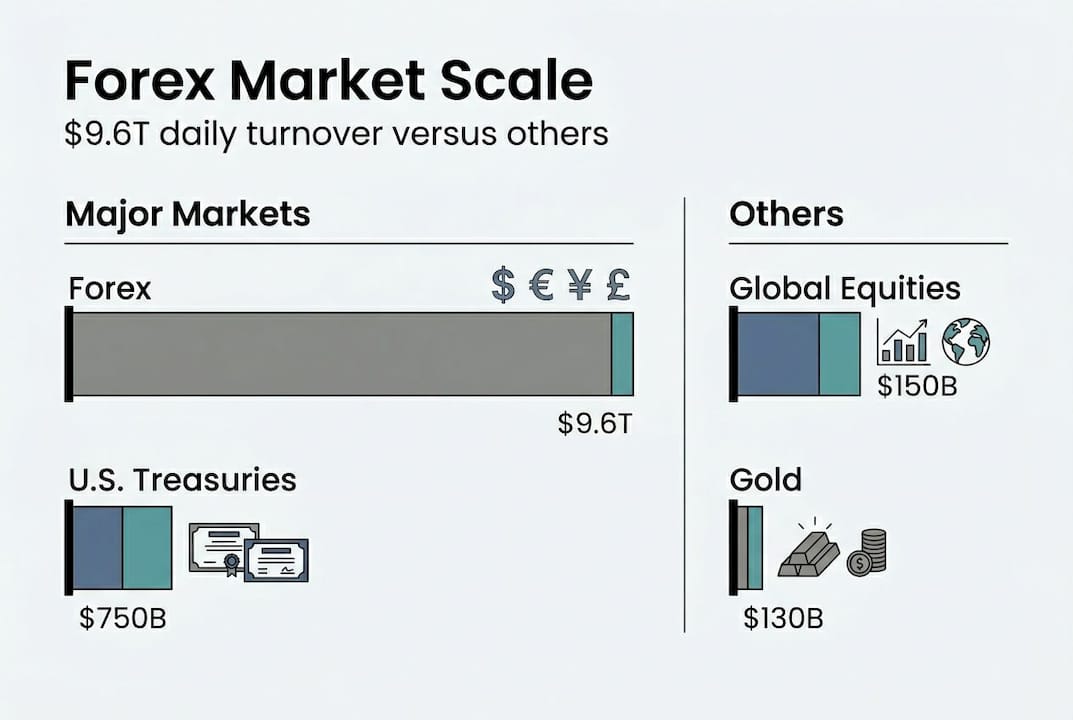
When you hear that daily forex volumes are measured in trillions, it is easy to let that figure wash over you without really registering what it means. Let’s put it in context. Global annual GDP for the entire world is roughly $110 trillion. Forex turns over that amount in less than two weeks. In fact, volumes are about 30 times the daily equivalent of global GDP, making forex unlike any other market in existence.
The growth trajectory is equally striking. Turnover has expanded dramatically over the past decade, fueled by electronic trading, greater participation from emerging market institutions, and the rise of algorithmic strategies. This growth tells you the market is becoming more accessible and more competitive simultaneously.
| Market | Daily / Annual Volume |
|---|---|
| Forex | $9.6 trillion/day |
| Global equities | ~$600 billion/day |
| US Treasury bonds | ~$900 billion/day |
| Global goods trade | ~$65 trillion/year |
The gap between forex and every other market is not close. The nearest competitor, US Treasuries, handles less than 10% of what forex processes daily.
Why does this matter beyond bragging rights? For traders, volume translates directly into liquidity. High liquidity means tighter bid-ask spreads, faster execution, and less slippage on your orders. It also means it is nearly impossible for any single participant to manipulate major currency pairs, which is a structural protection you simply do not get in smaller markets.
Understanding what is Forex at this scale also reframes risk. A market this large absorbs shocks differently than equities. Currency pairs can move sharply on news, but the depth of the market generally prevents the kind of total illiquidity that can freeze stock trading during a crisis. Monitoring trading volume patterns in forex gives you real-time signals about market sentiment and momentum that no other data source can match.
- Forex turnover grew from $6.6 trillion in 2019 to $9.6 trillion in 2025
- The market operates 24 hours a day, five days a week across global time zones
- Even a 0.1% move in a major pair can represent billions of dollars in value
What makes up the forex market’s activity?
Most people picture forex as two parties swapping currencies. The reality is far more structured. The market is segmented into distinct instrument types, each serving different purposes for different participants.
FX swaps dominate at $4 trillion daily, representing 41% of total turnover. Spot transactions follow at roughly $3 trillion (31%), and outright forwards account for about $1.8 trillion (19%). Options and other instruments make up the remainder.
| Instrument | Daily Volume | Share of Total |
|---|---|---|
| FX swaps | $4.0 trillion | 41% |
| Spot | $3.0 trillion | 31% |
| Outright forwards | $1.8 trillion | 19% |
| Options and other | ~$0.8 trillion | 9% |
Swaps dominate because they serve a critical function beyond speculation. Banks and corporations use them to manage short-term funding needs and hedge currency exposure across different settlement dates. A European company receiving USD payments next month might enter a swap to lock in a conversion rate today while maintaining flexibility. This is pure risk management, not speculation.
Here is how three different participants interact across these segments:
- A major bank uses FX swaps daily to manage its balance sheet, rolling over positions and funding foreign currency loans without taking outright directional risk.
- A hedge fund trades spot and forwards to express views on interest rate differentials or macroeconomic trends, often holding positions for days or weeks.
- A retail trader primarily operates in the spot market, using leverage to take short-term positions on currency pair movements based on technical or fundamental analysis.
Understanding swaps in forex is especially important if you hold positions overnight, since swap rates directly affect your cost of carry and can either add to or subtract from your returns.
Pro Tip: The spot market gets the most attention, but the swap and forward markets often signal where institutional money is positioning. Watching forward premiums and discounts can give you an early read on currency direction.
Who actually moves forex: The main players
Forex is not a level playing field, and knowing who sits at each tier of the market helps you trade more realistically. The Bank for International Settlements breaks participants into clear categories.
Reporting dealers account for 46% of global turnover. These are the largest banks, the ones with direct access to the interbank market. Other financial institutions, including non-reporting banks (23%), hedge funds, and proprietary trading firms, collectively handle 50% of volume. Nonfinancial customers, a category that includes retail traders, account for roughly 4%.
Here is what each group actually does in the market:
- Reporting dealers (major banks): Set interbank prices, provide liquidity to all other participants, and manage enormous currency inventories across global operations
- Non-reporting banks: Regional and mid-tier banks that access liquidity through dealers and serve corporate clients
- Hedge funds and prop traders: Drive directional volume through macro strategies, carry trades, and algorithmic execution
- Corporations: Buy and sell currencies to fund international operations, pay suppliers, and repatriate profits
- Retail traders: Access the market through brokers, trade smaller sizes, and increasingly influence short-term sentiment in liquid pairs
Retail traders represent only 4% of forex volume, but they are growing faster than any other segment. Platforms, technology, and education have lowered the barriers significantly, and retail flow increasingly influences intraday price behavior in major pairs.
If you want to compete effectively, investing in professional trading education and mastering forex basics before scaling up is not optional. It is the difference between informed participation and expensive guesswork.
Global hubs: Where does forex really flow?
Forex is a global market, but trading is not evenly distributed around the world. A handful of financial centers handle the overwhelming majority of volume, and understanding where activity concentrates helps you time your trades more effectively.

| Financial center | Share of global turnover |
|---|---|
| United Kingdom (London) | 38% |
| United States (New York) | 19% |
| Singapore | 12% |
| Hong Kong | 7% |
| Other centers | 24% |
UK leads with 38% of global turnover, a position London has held for decades. Its dominance comes from geography, time zone overlap with both Asian and American sessions, deep financial infrastructure, and a concentration of global bank headquarters and trading desks. When London opens, liquidity surges. When London and New York overlap, roughly 8 AM to 12 PM Eastern time, you get the deepest, most liquid conditions of the trading day.
Singapore and Hong Kong together handle nearly a fifth of global volume, reflecting Asia’s growing weight in global finance and the importance of CNY-related flows. Regional specializations matter too. Asian centers see heavier activity in JPY and AUD pairs, while London dominates EUR and GBP flows.
For traders, the forex trading advantages of timing your activity around peak liquidity windows are concrete and measurable. You can learn more about forex session timing and how it affects spreads and volatility.
Pro Tip: Spreads on major pairs like EUR/USD can be two to three times wider during off-peak hours compared to the London/New York overlap. If you are trading short-term, session timing is as important as your entry signal.
Currency dominance: The US dollar and beyond
Not all currencies are equal in forex. A small group of currencies drives the vast majority of global trading activity, and one currency sits at the center of nearly every transaction.
The US dollar appears in 89% of trades, the euro in 28.9%, and the Japanese yen in 16.8%. Because currencies always trade in pairs, these percentages add up to 200%, but the concentration is still remarkable. Remove the dollar from forex and the market would function very differently.
Why does the dollar hold this position?
- Reserve currency status: Central banks worldwide hold USD as their primary foreign reserve asset
- Oil and commodity pricing: Most global commodities are priced and settled in dollars, creating constant demand
- Cross-border settlement: International trade and debt contracts default to USD, especially in emerging markets
- Deep liquidity: Dollar pairs have the tightest spreads and deepest order books of any currency
- US financial market size: The scale of US equity and bond markets creates constant currency conversion needs globally
The landscape is slowly shifting. The Chinese yuan’s share of global forex turnover has grown, and central banks are gradually diversifying reserves. But the dollar’s structural role in global trade, debt, and settlement means any meaningful displacement is a multi-decade story, not a near-term event.
For traders, this concentration is actually useful. Focusing on dollar-denominated pairs gives you access to the most liquid, most researched, and most efficiently priced markets in the world.
A trader’s reality: Why size isn’t everything in forex
Here is the part most market overviews skip. The numbers are staggering, but size alone does not protect you. We have seen traders assume that a $9.6 trillion market is somehow inherently safe because it is so large. That thinking leads to real losses.
Liquidity in forex is not uniform. It clusters around major pairs, peak sessions, and normal market conditions. During major data releases or geopolitical shocks, even EUR/USD can gap sharply, and off-exchange retail brokers may widen spreads dramatically. Flash crashes, like the CHF spike in 2015 or the GBP flash crash in 2016, showed that even the most liquid markets can move violently in seconds.
The best traders we observe do not chase the biggest markets. They understand their specific instruments, know when liquidity is thin, and build processes around those realities. Following smarter forex trading tips means respecting the market’s complexity rather than being seduced by its scale.
Size gives you opportunity. Process gives you results.
Ready to take advantage of forex’s scale?
Knowing the structure and scale of the forex market is the foundation. The next step is applying that knowledge in a real trading environment with the right tools behind you.
At Olla Trade, you can discover forex trading across major, minor, and exotic pairs with tight spreads and fast execution. Whether you are just getting started or refining an existing approach, our step-by-step trading guide walks you through the practical mechanics of entering and managing trades. For a broader foundation, the complete forex guide covers everything from market structure to risk management in one place. The market is open. Your edge starts with understanding it.
Frequently asked questions
Why is the forex market so much bigger than other financial markets?
Forex volume is driven primarily by financial hedging and speculation rather than actual trade or investment needs, which is why volumes are about 30 times the daily equivalent of global GDP. The constant need to manage currency risk across global banking, corporate, and investment activity creates relentless demand for FX transactions.
How much of forex trading is done by retail investors?
Nonfinancial customers including retail account for roughly 4% of global forex turnover, with the overwhelming majority of activity controlled by banks, hedge funds, and other financial institutions. Retail participation is growing, but institutional flow still sets the dominant price direction.
Which city handles the most forex trading?
London handles more forex volume than any other city, accounting for 38% of global turnover thanks to its time zone position, deep financial infrastructure, and concentration of global bank trading desks.
Why is the US dollar in nearly every forex trade?
The dollar’s role as the world’s primary reserve currency, commodity pricing unit, and cross-border settlement currency means it appears on one side of 89% of trades. Its structural position in global finance makes it the default intermediary for converting between almost any two other currencies.