












সংক্ষেপে:
- Lot size is the standardized unit quantity of a financial instrument traded in a single transaction, directly controlling trading risk. Understanding and calculating the appropriate lot size using account equity, risk percentage, stop loss, and pip value is essential for responsible trading. Standardized lot sizes ensure market liquidity and price consistency across global markets, making precise lot management vital for survival.
Lot size is defined as the standardized quantity of a financial instrument traded in a single transaction, and it is the primary variable traders use to control risk on every position. Whether you trade forex on MetaTrader 4, CFDs on indices, or futures contracts, every order you place is measured in lots. Standard, mini, micro, and nano lots each represent different unit quantities, different pip values, and different levels of risk exposure. Understanding lot size is not optional for serious traders. It is the foundation of every position sizing decision you make.
What is lot size in forex and other markets?
Lot size in trading refers to the fixed unit of measurement that defines how many units of a base currency or financial instrument you buy or sell in one trade. The term comes from the broader financial world, where standardized contract sizes have long been used to create orderly, liquid markets across exchanges.
In forex, a standard lot equals 100,000 units of the base currency. That means one standard lot of EUR/USD represents 100,000 euros. This scale is designed for institutional traders and professionals who need to move large positions efficiently. For retail traders, smaller lot categories exist to make the market accessible at any account size.
The four main lot categories are:
- Standard lot: 100,000 units of the base currency
- Mini lot: 10,000 units
- Micro lot: 1,000 units
- Nano lot: 100 units
Each step down reduces your exposure by a factor of ten. A nano lot on EUR/USD means you are trading 100 euros per transaction, which makes it practical for beginners testing strategies with real money.
| লটের ধরন | ইউনিট | Typical trader profile |
|---|---|---|
| স্ট্যান্ডার্ড | 100,000 | প্রাতিষ্ঠানিক, পেশাদার |
| ক্ষুদ্র | 10,000 | Intermediate retail trader |
| মাইক্রো | 1,000 | Beginner or low-capital trader |
| ন্যানো | 100 | New trader, strategy testing |
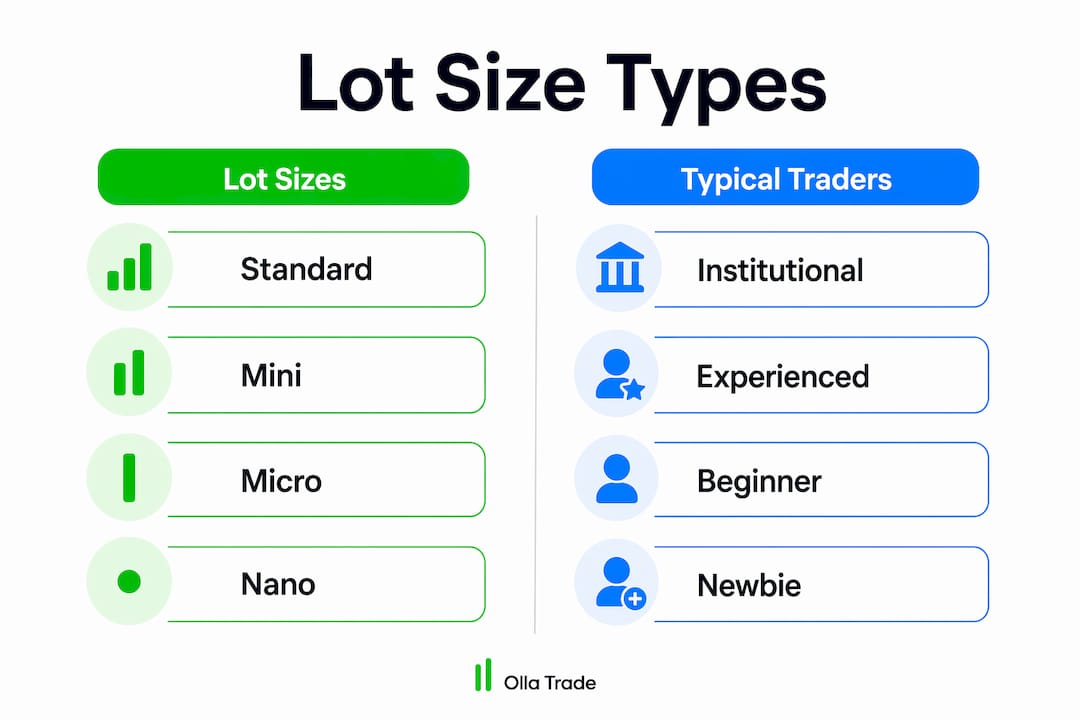
Smaller lot sizes allow beginners to limit risk while gaining real-market experience. This is not just a convenience feature. It is a structural advantage that lets you build skill without catastrophic drawdowns.
প্রো টিপ: If you are opening your first live account, start with micro lots. The psychological experience of real money trades is valuable, and micro lots keep your maximum loss per trade in single digits while you develop consistency.
How lot size impacts pip value and trading risk
The relationship between lot size and pip value is direct and linear. Pip value scales with lot size: a standard lot generates $10 per pip on major USD pairs, a mini lot generates $1 per pip, and a micro lot generates $0.10 per pip. This scaling is what makes lot size the most precise tool you have for controlling how much money moves with each pip of price action.

To understand the impact, consider a 50-pip stop loss on EUR/USD:
| Lot size | Pip value | Risk on 50-pip stop |
|---|---|---|
| Standard (1.0) | $10/pip | $500 |
| Mini (0.1) | $1/pip | $50 |
| Micro (0.01) | $0.10/pip | $5 |
The numbers make the point clearly. One standard lot with a 50-pip stop puts $500 at risk. The same trade with a micro lot risks $5. The market setup is identical. The only variable is the lot size you chose.
This linear relationship also means that doubling your lot size doubles your risk and doubles your potential profit. There is no complexity here, just arithmetic. The problem is that many traders treat lot size as an afterthought rather than a calculated decision, which is where accounts get damaged.
To understand pip value more deeply and how it connects to your overall trade math, the Ollatrade guide on forex pips explained is worth reading before you size any position.
প্রো টিপ: Always calculate your pip value before entering a trade, not after. On cross pairs like GBP/JPY, pip values differ from USD pairs, and the difference can be significant enough to throw off your risk calculation entirely.
How to determine the right lot size for your account
Calculating lot size correctly is a mathematical process, not a judgment call. The standard position sizing formula is:
Lot size = (Equity × Risk %) / (Stop Loss in Pips × Pip Value per Lot)
Each component of this formula has a specific role:
- Equity: Your current account balance or free margin, not your total deposited capital if you have open positions.
- Risk %: The percentage of equity you are willing to lose on this single trade. Most professional traders cap this at 1% to 2%.
- Stop loss in pips: The distance from your entry to your stop loss level, measured in pips.
- Pip value per lot: The dollar value of one pip for the lot size you are calculating, which varies by currency pair and lot type.
Here is a worked example. You have a $10,000 account. You risk 1% per trade, giving you a $100 risk budget. Your stop loss is 50 pips on EUR/USD, where one standard lot pip value is $10.
Lot size = $100 / (50 × $10) = $100 / $500 = 0.2 lots
You would trade 0.2 lots, which is two mini lots. That is the mathematically correct answer for that account, that risk tolerance, and that trade setup.
Traders who guess lot sizes instead of calculating them risk large losses or margin calls. This is one of the most common and most preventable mistakes in retail trading. The formula takes thirty seconds to apply and removes the single biggest source of uncontrolled risk from your trading.
Common mistakes to avoid when sizing positions:
- Choosing a round lot number (0.5 or 1.0) without checking if it fits your risk budget
- Ignoring stop loss distance and treating all trades as equal risk
- Increasing lot size after a winning streak without adjusting for account equity changes
- Confusing leverage with lot size, treating them as the same control mechanism
Leverage and lot size are related but distinct. Leverage is the borrowing capacity your broker provides. Lot size is the active decision you make about how much of that capacity to deploy. You control effective risk through lot size, not through leverage settings alone.
For a deeper walkthrough of the full position sizing process, the Ollatrade guide on position sizing in trading covers the formula, edge cases, and practical applications in detail.
প্রো টিপ: Build a simple spreadsheet or use a position size calculator before every trade. Input your equity, risk percentage, stop distance, and pair. Let the math tell you the lot size. Remove the temptation to override the calculation based on conviction about a trade.
Why standardized lot sizes matter for market liquidity
Fixed lot sizes are not arbitrary conventions. Lot size standardization ensures liquidity, consistent pricing, and efficient trade execution across global markets. Without standardized contract sizes, buyers and sellers would need to negotiate quantities on every transaction, which would fragment liquidity and widen spreads dramatically.
“Lot size standardization is essential for market smoothness and avoiding fragmentation that would hinder retail traders.” — Religare Broking
In forex, where the daily trading scale reaches $9.6 trillion, standardized lot sizes allow market makers to quote tight spreads because they know exactly what quantity each order represents. This predictability is what makes one-pip spreads on EUR/USD possible for retail traders. Without it, pricing would be inconsistent and execution would slow down.
The same principle applies across asset classes. In futures markets, contracts are standardized by exchange rules. In stock markets, a round lot is typically 100 shares, though fractional trading has introduced flexibility at the retail level. In forex, the lot system is the mechanism that connects retail order flow to the institutional liquidity pools that price the market. বাজারের তারল্য depends on this structure functioning correctly, and lot size is a core part of that structure.
Across CFDs on metals, indices, and energies, lot sizes also vary by instrument. Gold CFDs are typically quoted in troy ounces per lot, while index CFDs use contract multipliers. The underlying principle is the same: a fixed quantity per lot creates the pricing consistency that makes tight execution possible.
কী গ্রহণযোগ্যতা
Lot size is the single most controllable variable in your trading risk, and every position you open should be sized using the formula: Equity × Risk % divided by Stop Loss Pips × Pip Value.
| বিন্দু | বিস্তারিত |
|---|---|
| Lot size definition | A lot is the standardized unit quantity of a financial instrument traded in one transaction. |
| Four lot categories | Standard (100,000), mini (10,000), micro (1,000), and nano (100) units scale risk linearly. |
| Pip value connection | A standard lot generates $10 per pip on major USD pairs; micro lots generate $0.10 per pip. |
| Position sizing formula | Use Equity × Risk % divided by Stop Loss Pips × Pip Value to calculate every lot size. |
| Market liquidity role | Standardized lot sizes create the pricing consistency and liquidity that tight spreads depend on. |
The variable most traders underestimate
Most traders spend hours analyzing charts and minutes deciding lot size. That ratio is backwards. After years of watching how traders blow accounts, the pattern is almost never bad analysis. It is correct analysis paired with a lot size that makes a normal losing trade catastrophic.
The insight that changed how I think about this: lot size is your effective leverage control, not the leverage ratio your broker offers. A 1:500 leverage account trading 0.01 lots is far less risky than a 1:50 account trading 1.0 lots. The broker setting is a ceiling. The lot size is the floor you actually stand on.
Margin shocks happen when traders size up during a hot streak and then hit a volatile session. A 100-pip adverse move that would have cost $10 on a micro lot costs $1,000 on a standard lot. The trade setup was identical. The account damage was not. Discipline in lot sizing is what separates traders who survive drawdowns from those who do not.
My honest advice: treat the position sizing formula as non-negotiable. Calculate it before every trade. If the math says 0.03 lots and your gut says 0.2, trust the math. The market does not reward conviction. It rewards survival.
— এফএক্স
Ollatrade-এ সঠিক টুলস ব্যবহার করে ট্রেডিং শুরু করুন।
Understanding lot size is the first step. Applying it in a live trading environment with the right platform is where it becomes real.
Ollatrade gives retail and professional traders access to forex, CFDs on metals, indices, energies, and cryptocurrencies through MetaTrader 4 integration with tight spreads and fast execution. The platform supports all lot sizes from nano to standard, so you can apply your position sizing formula precisely regardless of account size. Whether you are calibrating micro lot trades as a new trader or executing standard lot positions as a professional, Ollatrade’s ফরেক্স ট্রেডিং প্ল্যাটফর্ম is built to support disciplined, calculated trading at every level.
প্রায়শই জিজ্ঞাসিত প্রশ্নাবলী
What is the standard lot size in forex?
A standard lot equals 100,000 units of the base currency in forex trading. It is the default contract size used by institutional traders and professionals executing large positions.
How do I calculate the correct lot size for a trade?
Use the formula: Lot size = (Equity × Risk %) divided by (Stop Loss in Pips × Pip Value per Lot). This calculation ensures your position size matches your risk budget for every trade.
What lot size should a beginner trader use?
Beginners should start with micro lots (0.01), which represent 1,000 units and generate $0.10 per pip on major USD pairs. This keeps maximum losses small while providing real-market trading experience.
Does lot size affect pip value?
Pip value scales directly with lot size. A standard lot produces $10 per pip, a mini lot produces $1 per pip, and a micro lot produces $0.10 per pip on major USD currency pairs.
What is the difference between lot size and leverage?
Leverage is the borrowing capacity your broker provides. Lot size is the active decision you make about how much of a position to take. You control your actual risk through lot size selection, not through your broker’s leverage setting alone.