












TL;DR:
- A margin call is a broker’s demand to deposit extra funds or close positions when account equity falls below the required margin. Ignoring a margin call leads to forced liquidation, losses exceeding original investments, and potential account restrictions, emphasizing the importance of proactive risk management. To avoid margin calls, traders should control leverage, set stop-loss orders, maintain cash buffers, diversify holdings, and monitor accounts continuously.
A margin call is a broker’s demand for additional cash or securities to restore margin account equity after losses reduce it below the required maintenance margin. Every trader using leverage needs to understand this mechanism before it appears in their account, because the consequences of ignoring one are swift and costly. Margin calls are not a rare edge case. They are a built-in feature of leveraged trading in Forex, CFDs, stocks, and commodities. Understanding the margin call definition, what triggers one, and how to respond separates disciplined traders from those who learn the hard way.
What is a margin call and how does it work?
A margin call occurs when your account equity falls below the broker’s maintenance margin threshold, triggering a demand to deposit more funds or reduce your positions. To understand this, you need three numbers: the market value of your positions, the amount you borrowed from the broker, and the maintenance margin percentage the broker requires.
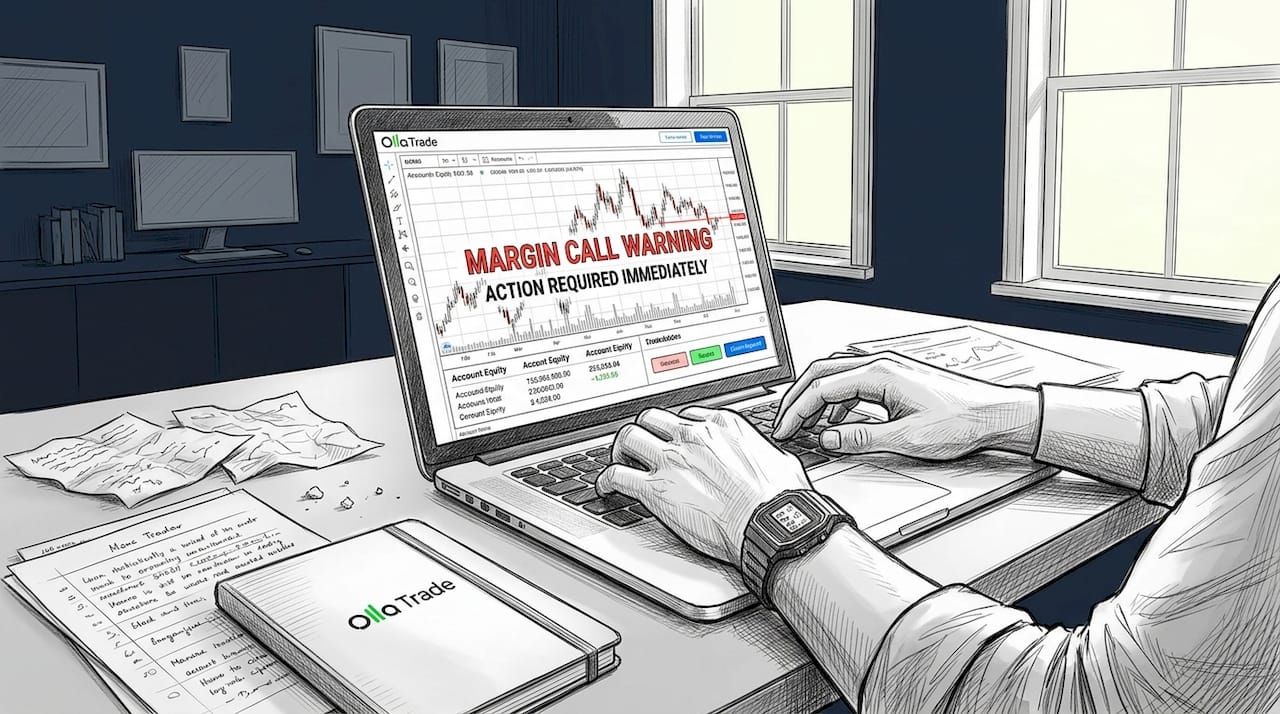
Your account equity equals the current market value of your holdings minus the amount borrowed. If you open a $10,000 position using $2,000 of your own capital and $8,000 borrowed, your equity is $2,000. If the position drops 15% in value to $8,500, your equity shrinks to just $500. Most brokers set maintenance margin requirements between 25% and 40% of the position value. At $8,500 position value, a 25% maintenance margin requires $2,125 in equity. Your $500 falls well short, and the margin call triggers immediately.
Common triggers include sharp price drops in volatile markets, sudden currency moves in Forex, and overnight gaps in CFD positions. Leverage amplifies equity shortfalls during small price moves, which is why margin calls appear faster than most traders expect. A 5% adverse move on a 10:1 leveraged position wipes out 50% of your equity.
Once a margin call is issued, you typically have two to five days to meet it. Brokers can, however, liquidate your positions immediately without waiting for that window to close.
Pro Tip: Monitor your margin ratio daily, not just when markets move. Set account alerts at 150% of your maintenance margin level so you have time to act before a call is issued.
What happens if you ignore a margin call?
Ignoring a margin call is one of the most expensive decisions a trader can make. Brokers hold the legal right to act without your consent, and they will.
The consequences break down as follows:
- Forced liquidation. The broker sells your securities without your approval to cover the margin deficit. They choose which positions to close, not you. This often means your best-performing holdings get sold at the worst possible moment.
- Losses beyond your initial investment. If the market moves faster than the liquidation process, your losses can exceed the capital you originally deposited. You are still liable for that deficit.
- Commissions and fees. Brokers typically charge transaction fees on every position they close during forced liquidation. These costs compound your losses.
- Disruption to your trading strategy. Forced liquidation during margin calls can crystallize losses and derail long-term positions you intended to hold through short-term volatility.
- Account standing. Repeated margin calls and forced liquidations can affect your relationship with your broker and your ability to access certain instruments or leverage tiers.
The critical point is that brokers in the US can liquidate positions at any time without prior notice. The margin agreement you signed grants them that right. Treat a margin call as an early alert, not a guaranteed warning with a comfortable deadline.
Pro Tip: Keep a liquidity buffer of at least 20% above your maintenance margin requirement in cash or near-cash assets. This gives you room to absorb volatility without triggering a forced sale.
How to meet a margin call: comparing your options
Three main responses exist when a margin call arrives: deposit cash, transfer marginable securities, or liquidate existing positions. Each carries different speed, cost, and strategic implications.
| Response method | Speed | Cost | Risk level |
|---|---|---|---|
| Deposit additional cash | 1 to 3 business days | Low (transfer fees only) | Low. Preserves all positions. |
| Transfer marginable securities | 1 to 2 business days | Low to medium | Medium. Depends on asset quality accepted by broker. |
| Liquidate existing holdings | Immediate | Medium to high (spreads, commissions, possible tax events) | High. Locks in losses and disrupts strategy. |
| Combination approach | Varies | Varies | Medium. Balances speed and cost. |
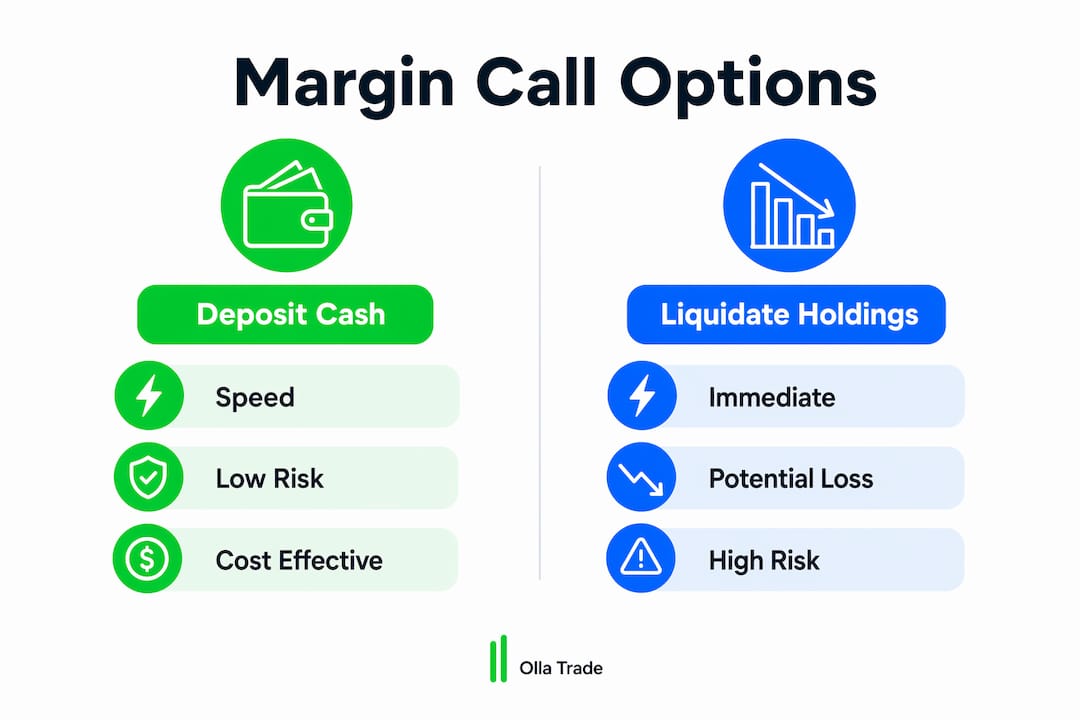
Depositing cash is the cleanest solution when you have liquid reserves. It restores equity without touching your open positions and avoids transaction costs beyond the transfer itself. The drawback is timing. Bank transfers can take one to three business days, which may not satisfy a broker demanding immediate action.
Transferring marginable securities works if you hold qualifying assets in another account. Brokers accept stocks, ETFs, and certain bonds at a percentage of their market value, called the loan value. Not all assets qualify, and the broker sets the terms.
Liquidating holdings is the fastest method and often the most painful. You close positions at current market prices, which during a margin call scenario are typically unfavorable. This method also triggers commissions and, in taxable accounts, potential capital gains events. When speed is the only priority, liquidation resolves the call immediately.
The combination approach works well for traders with moderate cash reserves and a diversified portfolio. Deposit what cash you have, transfer any qualifying securities, and close only the positions you would exit anyway. This minimizes forced selling while meeting the broker’s requirement.
Risk management strategies to avoid margin calls
The most effective way to handle a margin call is to never receive one. These strategies, applied consistently, reduce the probability significantly:
- Control your leverage ratio. Understanding leverage in trading is the starting point for avoiding margin calls. Using 2:1 or 3:1 leverage instead of 10:1 or 20:1 gives your positions far more room to absorb adverse moves before your equity falls below maintenance margin.
- Use stop-loss orders on every position. A stop-loss at 5% to 10% below your entry price closes the position automatically before losses compound to margin call territory. This is not optional for leveraged traders. It is the minimum standard of account protection.
- Maintain a cash buffer above maintenance margin. Keeping extra funds in your account above the maintenance margin requirement absorbs short-term volatility without triggering a call. A buffer of 30% to 50% above the maintenance level is a reasonable target for active traders.
- Avoid overconcentration in a single instrument. A portfolio spread across Forex pairs, indices, and metals does not move uniformly. Diversification reduces the chance that a single adverse move wipes out enough equity to trigger a call across your entire account.
- Review your positions before high-impact events. Economic data releases, central bank decisions, and earnings reports create sudden volatility. Reducing position size or closing leveraged trades before these events removes the risk of a gap move triggering a margin call overnight.
- Monitor your account in real time. Set alerts at 150% and 125% of your maintenance margin level. The first alert gives you time to plan. The second tells you to act now. Waiting until the broker contacts you is always too late.
Applying a structured risk management approach to every trade is what separates traders who survive volatile markets from those who get wiped out by a single bad week.
Key takeaways
A margin call is a broker’s demand to restore account equity, and the fastest resolution is almost always reducing position size rather than scrambling for new cash.
| Point | Details |
|---|---|
| Margin call definition | A broker’s demand to restore equity when it falls below the maintenance margin threshold. |
| Primary triggers | Leveraged position losses, market volatility, and overnight gaps in CFD or Forex trades. |
| Response timeline | Brokers can liquidate immediately; the typical window is two to five days, but it is not guaranteed. |
| Best response method | Liquidating positions is fastest; depositing cash preserves strategy but takes one to three days. |
| Prevention strategy | Maintain a cash buffer, use stop-loss orders, and keep leverage ratios conservative at all times. |
The uncomfortable truth about margin calls
Most traders treat a margin call as a crisis. I think that framing is wrong, and it leads to bad decisions under pressure.
A margin call is a signal, not a sentence. It tells you that your position sizing, leverage ratio, or cash management fell out of alignment with market conditions. That is useful information. The traders I have seen blow up accounts are not the ones who received margin calls. They are the ones who responded to margin calls by depositing more cash to hold losing positions, doubling down on the thesis that got them into trouble in the first place.
My honest advice: when a margin call arrives, your first instinct should be to reduce exposure, not to find more money. Liquidating the weakest positions in your book is almost always the right move. It restores equity, reduces your risk surface, and forces you to reassess whether the remaining positions still make sense at current prices. Scrambling to deposit cash just to keep a losing trade alive is how small losses become catastrophic ones.
The other thing most articles will not tell you is that proactive broker communication matters. If you are approaching margin call territory and you know a cash transfer is incoming, call your broker. Many will work with you on a short extension if you have a clean account history. That conversation costs you nothing and can buy you the time to respond on your terms rather than theirs.
Discipline in leveraged trading means treating your margin ratio as a live risk indicator, not a number you check after something goes wrong.
— FX
Trade smarter with Ollatrade’s margin and leverage tools
Managing margin calls starts with having the right platform behind you. Ollatrade gives retail and professional traders real-time account monitoring, instant margin alerts, and access to a full suite of leveraged instruments across Forex, CFDs, metals, indices, and cryptocurrencies.

When a margin call hits, speed and clarity matter. Ollatrade’s MetaTrader 4 integration and advanced charting tools let you assess your positions and act immediately, whether that means closing a trade, adjusting exposure, or reviewing your overall risk. Explore leveraged instruments trading on Ollatrade to understand exactly what you are trading and how margin requirements apply before you open a position.
FAQ
What is the margin call definition in simple terms?
A margin call is a broker’s demand that you deposit more funds or close positions when your account equity drops below the required maintenance margin. It is a risk control mechanism built into every margin account.
What triggers a margin call?
A margin call triggers when your account equity falls below the broker’s maintenance margin threshold, typically caused by adverse price moves in leveraged positions. High leverage and market volatility are the most common accelerators.
How does a margin call work in Forex trading?
In Forex, a margin call occurs when currency price moves reduce your account equity below the broker’s required margin level. Because Forex positions are highly leveraged, even a small adverse move in a major pair can trigger a call quickly.
Can a broker liquidate my account without warning?
Yes. In US margin accounts, brokers can liquidate positions immediately without prior notice under the terms of the margin agreement. A margin call notification is a courtesy, not a legal requirement in most cases.
How long do I have to meet a margin call?
The standard window is two to five business days, but brokers retain the right to act immediately if market conditions warrant it. Never assume you have the full window available.