











TL;DR:
- Most retail traders fail due to lack of a structured workflow and poor risk management.
- Following a disciplined, step-by-step trading routine and risk limits increases long-term success.
- Building habits and consistency are more crucial than finding perfect strategies or indicators.
Between 80 and 97% of retail traders lose money over the long term, and the leading reason is not a lack of market knowledge. It is the absence of a structured workflow. Without a repeatable process, every trade becomes a gamble driven by emotion rather than logic. This article gives you a practical, step-by-step framework to prepare, execute, and review trades with real discipline. Follow it consistently and you will start building the habits that separate traders who survive from those who quit in the first three months.
Table of Contents
- Laying the groundwork: Core concepts and preparation
- Designing your trading plan: The roadmap to success
- Setting up and practicing: Accounts, brokers, and demo trading
- Executing your daily trading workflow: From prep to review
- Risk management: Protecting your account from mistakes
- Our perspective: The workflow is the strategy
- Take your next step with Olla Trade
- Frequently asked questions
Key Takeaways
| Point | Details |
|---|---|
| Have a plan | A clearly defined, rules-based strategy is essential for successful trading. |
| Start small and practice | Demo accounts and small positions help you learn without risking your capital. |
| Follow a daily routine | Consistency in preparation, execution, and review builds confidence and skill. |
| Control your risk | Limiting losses per trade and protecting your account is more important than picking winners. |
| Learn from your results | Regular journaling and reviewing your trades helps you refine your process and avoid repeating mistakes. |
Laying the groundwork: Core concepts and preparation
Before you place a single trade, you need to understand what you are actually doing. Trading is the act of buying and selling financial instruments, such as stocks, forex currency pairs, CFDs (contracts for difference), or commodities, with the goal of profiting from price movements. Key terms you must know include leverage (borrowing capital to increase position size), volatility (how sharply prices move), and spread (the cost built into each trade by your broker).
A solid beginner’s guide to online trading will help you internalize these concepts before you risk any real money. Understanding basic trading concepts is not optional. It is your foundation.
Here is a preparation checklist every beginner should complete:
- Education: Study market basics, chart reading, and order types
- Hardware and software: A reliable computer, stable internet, and a trading platform
- Capital: Only use money you can afford to lose entirely
- Broker account: Choose a regulated broker with transparent fees
- Demo account: Practice before going live
According to a trading guide for beginners, managing expectations is equally critical. Most beginners overestimate returns and underestimate how long it takes to become consistently profitable.
| Preparation step | Why it matters |
|---|---|
| Financial education | Prevents costly beginner mistakes |
| Demo account practice | Builds confidence without real risk |
| Realistic capital allocation | Protects your financial stability |
| Broker selection | Ensures fair pricing and fund security |
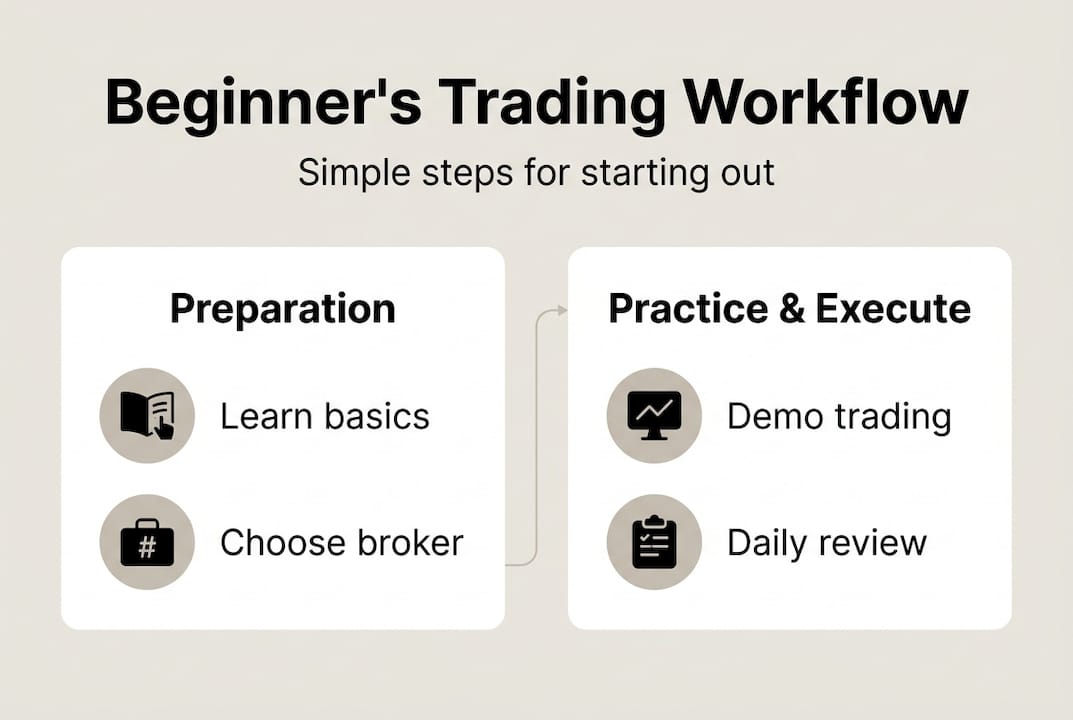
A beginner’s trading workflow starts with education, a trading plan, broker selection, demo practice, risk management, and a daily routine. Every element on that list matters before you go live.
Pro Tip: Spend at least 30 days in demo mode before funding a live account. Treat every demo trade as if real money is on the line.
Designing your trading plan: The roadmap to success
A trading plan is a written set of rules that governs every decision you make in the market. Without one, you are improvising. Improvising leads to emotional trades, and emotional trades lead to losses.
Key steps in building a trading plan include defining your goals, selecting a trading style, developing a strategy, analyzing the market, setting risk parameters, and reviewing your performance regularly.
Here is how to build yours:
- Define your financial goals. Are you trading for supplemental income or long-term wealth? Be specific.
- Assess your risk tolerance. How much of your account can you lose on a bad week without panicking?
- Choose a trading style. Review swing trading vs. day trading to find the right fit for your schedule and personality.
- Set entry and exit rules. Define exact conditions that must be met before you enter or exit a trade.
- Document every trade. Use a journal to record what you did, why, and what happened.
The trading plan essentials framework recommends treating your plan like a business document, not a loose guideline. Revise it only when your data supports a change, not when you are frustrated after a losing streak.
| Trading style | Time commitment | Best for |
|---|---|---|
| Day trading | High (full-time) | Traders with flexible schedules |
| Swing trading | Medium (part-time) | Traders with regular jobs |
| Position trading | Low (long-term) | Patient, macro-focused traders |
Explore day or swing trading strategies to see which approach matches your lifestyle. Also review the trading steps for beginners to understand how each style translates into daily action.
Pro Tip: Keep your trading plan to one page at first. Complexity is the enemy of consistency when you are starting out.
Setting up and practicing: Accounts, brokers, and demo trading
Once your plan exists on paper, you need the right tools to bring it to life. Setting up your trading environment is a practical process with a clear sequence.
Follow these steps:
- Select a regulated broker. Look for tight spreads, fast execution, and strong customer support.
- Open your account. Complete identity verification and fund your account only after demo practice.
- Choose your platform. MetaTrader 4 is widely used and offers powerful charting and automation tools.
- Start in the demo environment. Practice your full workflow, including scanning, entering, and exiting trades.
Demo practice is essential before live trading. Focus on just one or two strategies initially rather than jumping between methods. Mastery of one approach beats shallow knowledge of ten.
When practicing on demo, replicate your live workflow exactly:
- Build a watchlist of instruments you plan to trade
- Set alerts for your key price levels
- Enter trades only when your plan’s criteria are met
- Record every trade in your journal
Learn more about using a demo account to get the most out of your practice sessions. If you are wondering about starting capital, read about starting with a small amount to understand realistic expectations.
Many beginners skip the demo phase because it feels slow. That impatience is expensive. The trading for beginners framework is clear: practice reduces the costly errors that wipe out new accounts in the first weeks.
Pro Tip: Run your demo account for at least one full month across different market conditions, including trending and choppy markets, before switching to live funds.
Executing your daily trading workflow: From prep to review
A structured daily routine improves discipline and outcomes for new traders more than any single strategy ever will. The routine itself becomes your edge.
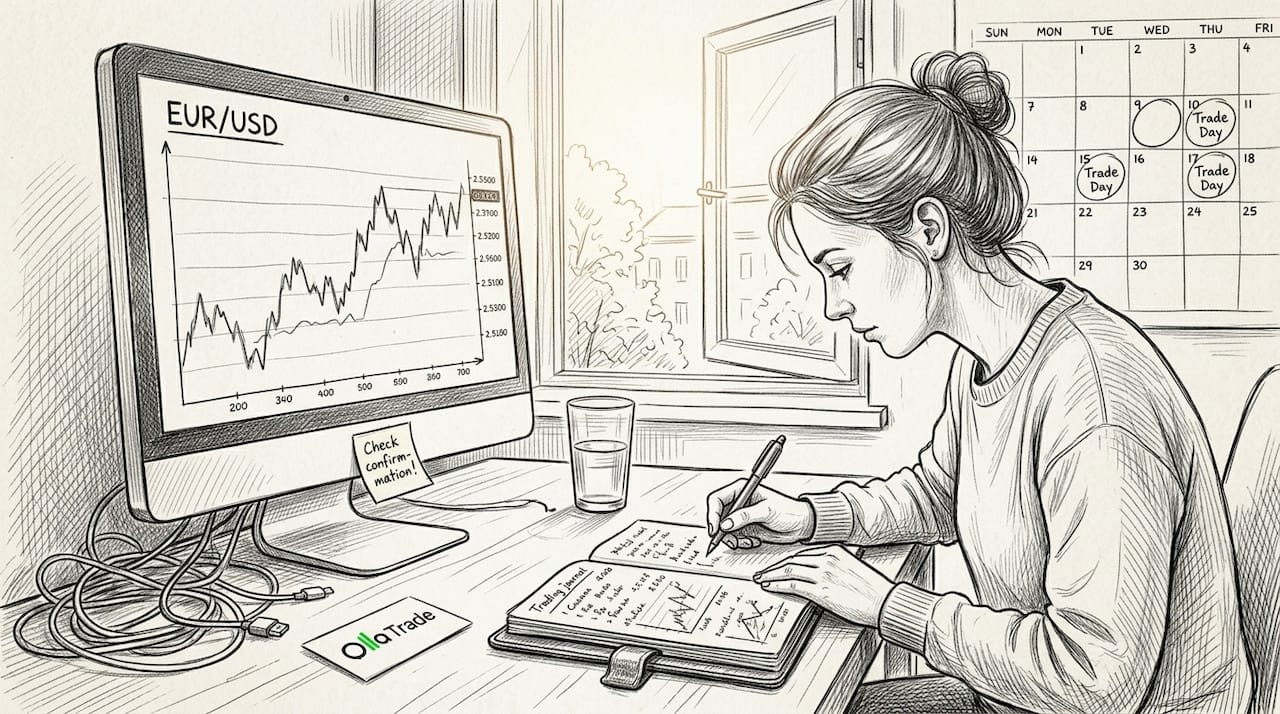
Here is how a disciplined trading day looks:
Pre-market (30 to 60 minutes before open):
- Check economic calendars for high-impact news events
- Review overnight price action on your watchlist
- Identify key support and resistance levels
- Set your trade alerts and price targets
During market hours:
- Execute only trades that match your pre-defined criteria
- Avoid reacting to sudden news unless it was already in your plan
- Monitor open positions without micromanaging every tick
- Step away if you feel emotional or frustrated
Post-market review:
- Journal every trade with entry price, exit price, and reasoning
- Rate your discipline, not just your profit or loss
- Identify one thing you did well and one thing to improve
- Plan your watchlist for the next session
“The goal of a daily routine is not to find more trades. It is to make better decisions on fewer, higher-quality setups.”
Explore day trading strategies and tools to sharpen your execution skills. The trading routine guide reinforces that preparation before the open is where most of the real work happens.
Risk management: Protecting your account from mistakes
You can have the best trading plan in the world and still blow your account if you ignore risk management. This is where most beginners fail, and it is not a knowledge problem. It is a discipline problem.
The core rules are simple:
- Risk no more than 1 to 2% of your account per trade. On a $1,000 account, that means a maximum $20 loss per trade.
- Always use a stop-loss order. No exceptions. Ever.
- Aim for a minimum 1:3 risk-to-reward ratio. Risk $1 to potentially make $3.
- Never add to a losing position hoping it will reverse.
Risk 1 to 2% per trade and use proper position sizing with a stop-loss in place. This single habit separates traders who survive from those who do not. The 80 to 97% failure rate among retail traders is driven largely by ignoring these principles.
Common mistakes to avoid:
- Overleveraging: Using maximum leverage on every trade amplifies losses just as fast as gains
- Skipping stop-losses: One uncapped loss can erase weeks of gains
- Revenge trading: Trying to win back losses immediately leads to bigger losses
“Protect your capital first. Profits come second. You cannot trade tomorrow if you blow your account today.”
Read more about capital protection basics to understand why account security is a non-negotiable foundation. Study the most common trading mistakes so you can recognize and avoid them before they cost you real money.
Pro Tip: After every losing trade, wait at least 15 minutes before considering your next entry. Emotional cooldown is a legitimate risk management tool.
Our perspective: The workflow is the strategy
Most beginner content focuses on finding the perfect strategy, the best indicator, or the right market to trade. We think that framing is backwards. After working with traders across all experience levels, the clearest pattern we see is this: traders who follow a structured workflow consistently outperform traders who rely on superior analysis but lack discipline.
The workflow is not a support system for your strategy. The workflow is the strategy. A mediocre setup executed with perfect discipline beats a brilliant setup executed emotionally every single time. This is uncomfortable to accept because it means the edge you are looking for is largely behavioral, not analytical.
Beginners often spend months searching for the right moving average combination or the perfect candlestick pattern. Meanwhile, the traders making steady progress are the ones journaling every trade, reviewing their mistakes weekly, and sticking to their 1 to 2% risk rule without exception. The market does not reward intelligence. It rewards consistency.
Start there. Build the process first. The profits follow the process.
Take your next step with Olla Trade
Building a structured trading workflow is the clearest path from beginner confusion to real confidence in the markets. You now have the framework: prepare, plan, practice, execute, and review.
Olla Trade gives you everything you need to put this workflow into action. From a full-featured demo account to MetaTrader 4 integration, tight spreads across forex, CFDs, metals, indices, and crypto, and educational resources built for beginners, the platform is designed to support every step of your journey. Create your account in minutes, practice risk-free, and start building the habits that matter. Your structured trading career starts here.
Frequently asked questions
What is the most important part of a beginner’s trading workflow?
A disciplined trading plan with strict risk management is the most critical element, since most failures stem from poor planning and emotional decision-making rather than a lack of market knowledge.
How much money should I risk per trade as a beginner?
Experts recommend risking no more than 1 to 2% of your total account balance on any single trade to protect your capital during the learning phase.
Do I need to practice on a demo account before trading live?
Yes, demo practice is essential for building real experience and confidence before committing actual funds to the market.
What routine should I follow each trading day?
Start with pre-market analysis and watchlist preparation, execute only pre-planned trades during market hours, and close each session with journaling and review to track your progress.
Why do most beginner traders fail?
Most fail because of no structured plan and poor risk management, not because they lack market knowledge or analytical skill.