











Trading workflows are complex systems prone to delays, errors, and missed opportunities that directly impact your bottom line. Whether you’re executing Forex trades, managing CFD positions, or navigating volatile crypto markets, inefficiencies in your workflow translate to slower execution, higher costs, and reduced profitability. This guide walks you through proven methods to optimize your trading workflow using automation platforms, algorithmic tools, and advanced verification techniques. You’ll learn how to prepare your infrastructure, implement strategy automation, validate performance with Walk-Forward Analysis, and enhance order execution to maximize returns across all asset classes.
Table of Contents
- Key takeaways
- Preparing your trading workflow for optimization
- Executing automation and algorithmic strategy implementation
- Verifying and optimizing trading strategies with analysis techniques
- Enhancing order execution and cost control for higher profitability
- Optimize your trading today with Olla Trade platforms
- FAQ
Key Takeaways
| Point | Details |
|---|---|
| Multi Asset Automation | Automated platforms unify data and order management across assets, reducing switching and execution delays. |
| Low Latency Execution | Prioritize real time data feeds, low latency APIs, and fast order routing to improve fill rates and ROI. |
| Walk Forward Validation | Use Walk Forward Analysis to validate strategy performance and reduce overfitting during optimization. |
| Infrastructure Readiness | Ensure infrastructure readiness with reliable internet, near exchange servers, and multi device setups to maximize speed and reliability. |
| Monitoring and Costs | Regular monitoring and cost control improve trading efficiency and profitability. |
Preparing your trading workflow for optimization
Before you can optimize your trading workflow, you need the right infrastructure and tools in place. Multi-asset automation platforms form the backbone of efficient trading operations, enabling you to manage Forex, CFDs, and cryptocurrencies from a unified interface. These platforms eliminate the need to switch between multiple terminals, reducing cognitive load and execution time.
When selecting an automation platform, prioritize systems that offer real-time data feeds, robust order management systems, and comprehensive API integrations. Platforms like Obermind Flow and Integral FX provide enterprise-grade orchestration capabilities that connect your trading strategies directly to multiple liquidity providers and exchanges. This connectivity is essential for executing cross-asset strategies without manual intervention.
Your hardware and software setup directly impacts execution speed and reliability. A robust internet connection with redundancy options prevents disconnections during critical trading moments. VPS hosting located near exchange servers minimizes latency, giving you an edge in fast-moving markets. Multi-device setups allow you to monitor positions and execute trades from desktop, mobile, and tablet simultaneously, ensuring you never miss an opportunity.
Consider these essential platform features when evaluating automation solutions:
- Real-time market data aggregation across multiple asset classes
- Advanced order types including conditional orders and bracket strategies
- API connectivity supporting REST, WebSocket, and FIX protocols
- Backtesting engines with tick-level precision
- Risk management tools with position sizing and exposure limits
Here’s a comparison of leading automation platforms for multi-asset trading:
| Platform | Asset Coverage | API Types | Latency Optimization | Pricing Model |
|---|---|---|---|---|
| Obermind Flow | Forex, CFDs, Crypto, Equities | REST, WebSocket, FIX | Co-location support | Enterprise licensing |
| Integral FX | Forex, Metals | FIX, Proprietary | Ultra-low latency routing | Volume-based |
| MetaTrader 5 | Forex, CFDs, Stocks | REST, Native | VPS integration | Free platform, broker fees |
Pro Tip: Integrate your OMS with low-latency APIs to reduce order execution delays. The difference between 50ms and 5ms latency can determine whether you capture profitable arbitrage opportunities or miss them entirely.
Once your infrastructure is ready, master key features of trading platforms for better results by exploring advanced charting, order routing, and risk management capabilities. The preparation phase sets the foundation for all subsequent optimization efforts, so invest time in selecting and configuring the right tools. Many traders underestimate the importance of proper setup and pay the price through suboptimal execution and missed trades.
For traders new to automation, start with top automated trading software options that offer user-friendly interfaces while still providing professional-grade capabilities. The learning curve is steeper with enterprise platforms, but the performance gains justify the initial investment of time and resources.
Executing automation and algorithmic strategy implementation
With your infrastructure prepared, the next step is implementing algorithmic tools and automation workflows that execute trades faster and more reliably than manual methods. Algorithmic trading platforms like MetaTrader 4/5, Quantower, and Sierra Chart offer low-latency execution engines and strategy automation capabilities that transform how you interact with markets.

Setting up algorithmic trading requires a systematic approach. Start by defining your strategy logic in a format your platform understands. MetaTrader uses MQL4/MQL5 programming languages, while platforms like Quantower support C# and Python. If coding isn’t your strength, many platforms offer visual strategy builders that let you create algorithms through drag-and-drop interfaces.
VPS hosting is non-negotiable for serious algorithmic trading. When you run strategies from your home computer, you’re vulnerable to power outages, internet disruptions, and system crashes. A VPS located near exchange servers runs 24/7 with minimal latency, ensuring your algorithms execute trades exactly when conditions are met. This stability is especially critical for high-frequency strategies and overnight positions in global markets.
Follow this workflow to deploy an automated Forex or CFD strategy:
- Code or configure your strategy logic using backtested parameters
- Test the strategy in a demo environment with real-time data feeds
- Monitor performance metrics including fill rates, slippage, and execution speed
- Gradually scale position sizes as you verify consistent performance
- Set up automated alerts for unusual behavior or technical failures
- Review and adjust parameters weekly based on changing market conditions
Low-latency order routing separates profitable algorithmic traders from those who struggle. When your strategy identifies an opportunity, milliseconds matter. Configure your platform to route orders through the fastest available path to your broker or exchange. Some platforms offer smart order routing that automatically selects the best execution venue based on current liquidity and spreads.
Strategy automation extends beyond simple buy and sell signals. Modern platforms let you automate position sizing based on account equity, adjust stop losses dynamically as trades move in your favor, and even pause trading during high-impact news events. These automated risk management features protect your capital without requiring constant monitoring.
Pro Tip: Monitor VPS uptime and server location to optimize latency for high-frequency trades. A VPS in New York works well for US equity markets, while London-based servers suit European Forex trading. Some traders run multiple VPS instances in different regions to optimize execution across global markets.
Integration with your broker’s API determines execution quality. Check your VPS guide for trading to ensure your hosting provider offers direct connectivity to major brokers and exchanges. The fewer intermediaries between your algorithm and the market, the faster your orders execute and the less slippage you experience.
As you gain confidence with automation, explore best trading tools that complement your algorithmic setup. Tools for sentiment analysis, order flow visualization, and market depth can inform your strategy parameters and improve decision-making. The goal is creating a cohesive ecosystem where automated execution combines with human oversight for optimal results.
Verifying and optimizing trading strategies with analysis techniques
Implementing strategies is only half the battle. Without rigorous verification and optimization, you risk deploying algorithms that worked in backtests but fail in live markets. Walk-Forward Analysis validates strategies by testing them on rolling periods of out-of-sample data, revealing how they perform in conditions they weren’t optimized for.
Traditional backtesting optimizes strategy parameters on historical data, then assumes those parameters will work going forward. This approach suffers from overfitting, where strategies are tuned so precisely to past data that they capture noise rather than genuine market patterns. Walk-Forward Analysis solves this by dividing your data into multiple in-sample and out-of-sample periods, optimizing on in-sample data and validating on out-of-sample data repeatedly.
Here’s how Walk-Forward Analysis compares to traditional backtesting:
| Method | Optimization Approach | Out-of-Sample Testing | Overfitting Risk | Real-World Reliability |
|---|---|---|---|---|
| Traditional Backtesting | Single historical period | Optional, often skipped | High | Low to moderate |
| Walk-Forward Analysis | Rolling optimization windows | Mandatory for each period | Low to moderate | High |
| Monte Carlo Simulation | Random data permutations | Synthetic scenarios | Moderate | Moderate |
Financial metrics guide your optimization process by quantifying risk-adjusted returns. The Sharpe ratio measures return per unit of volatility, helping you identify strategies that generate consistent profits rather than occasional large wins. Maximum Drawdown reveals the worst peak-to-trough decline your strategy experienced, which is often more important than average returns when assessing whether you can psychologically and financially withstand the strategy’s rough patches.
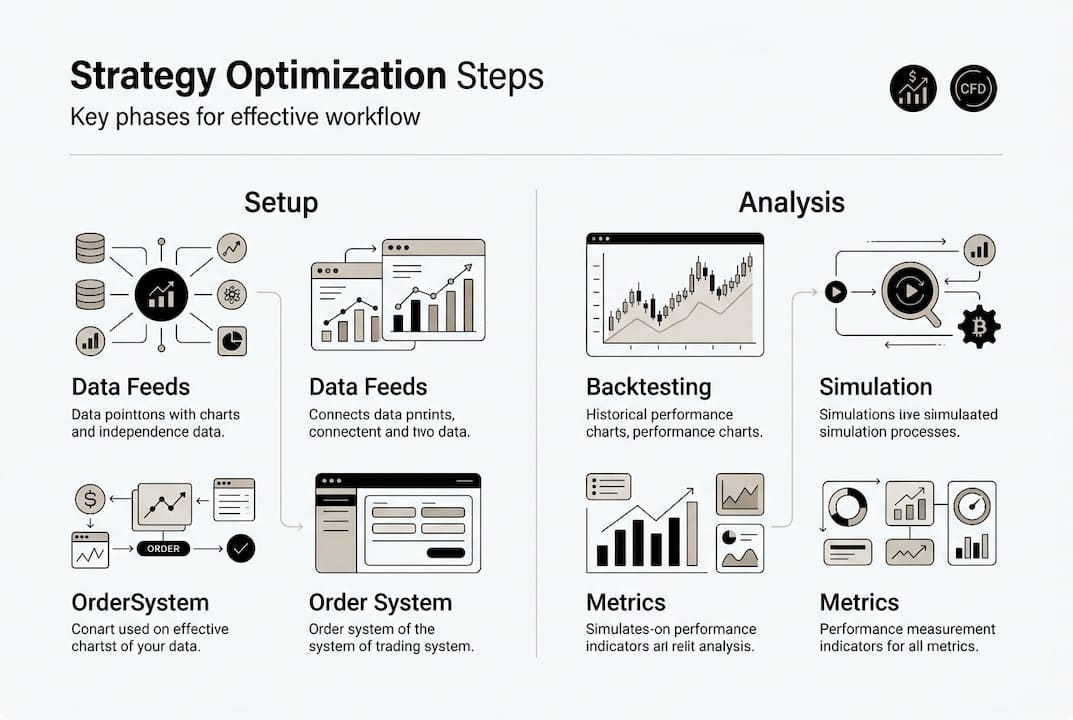
When building machine learning models for trading, finance-grounded losses like Sharpe ratio and Maximum Drawdown produce better results than generic accuracy metrics. Traditional ML models optimize for prediction accuracy, but trading profitability depends on risk-adjusted returns and drawdown control. Incorporating these metrics directly into your loss function aligns model training with trading objectives.
Turnover regularization addresses a critical but often overlooked aspect of trading optimization: transaction costs. High-frequency strategies that trade excessively generate impressive returns in simulations but fail in live markets because commissions and slippage erode profits. Adding turnover penalties to your optimization objective function encourages strategies that trade only when expected profits exceed transaction costs.
Key considerations when implementing Walk-Forward Analysis:
- Choose in-sample periods long enough to capture various market conditions
- Use out-of-sample periods that reflect realistic trading timeframes
- Re-optimize parameters periodically but not so frequently that you overfit to recent data
- Track consistency of performance across multiple out-of-sample periods
- Abandon strategies that show degrading performance in successive walk-forward tests
Pro Tip: Reassess strategies periodically using WFA to adapt to market regime changes. Markets evolve, and strategies that worked during trending periods may fail in ranging markets. Running Walk-Forward Analysis quarterly helps you identify when a strategy’s edge has diminished and when it’s time to retire or retune it.
Combining Walk-Forward Analysis with robust financial metrics creates a verification framework that dramatically improves your odds of live trading success. Many traders skip this step, eager to deploy strategies that look good in backtests. The extra effort of proper verification pays dividends by filtering out strategies destined to fail and giving you confidence in those that pass rigorous testing.
For ongoing cost management, monitor trading fees as part of your verification process. Even a strategy with positive expected value can become unprofitable if transaction costs aren’t factored into optimization. Include realistic commission and slippage assumptions in all backtests and Walk-Forward Analysis runs.
Enhancing order execution and cost control for higher profitability
Even the best-optimized strategies fail without efficient order execution. Upgrading your Order Management System to support millisecond-level routing across multiple exchanges unlocks opportunities that slower systems miss entirely. Low-latency OMS implementations boost arbitrage ROI from 0.5% to 3% by capturing price discrepancies before they disappear.
Modern OMS platforms offer tiered execution speeds that match different trading styles. Market makers and high-frequency traders require sub-millisecond execution, while swing traders can tolerate slightly higher latency. Understanding your strategy’s latency requirements helps you choose the right execution tier without overpaying for speed you don’t need.
Cross-exchange arbitrage represents one of the most compelling use cases for low-latency execution. When Bitcoin trades at $64,200 on one exchange and $64,350 on another, you have roughly 150 milliseconds to execute both sides of the trade before the opportunity vanishes. Traders with superior execution infrastructure capture these trades consistently, while those with slower systems watch opportunities disappear.
Cost control extends beyond minimizing commissions. Slippage, the difference between expected and actual execution prices, often exceeds commission costs for larger orders. Smart order routing algorithms split large orders across multiple venues and time periods to minimize market impact. Some platforms offer VWAP and TWAP algorithms that execute trades gradually at volume-weighted or time-weighted average prices.
Implementing comprehensive cost controls requires:
- Real-time tracking of commissions, exchange fees, and financing costs
- Slippage analysis comparing expected versus actual fill prices
- Position-level P&L that includes all transaction costs
- Automated alerts when costs exceed predefined thresholds
- Regular reviews of broker fee structures and negotiation of volume discounts
Performance monitoring closes the loop on workflow optimization. Deploy analytics tools that track key metrics including fill rates, average execution time, rejected orders, and cost per trade. These metrics reveal bottlenecks in your workflow and highlight areas for improvement. A sudden increase in rejected orders might indicate connectivity issues, while rising slippage could signal that your order sizes have outgrown available liquidity.
Pro Tip: Use real-time performance analytics tools to adjust execution parameters promptly. Markets change throughout the day, with liquidity and volatility fluctuating based on session overlaps and news events. Dynamic parameter adjustment ensures your execution strategy matches current market conditions rather than relying on static settings.
The cumulative impact of execution improvements compounds over time. Saving 0.5 basis points per trade might seem trivial, but across thousands of trades annually, it represents substantial profit enhancement. Professional traders obsess over execution quality because they understand that consistent small edges create long-term success.
For detailed execution policies and best practices, review the order executions policy to understand how professional platforms handle order routing, fill priorities, and execution guarantees. Transparency in execution practices builds trust and helps you set realistic expectations for fill quality.
Optimize your trading today with Olla Trade platforms
You’ve learned the techniques professional traders use to optimize workflows, from automation and algorithmic execution to rigorous strategy verification and cost control. Now it’s time to apply these principles with platforms built for serious trading. Olla Trade offers comprehensive tools supporting Forex, CFDs, and cryptocurrencies with the fast execution speeds and advanced features that workflow optimization requires.
Our platform integrates seamlessly with the optimization strategies covered in this guide. Master key features of trading platforms including advanced charting, multiple order types, and risk management tools designed for both retail and professional traders. Whether you’re implementing automated strategies or executing discretionary trades, Olla Trade provides the infrastructure for efficient, profitable trading.
Explore our complete guide to trading platforms to understand how modern trading technology supports the workflow optimizations you’ve learned today. Start with Forex trading on Olla Trade to experience tight spreads, fast execution, and the reliability that workflow optimization demands. Your next step toward trading excellence begins with the right platform.
FAQ
How can automation improve my trading workflow?
Automation platforms integrate data feeds and trade execution into unified systems, eliminating manual steps that introduce delays and errors. They enable simultaneous monitoring of multiple assets across Forex, CFDs, and crypto markets, dramatically improving efficiency. By removing human intervention from routine tasks, automation frees you to focus on strategy development and risk management.
What is Walk-Forward Analysis and why is it important?
Walk-Forward Analysis tests trading strategies on rolling periods of out-of-sample data to verify they perform well on market conditions they weren’t optimized for. This technique reveals whether your strategy captures genuine market patterns or simply fits historical noise. It’s essential because strategies that pass Walk-Forward Analysis have much higher odds of succeeding in live trading compared to those validated only through traditional backtesting.
Why is low-latency order execution crucial for traders?
Low-latency execution captures narrow arbitrage windows and fast market movements that disappear within milliseconds. Faster order routing reduces slippage by getting your orders filled at prices closer to your intended entry points. The difference between 50ms and 5ms execution time directly impacts profitability, especially for strategies exploiting short-term price discrepancies across exchanges.
How can I control trading costs within my workflow?
Regularly review detailed breakdowns of your trading fees, commissions, financing costs, and slippage statistics to identify where costs are eroding profits. Use execution policies and OMS features like smart order routing to minimize market impact and reduce slippage on larger orders. Monitor trading fees systematically and negotiate volume discounts with brokers as your trading activity grows. Even small percentage improvements in cost efficiency compound significantly over thousands of trades.