












TL;DR:
- In 2026, authenticity and recency are crucial for testimonials, as consumers distrust generic or outdated reviews. Detailed, outcome-focused testimonials, especially video or case studies, significantly boost trust and conversion rates. Businesses must respond professionally to reviews and ensure regulatory compliance to build genuine credibility and secure customer confidence.
Consumers don’t take your word for it anymore. They take each other’s. The role of testimonials in trust has never been more consequential, and in 2026, the stakes are higher than ever. Fake reviews are rampant, regulators are watching, and buyers are sharper. A glowing wall of five-star praise no longer moves people the way it once did. What moves them is specificity, recency, and authenticity. This guide breaks down exactly how testimonials shape consumer trust today, what makes them credible, and what kills their impact before a single customer reads them.
Table of Contents
- Key takeaways
- The role of testimonials in trust: how they actually work
- What makes a testimonial credible in 2026
- Common pitfalls that undermine testimonial trust
- Practical strategies for using testimonials to build trust
- My honest take on testimonials and trust
- Why trust signals matter on Ollatrade
- FAQ
Key takeaways
| Point | Details |
|---|---|
| Authenticity beats quantity | A handful of detailed, honest reviews outperforms hundreds of generic five-star ratings. |
| Recency is non-negotiable | 74% of consumers only trust reviews from the last three months, making freshness a core trust signal. |
| Responses build credibility | Businesses that reply to all reviews are more trusted by 80% of consumers than those who stay silent. |
| Perfect ratings hurt trust | A 4.7 to 4.8 average is more persuasive than a flawless 5.0, which triggers skepticism in nearly half of shoppers. |
| FTC compliance is mandatory | Incentivized or fake testimonials carry penalties up to $53,088 per violation under federal law. |
The role of testimonials in trust: how they actually work
The psychology behind testimonials is not complicated, but most people underestimate how deeply it runs. When a potential buyer encounters a product or service they have never used, their brain looks for a shortcut to reduce risk. Testimonials provide that shortcut. They function as social proof, a cognitive mechanism where people look to others’ experiences to inform their own decisions.
Here is what the research actually shows about their impact:
- Displaying five or more reviews can lift conversion rates by an average of 270%. For high-ticket items, that number climbs to 380%.
- 49% of consumers trust online reviews as much as personal recommendations from friends or family.
- Detailed, outcome-driven testimonials reduce perceived buyer risk far more effectively than generic praise.
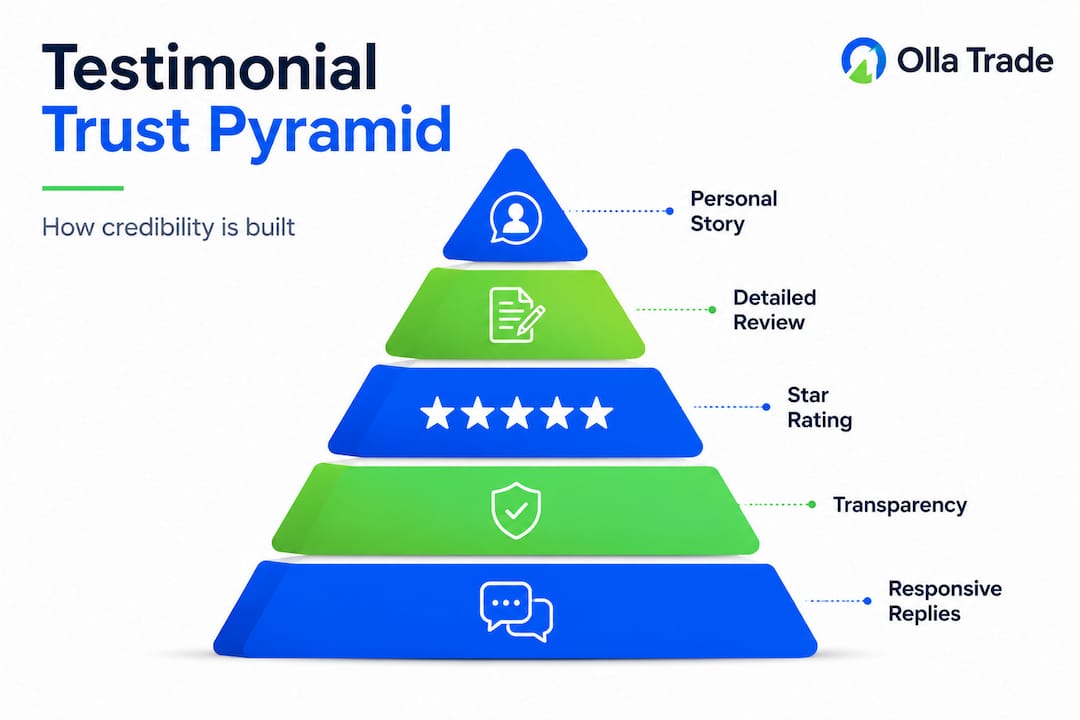
- Star ratings alone have limited power. Narrative reviews that describe a specific situation carry dramatically more weight.
Not all testimonials are created equal. A one-sentence “Great service!” carries almost no trust value. A detailed account of how a customer solved a specific problem, with measurable results, tells a story that resonates. The importance of testimonials lies precisely in this distinction. Outcome-driven narratives that follow a problem-solution-result structure are consistently the most persuasive format across industries.
The impact of reviews on trust also varies by format. Video testimonials add a layer of authenticity that text cannot replicate because viewers can read body language and tone. For B2B purchases or high-stakes financial decisions, detailed case studies and video testimonials elevate credibility beyond what any star rating can achieve.
Pro Tip: When collecting testimonials, ask customers to answer three specific questions: What was your situation before? What changed after using this product or service? What specific result did you see? This structure produces testimonials that actually convert.
What makes a testimonial credible in 2026
Trustworthiness in testimonials comes down to several specific qualities. Knowing these helps both buyers spotting manipulation and businesses building genuine credibility.
Recency matters more than ever. 32% of consumers now look specifically for reviews from the last two weeks, a figure that has jumped significantly from previous years. A five-star review from 2022 is nearly worthless to today’s buyer.
Volume supports confidence, but diminishing returns apply. The trust lift from reviews plateaus after a certain point. What sustains it is a continuous stream of fresh feedback rather than a large, static collection.
Imperfection signals honesty. 46% of shoppers distrust a perfect 5.0 rating. A 4.7 to 4.8 average, supported by a mix of detailed positives and a few well-handled negatives, reads as far more believable.
Business responses signal accountability. When a company addresses a negative review publicly and professionally, it demonstrates genuine customer care. Silence or copy-pasted templates do the opposite.
Regulatory compliance is a trust signal in itself. The FTC’s Consumer Review and Testimonials Rule bans fake reviews and undisclosed incentives. Businesses that transparently label sponsored or gifted reviews build more credibility than those that hide it.
Specificity separates credible from forgettable. “I made a significant return on my investment within six weeks using this platform” is more persuasive than “Highly recommend.” Buyers want evidence, not enthusiasm.
Here is a quick comparison of testimonial formats and their trust impact:
| Format | Trust signal strength | Best use case |
|---|---|---|
| Star rating only | Low | Quick decision support |
| Short text review | Moderate | General credibility |
| Detailed narrative review | High | Reducing purchase risk |
| Video testimonial | Very high | High-stakes or B2B decisions |
| Case study with data | Highest | Enterprise, finance, professional services |
Pro Tip: Never remove all negative reviews. A mix of ratings with predominantly positive but occasional critical feedback tells buyers that your review collection is real, not curated for appearance.
Common pitfalls that undermine testimonial trust
Businesses make predictable mistakes with testimonials, and each one chips away at the credibility they are trying to build. Here are the most damaging ones:
- Chasing volume over quality. Flooding a page with short, vague praise does not build trust. It creates noise. Buyers scroll past generic five-star ratings looking for substance.
- Buying or incentivizing reviews without disclosure. Beyond being ethically wrong, it is now a federal enforcement priority. Consumers overwhelmingly believe that someone must be held accountable for fake review manipulation, and the FTC agrees.
- Ignoring reviews entirely. 42% of consumers are unlikely to use a business that fails to respond or replies with templated messages. Silence reads as indifference.
- Using testimonials that praise the brand, not the outcome. “Amazing company to work with” tells a buyer nothing. “Cut my trading research time in half” tells them everything.
- Mishandling negative reviews. A defensive or dismissive response to a critical review is far more damaging than the review itself.
“Handled with honesty, a negative review becomes one of your most powerful trust signals. Mishandled, it becomes a public record of poor customer care.”
Trust-building through customer feedback requires treating every review, positive or negative, as a conversation worth having in public. The businesses that respond professionally to criticism demonstrate confidence and accountability in a way that polished marketing copy simply cannot replicate.
Practical strategies for using testimonials to build trust
Knowing what makes testimonials work is only useful if you act on it. Here is how to build a testimonial strategy that actually strengthens credibility.
Ask at the right moment. Request feedback when customer satisfaction is highest, directly after a successful outcome, a completed purchase, or a resolved support issue. Timing determines whether you get enthusiastic detail or a reluctant one-liner.
Make it easy and specific. Send short, guided prompts rather than open-ended “leave us a review” requests. Specific questions produce specific answers, and specific answers build trust. Tools like post-purchase surveys or follow-up emails with three targeted questions work well here.
Respond to every review, personally. 80% of consumers are more likely to choose a business that responds to all reviews. Personalized replies that address the customer by name and reference their specific experience signal active, genuine care.
Distribute testimonials across every relevant touchpoint. Your website homepage, product pages, email sequences, social media, and even paid advertising all benefit from strategically placed social proof. The goal is to meet buyers with reassurance at every stage of their decision process.
Monitor and audit your review profile regularly. Consumers want businesses to actively detect and remove fraudulent reviews. Platforms like Google and Yelp have reporting tools. Use them, and communicate that you do.
Use testimonials to justify premium pricing. When a customer describes a specific outcome that saved them time, money, or stress, that narrative makes higher pricing feel rational rather than arbitrary. Outcome-focused stories are your most persuasive pricing defense.
For anyone operating in financial services or online trading, transparency around trading rule transparency has been shown to directly influence whether potential clients trust a platform enough to commit real money.
My honest take on testimonials and trust

I’ve watched brands obsess over review counts while completely neglecting what those reviews actually say. More testimonials do not automatically mean more trust. I’ve seen platforms with hundreds of five-star ratings lose prospective clients to competitors with fewer but sharper, more specific reviews. The buyer reads between the lines faster than most marketers realize.
What I’ve learned from years of watching this play out is that authenticity is not a nice-to-have. It is the only thing that survives scrutiny. Consumers in 2026 are not naive. They know what a purchased review looks like. They can feel when a testimonial section has been curated into something that feels too clean. That instinct is almost always correct.
The brands that get this right share one habit: they treat their customers’ words as a mirror, not a marketing tool. When a real customer describes a real outcome, it carries a weight that no copywriter can manufacture. I’ve also seen the flip side. Companies that incentivized reviews without disclosure, or quietly buried negative feedback, eventually face the kind of public trust collapse that no ad budget can fix.
My honest advice is to prioritize one genuinely detailed testimonial over ten generic ones. Respond to criticism before you celebrate praise. And never, under any circumstances, mistake a clean review page for a trustworthy one.
— FX
Why trust signals matter on Ollatrade
In online trading, trust is not abstract. It is the difference between a visitor and an active trader. At Ollatrade, user testimonials and transparent ratings are core to how the platform communicates its reliability to both new and experienced traders. When you’re deciding where to place capital in forex markets or across CFD instruments, the experiences of real traders carry more weight than any feature list. Ollatrade’s emphasis on secure trading practices and verified account standards reflects the same principle this article explores: trust is built through consistent, transparent behavior over time. Explore Ollatrade’s platform and read what real traders say about their experience before making your next move.
FAQ
What is the role of testimonials in trust?
Testimonials act as social proof that reduces perceived risk for potential buyers. They transfer trust from existing customers to prospects, making decision-making faster and more confident.
How many reviews does a business need to build trust?
Research shows that displaying at least five reviews significantly lifts conversion rates, but ongoing recency matters more than a large static count.
Do negative reviews hurt or help trust?
Professionally handled negative reviews often increase trust. A business that responds with accountability and care signals reliability in a way that a flawless review profile never can.
Are fake or incentivized testimonials illegal?
Yes. The FTC enforces rules against fake and undisclosed incentivized reviews, with penalties reaching $53,088 per violation under the Consumer Review and Testimonials Rule.
What makes a testimonial more credible than a star rating?
Narrative testimonials that follow a problem-solution-result format provide specific, verifiable evidence that buyers can relate to. Star ratings alone offer no context and carry far less persuasive weight.