










TL;DR:
- Cryptocurrency trading offers high profits but involves significant risks requiring disciplined strategies.
- Choosing regulated exchanges and using proper wallets are essential for safety and compliance.
- Implementing risk management, technical analysis, and a hybrid trading approach enhances long-term success.
Cryptocurrency markets offer some of the most dramatic profit opportunities available to retail traders today, but they also carry risks that can wipe out your capital faster than almost any other asset class. Crypto volatility can produce 50% price swings in weeks and historic drawdowns of 80 to 90% from peak to trough. That reality doesn’t mean you should stay away. It means you need a structured, step-by-step approach before you put a single dollar on the line. This guide covers everything from opening your first account to deploying advanced strategies, built for both beginners and experienced traders who want to trade smarter.
Table of Contents
- Getting started: Setting up for your first crypto trade
- Core mechanics: Orders, fees, and trading tools explained
- Risk management essentials: Protecting your capital
- Trading strategies for every level: From HODL to advanced tactics
- Common pitfalls and how to avoid them: Safety, regulation, and edge cases
- What most crypto trading guides miss: It’s about disciplined process, not just signals
- Ready to trade crypto? Your next steps with Olla Trade
- Frequently asked questions
Key Takeaways
| Point | Details |
|---|---|
| Start with reputable exchanges | Choose regulated platforms and complete all account verifications for security. |
| Understand trading costs | Learn about fees, spreads, and order types before executing trades. |
| Prioritize risk management | Never risk more than you can lose, and use stop-losses and diversification. |
| Match strategy to your goals | Select trading tactics—HODL, active, or hybrid—that fit your risk tolerance and experience. |
| Protect against crypto’s unique pitfalls | Stay vigilant for edge cases like exchange hacks, network errors, and regulatory changes. |
Getting started: Setting up for your first crypto trade
Now that you understand the risks and opportunities, let’s break down the first steps.
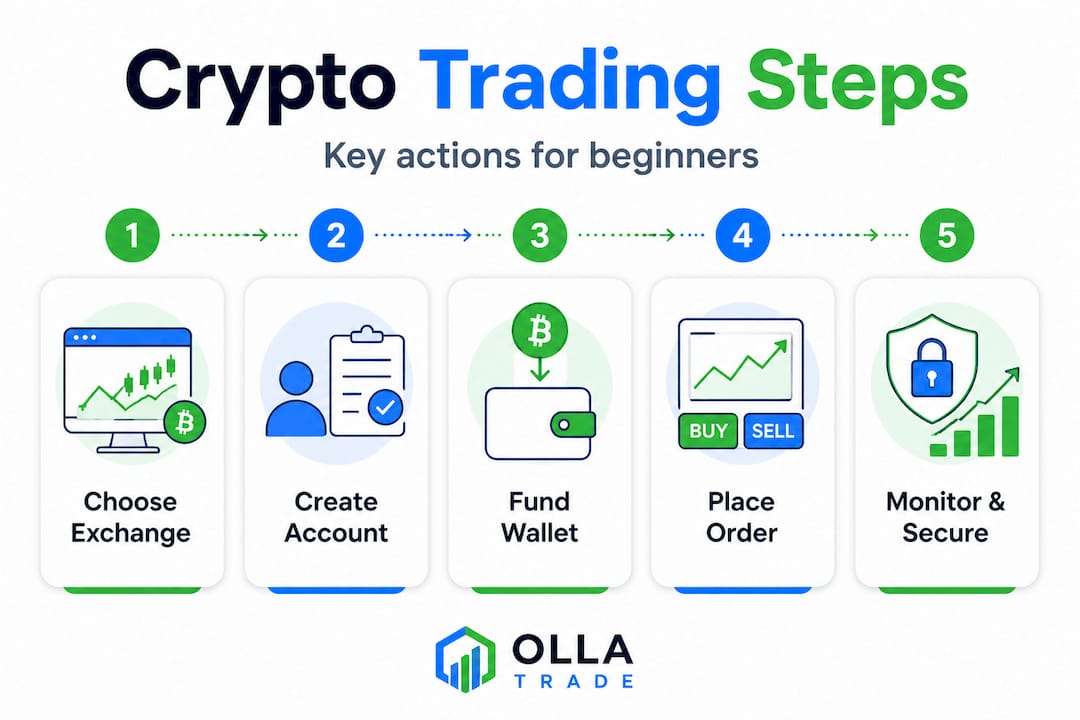
Choosing where to trade is your most important early decision. Not every exchange is created equal, and the wrong choice can expose you to hacks, poor liquidity, or outright fraud. For beginners, reputable regulated exchanges like Coinbase, Kraken, or Binance give you a solid starting point. They offer established coins like Bitcoin and Ethereum, user-friendly interfaces, and custodial wallets that handle security on your behalf. You follow a step-by-step trading setup that gets you from registration to your first trade without unnecessary complexity.
For US-based retail traders specifically, regulated US exchanges like Coinbase, Kraken, and Gemini are the safest starting point because they minimize counterparty risk and comply with local financial regulations. This matters more than most beginners realize. When an unregulated offshore exchange collapses, your funds often disappear with it.
Here’s a step-by-step breakdown of the setup process:
- Research and select a regulated exchange that supports your country and preferred payment methods.
- Complete KYC (Know Your Customer) verification by submitting a government-issued ID and proof of address. This is mandatory on all legitimate platforms.
- Fund your account via bank transfer, debit card, or wire. Bank transfers typically carry lower fees than card deposits.
- Choose your starting assets. Bitcoin (BTC) and Ethereum (ETH) are the most liquid and widely analyzed, making them ideal for beginners.
- Decide on a wallet strategy. Custodial wallets (held on the exchange) are simpler for beginners. Non-custodial wallets give you full control of your private keys but require more technical responsibility.
The custodial vs. non-custodial decision deserves extra attention. A custodial wallet means the exchange holds your private keys. It’s convenient, but if the exchange is hacked or goes insolvent, your funds are at risk. A non-custodial wallet, like MetaMask or a hardware device, puts you in full control. For small trading amounts, custodial is fine. For larger holdings, self-custody becomes critical.
| Feature | Custodial wallet | Non-custodial wallet |
|---|---|---|
| Control of keys | Exchange holds keys | You hold keys |
| Ease of use | Very easy | Moderate to advanced |
| Security risk | Exchange hack or insolvency | User error or device loss |
| Best for | Beginners, active traders | Large holdings, long-term storage |
Pro Tip: Start with a custodial wallet on a regulated exchange while you learn. Once you’re comfortable and holding meaningful amounts, migrate to a hardware wallet for long-term storage.
If you’re new to online trading more broadly, a beginner’s online trading guide can help you understand the foundational concepts that apply across forex, stocks, and crypto before you go deeper.
Core mechanics: Orders, fees, and trading tools explained
After setting up your trading accounts, it’s time to understand exactly how trades are made and what they cost.
Every crypto trade you execute involves choosing an order type, paying a fee, and interpreting price data. Getting these mechanics wrong is one of the most common ways beginners lose money before they even develop a strategy.
Order types you need to know:
- Market order: Executes immediately at the current market price. Fast, but you may get a worse price than expected in volatile conditions. This is called slippage.
- Limit order: You set the exact price you’re willing to buy or sell at. The order only fills if the market reaches that price. More control, but no guarantee of execution.
- Stop-loss order: Automatically sells your position if the price drops to a specified level. Essential for protecting capital.
- Spot trading: You buy and own the actual cryptocurrency. No leverage involved.
Basic trading mechanics like understanding the difference between a market order and a limit order can save you significant money, especially when trading lower-liquidity altcoins where spreads are wide and slippage is common.
Fees are where many traders quietly bleed capital. Understanding the fee structure before you trade is non-negotiable. Coinbase fees on simple trades run from 1.49% to 3.99%, while the advanced trading interface charges 0.05% to 0.6%. Binance charges a flat 0.1% maker-taker fee on most pairs. These differences compound dramatically over time.
| Exchange | Simple/retail fee | Advanced/pro fee |
|---|---|---|
| Coinbase | 1.49% to 3.99% | 0.05% to 0.6% |
| Binance | 0.1% | 0.1% (maker-taker) |
| Kraken | 0.26% taker | 0.16% maker |
For tools, start with price charts and moving averages. A 50-day moving average crossing above a 200-day moving average (called a golden cross) is a widely followed bullish signal. The Relative Strength Index (RSI) tells you whether an asset is overbought or oversold on a scale of 0 to 100. For a deeper look at decoding crypto trading fees and understanding how spreads affect your bottom line, these resources will sharpen your cost awareness significantly.
Pro Tip: Always use the advanced trading interface on any exchange, even as a beginner. The fee savings alone, often 10x lower than the simple interface, justify the slight learning curve.
Explore top crypto trading tools to find the charting platforms and indicators that professional traders use daily.
Risk management essentials: Protecting your capital
Understanding trading mechanics is only half the equation; now you need to protect your capital with smart risk management.
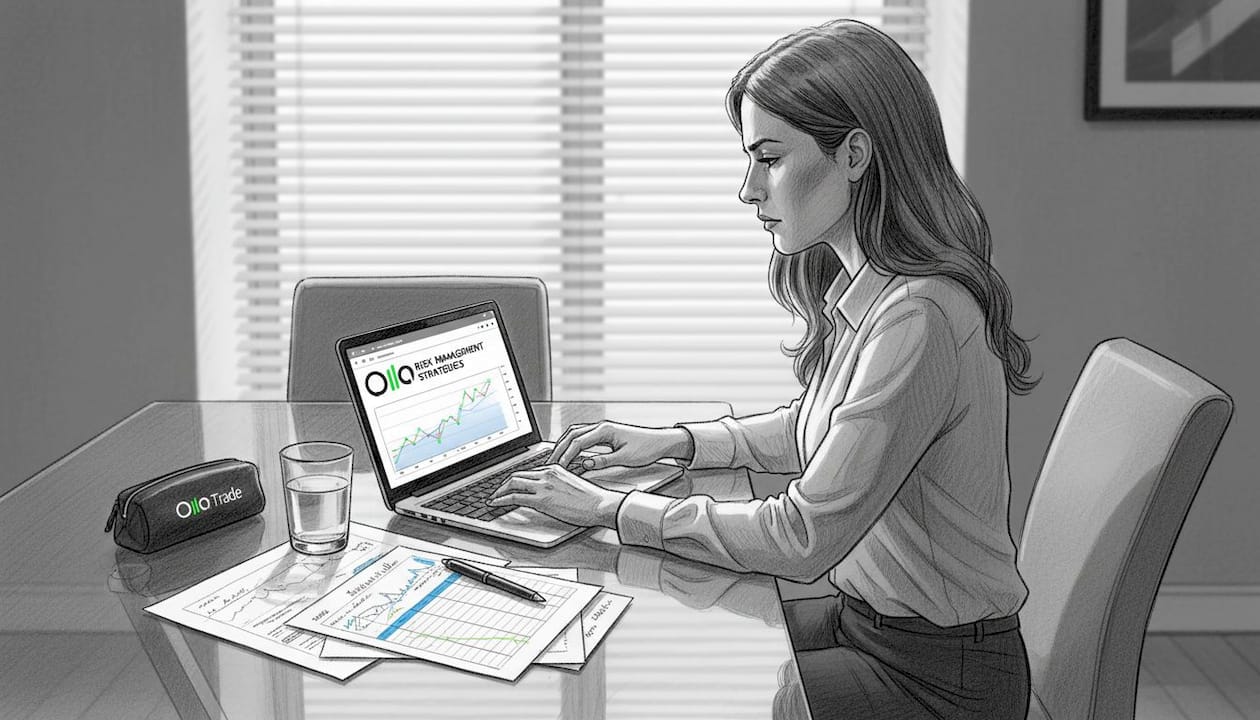
Most traders focus on finding winning trades. The best traders focus on surviving losing trades. That mental shift is what separates those who build lasting portfolios from those who blow up their accounts in the first bear market.
Core risk management principles:
- Risk only 0.5% to 2% of your total portfolio on any single trade. This means a string of losses won’t destroy your account.
- Use stop-loss orders on every trade, typically set 5% to 15% below your entry price depending on the asset’s volatility.
- Size positions using the Average True Range (ATR), a volatility indicator that tells you how much an asset typically moves per day. This helps you set stops that aren’t triggered by normal price noise.
- Diversify across asset types. A core of BTC and ETH combined with a smaller allocation to altcoins reduces the impact of any single position collapsing.
- Dollar-cost average (DCA) into positions rather than deploying all your capital at once. This smooths out your entry price over time.
- Keep aggregate portfolio risk under 5% to 6% across all open positions simultaneously.
Risk management benchmarks show that disciplined traders who limit risk per trade to 0.5% to 2% and diversify across BTC, ETH, and selective altcoins significantly outperform those who concentrate positions or over-leverage.
“Crypto lacks traditional investor protections like SIPC insurance. Use hardware wallets for large holdings, enable two-factor authentication on every account, and never store more on an exchange than you need for active trading.” — Consumer Reports
Security is a form of risk management that traders often overlook until it’s too late. Crypto lacks traditional protections like SIPC coverage that protects brokerage accounts. If your exchange is hacked or goes bankrupt, you may have no legal recourse. Enable 2FA, use a unique password for every platform, and withdraw large holdings to cold storage regularly.
Pro Tip: Treat your stop-loss as sacred. The moment you start moving your stop-loss further away to avoid being “stopped out,” you’ve abandoned risk management and started gambling.
Understanding the broader crypto market impact on your portfolio helps you anticipate volatility events and prepare your risk controls in advance.
Trading strategies for every level: From HODL to advanced tactics
With your risk controls in place, you’re ready to choose and tailor a trading strategy.
Not every strategy suits every trader. Your time availability, risk tolerance, and capital size all influence which approach will work best for you. Here’s a clear comparison of the main options.
| Strategy | Time commitment | Risk level | Best for |
|---|---|---|---|
| HODL (buy and hold) | Very low | Medium (long-term) | Long-term investors |
| Swing trading | Low to moderate | Medium | Part-time traders |
| Day trading | Very high | High | Full-time traders |
| Arbitrage | Moderate | Low to medium | Technical traders |
| Scalping | Extreme | Very high | Professional traders |
Advanced professional strategies include day trading with momentum and trend-following signals, triangular arbitrage across trading pairs, range trading between support and resistance levels, breakout trading on volume surges, and futures trading with leverage. All of these require technical analysis tools including RSI, moving averages, and order flow analysis.
For most traders, the smartest approach is a hybrid model. A 70% to 80% HODL core in BTC and ETH combined with 20% to 30% allocated to active strategies gives you long-term upside while allowing tactical trading. Rebalance this allocation quarterly to maintain your target ratios.
Here’s how to implement a hybrid strategy step by step:
- Allocate 70% to 80% of your crypto capital to BTC and ETH as your long-term core positions.
- Set aside 20% to 30% for active trading in higher-volatility altcoins or derivatives.
- Choose one active strategy to master first, whether swing trading, day trading, or arbitrage, before adding complexity.
- Use technical analysis tools like RSI, MACD, and Bollinger Bands to time entries and exits on your active positions.
- Review and rebalance your overall allocation quarterly, trimming active positions that haven’t performed and reinforcing the core.
HODL versus active trading also has major tax implications. Short-term trades (assets held under a year) are taxed as ordinary income in the US. Long-term holds qualify for lower capital gains rates. This alone can make the HODL core component of a hybrid strategy significantly more tax-efficient.
Explore essential crypto trading strategies and learn how chart patterns can sharpen your entry and exit timing. For those ready to go further, advanced crypto trading tools can give you a professional-grade edge.
Common pitfalls and how to avoid them: Safety, regulation, and edge cases
Even seasoned traders can stumble. Here’s how to avoid the most common crypto trading errors.
The crypto space has unique failure modes that don’t exist in traditional markets. Understanding them before they happen to you is the difference between a recoverable mistake and a total loss.
Critical pitfalls to watch for:
- Wrong network deposits. Sending crypto to the wrong blockchain network (for example, sending ERC-20 tokens to a BSC address) can result in permanently lost funds. Always verify the network before confirming any transaction.
- Exchange hacks and insolvency. Exchange failures happen with no SIPC protection, meaning you may lose everything stored on a compromised platform.
- Regulatory uncertainty. The legal status of crypto assets in the US remains in flux, with ongoing debates about whether tokens are commodities or securities. This affects which exchanges can legally operate and which assets remain accessible.
- Leveraged liquidation. Using leverage amplifies both gains and losses. A 10x leveraged position can be fully liquidated by a 10% adverse price move. Funding rates on perpetual contracts also quietly erode your position over time.
- Phishing scams and fake apps. Always access exchanges through official URLs and never click links in unsolicited messages.
“Short-term crypto trades are taxed as ordinary income in the US. Long-term holds qualify for capital gains treatment. Track every single transaction meticulously.” — Investopedia
Tax implications catch many traders off guard. Every swap, sale, and taxable event must be reported. Using crypto tax software from day one, rather than trying to reconstruct records later, saves enormous headaches at tax time.
For a broader look at safety practices, regulations, and what to watch for as a crypto trader, explore more on crypto safety through Olla Trade’s dedicated resources.
What most crypto trading guides miss: It’s about disciplined process, not just signals
Having covered the technicalities and pitfalls, it’s time to address a deeper truth about success in crypto trading.
Most guides focus on finding the right coin, the right signal, or the right moment to buy. That framing is fundamentally misleading. The traders who consistently survive and grow their portfolios aren’t the ones with the best market predictions. They’re the ones with the most repeatable, disciplined process.
Think about what that means in practice. A trader who risks 1% per trade, uses defined entry and exit rules, and rebalances quarterly will outperform a trader who makes brilliant calls but risks 20% on a single position, every single time over a long enough horizon. The math is unforgiving. One catastrophic loss from over-leveraging or ignoring a stop-loss can erase months of gains.
Psychology plays a bigger role than most traders admit. Fear of missing out (FOMO) drives people to buy at market tops. Panic selling locks in losses at market bottoms. These aren’t failures of analysis. They’re failures of emotional discipline. Building a written trading plan, including your entry criteria, position size, stop-loss level, and profit target, before you enter any trade forces you to think rationally rather than reactively.
The hybrid approach we described earlier isn’t just a portfolio strategy. It’s a psychological tool. When 70% to 80% of your crypto capital is in a long-term HODL position, short-term market volatility becomes less threatening. You’re not watching every candle with anxiety because your core position is designed to weather drawdowns. That stability frees you to make better decisions with your active trading allocation.
Understanding crypto strategy fundamentals and how market dynamics affect your portfolio is the foundation that makes all other tactics work. Without it, even the best signals are just noise.
Ready to trade crypto? Your next steps with Olla Trade
Armed with knowledge, those ready to take the next step toward trading can find the tools and support they need.
Olla Trade gives you direct access to cryptocurrency markets alongside forex, metals, indices, and more, all through a single, professional-grade platform. Whether you’re placing your first crypto trade or running advanced strategies with technical indicators, the platform is built to support both.
Start trading crypto on Olla Trade with tight spreads, fast execution, and a multi-device compatible interface that works whether you’re at your desk or on the move. Dig deeper into market impact and strategies to refine your approach, or explore MetaTrader tools for crypto to leverage expert advisors, custom indicators, and advanced charting features that professional traders rely on. Your education is solid. Now it’s time to put it to work.
Frequently asked questions
What is the minimum amount required to start trading cryptocurrencies?
Many exchanges allow you to start trading with as little as $10 to $20 via bank transfer or card, but always account for fees and only trade what you can afford to lose entirely.
How are profits from crypto trading taxed?
Short-term crypto trades are taxed as ordinary income in the US, while assets held for over a year may qualify for the lower long-term capital gains tax rate.
What’s the safest way to store large amounts of cryptocurrency?
Hardware wallets are the safest option for large holdings, and you should always enable two-factor authentication on every exchange account you use.
Can I lose all my money trading crypto?
Yes. Due to 50%+ price swings, high leverage, and exchange risks, you can lose your entire investment, particularly without strict risk management in place.
Is trading cryptocurrencies legal in the US?
Yes, but only through regulated US exchanges and with proper tax reporting. Always verify the current regulatory status in your specific state before trading.