












TL;DR:
- Swap rates are interest charges or credits applied when holding leveraged Forex or CFD positions overnight, driven by interest rate differentials and broker policies. They vary across currencies, account types, and broker markups, influencing long-term trade profitability significantly. Traders must monitor, calculate, and incorporate swap costs into their strategies, especially for positions held over multiple days or during triple swap periods, to gain a practical trading edge.
You open a Forex position Monday morning, close it Thursday afternoon, and your profit is smaller than your chart suggested it would be. No obvious slippage. No wide spread. Just a line in your trade history that quietly drained a few dollars each night. That line is the swap rate, and it catches thousands of traders off guard every week. Whether you hold positions for hours or weeks, understanding how overnight costs work, what drives them, and how to use them strategically is one of the most practical edges you can build as a trader in Forex and CFD markets.
Table of Contents
- Swap rate basics: What you pay (or get) for holding positions overnight
- How swap rates are calculated: Key factors and real examples
- Why swap rates differ: Broker policies, markups, and rate changes
- How to use swap rates in your trading strategy
- The uncomfortable truth about swap rates: They reward the prepared, punish the unaware
- Ready to optimize your trading? Explore swap-aware solutions
- Frequently asked questions
Key Takeaways
| Point | Details |
|---|---|
| Swap rates explained | Swap rates are interest paid or earned on overnight positions in Forex and CFD trading. |
| Calculation factors | Swap rates depend on currency interest differences, broker policies, and market events. |
| Broker differences matter | Different brokers can charge or credit very different swap rates for the same pair. |
| Check before holding | Always check swap policies and rates before holding positions overnight to avoid surprises. |
| Use swaps strategically | With knowledge, you can avoid unnecessary costs or even profit from positive swap opportunities. |
Swap rate basics: What you pay (or get) for holding positions overnight
Think of a swap rate as the interest charge or credit that your broker applies when you hold a leveraged position past the daily market close, usually at 5:00 PM New York time. When you buy a currency pair, you are borrowing one currency to buy another. That borrowing has a cost based on the interest rate differential between the two currencies involved. Depending on which direction the differential runs, that cost can go either way. You might pay the broker, or the broker might pay you.
This applies across overnight swap rates explained for both Forex and CFDs on metals, indices, stocks, and energies. Each product category has its own settlement convention, so the timing of swaps is not identical across instruments.
Key factors that drive swap rates include:
- Interest rate differentials between the base and quote currencies
- Central bank policy decisions, which can shift rates overnight
- Broker markup, added on top of interbank rates
- Position direction (long or short), because borrowing dynamics differ
- Lot size and position value, which scale the swap charge proportionally
One of the most misunderstood mechanics is the triple swap. Triple swap applied on Wednesdays for Forex to cover the weekend, since markets settle T+2 and Saturday/Sunday do not count as settlement days. For indices, the triple swap often falls on Friday instead. If you are not aware of this, you can be blindsided by a charge three times larger than your usual overnight cost. Always confirm the triple swap day with your broker because the convention can vary.
“Swap rates are not a fixed tax on your account. They are dynamic, policy-driven, and in some cases, a direct source of income. Knowing which side you are on changes everything.”
Pro Tip: Always check the what influences swap rates in your specific instrument before entering a multi-day trade. Do not assume they are negligible just because your spread is tight.
How swap rates are calculated: Key factors and real examples
With the basics understood, let’s break down exactly how swap rates are decided and see what that means in real numbers.
The core calculation involves four components: the interest rate differential between the two currencies, the direction of your trade (buy or sell), your position size in lots, and the broker’s markup or administrative fee. While brokers often provide this as a pre-calculated pip value per lot per night, knowing the underlying math helps you question whether a rate is competitive.
Here is the general sequence for calculating a swap:
- Identify the central bank rates for both the base and quote currencies in the pair.
- Calculate the differential by subtracting the lower rate from the higher.
- Determine your position direction: a long trade benefits when the base currency has the higher rate; a short trade benefits when the quote currency does.
- Apply the broker’s markup, which is added to the raw interbank rate.
- Multiply by lot size and position value to get the daily swap in your account currency.
According to how swap rates are calculated, the precision of this calculation matters most for traders holding positions for multiple days or weeks, where even a small daily rate compounds into a significant cost or income.
Here is a comparison of typical swap rates across major pairs:
| Currency Pair | Long Swap (per lot/day) | Short Swap (per lot/day) | Notes |
|---|---|---|---|
| EUR/USD | Approx. -0.7 pips | Approx. +0.3 pips | Commonly negative for longs |
| USD/JPY | Approx. +0.5 pips | Approx. -1.2 pips | Positive carry for buyers |
| GBP/USD | Approx. -0.8 pips | Approx. +0.2 pips | Rate-sensitive post-BoE decisions |
| AUD/USD | Approx. -0.4 pips | Approx. -0.1 pips | Both sides can be negative |
| USD/CHF | Approx. +0.3 pips | Approx. -0.9 pips | Swiss National Bank holds low rates |
For real benchmark data, example rates show EUR/USD long swaps running between approximately -0.5 to -0.9 pips per day, while a USD/JPY buy position can generate roughly +2,205 in annual income per standard lot under favorable conditions. These figures move as central bank policies shift, so they are reference points, not guarantees.
Pro Tip: Use the swap rate calculation details available on your platform before entering any trade you plan to hold beyond one day. Most platforms also offer a built-in forex swap calculator that does the math for you in seconds.
Why swap rates differ: Broker policies, markups, and rate changes
Knowing the basics and calculations, you might notice that swap rates can differ widely in practice depending on where you trade. Let’s find out why.

The same EUR/USD position held for one week might cost you significantly more at one broker than another. That difference almost never comes from the underlying interest rate differential, which is publicly available data. It almost always comes from the broker’s markup, how they apply it, and what administrative fees are layered on top.
Broker markups create real variance between platforms, and the gap becomes especially meaningful for traders who hold positions for days or weeks. A markup difference of just 0.2 pips per day compounds to over 1 pip per week and roughly 4 pips per month on a single position. Scale that across multiple lots and the dollar impact becomes impossible to ignore.
Here is a quick comparison of how different account structures handle swaps:
| Account Type | Swap Treatment | Additional Fees | Best For |
|---|---|---|---|
| Standard account | Standard swap rates apply | None beyond markup | Most retail traders |
| ECN/Raw spread account | Lower markup, tighter rates | Commission per trade | High-frequency or volume traders |
| Swap-free (Islamic) account | No overnight interest charged | Possible fixed admin fee | Faith-based traders or long holders |
| VIP/Professional account | Negotiated swap rates | Varies | High-volume traders |
Swap-free account options are available at many brokers, but read the fine print carefully. These accounts, often called Islamic accounts, eliminate the interest component for religious compliance, but they sometimes replace it with a fixed nightly administration fee that can exceed what a regular swap would have cost. Always run the numbers for your typical holding period before choosing this account type.
Central bank rate changes are the other major variable. When the European Central Bank or the Federal Reserve adjusts rates, swap calculations shift immediately. A pair that was generating positive carry income can flip to a cost overnight when a rate decision catches the market off guard.
“The difference between a trader who profits from swaps and one who simply absorbs them often comes down to one habit: reading the account conditions before depositing, not after.”
Watch for these specific items in your broker’s swap policy:
- Minimum holding time before a swap is applied
- Triple swap days for each instrument class
- Whether swap-free accounts have expiry periods on positions
- Whether swap rates are fixed or variable and how often they update
- Currency conversion fees if your account currency differs from the swap calculation currency
Comparing account types across brokers is a practical step before committing to a platform. Use compare broker accounts resources to see side-by-side differences in real conditions.
How to use swap rates in your trading strategy
Understanding variance and mechanics is only part of the puzzle. Let’s pivot to how you can use this information for better outcomes in your actual trading.
For short-term traders, swap rates are often a minor concern. A scalper closing positions within hours or a day trader shutting everything before the rollover time faces minimal exposure. The math is simple: if your expected daily gain from a trade is 30 pips and the overnight swap costs 0.7 pips, that cost is noise, not signal.
For swing traders and position traders, the dynamic shifts entirely. Holding a position for two weeks means approximately 14 days of swap charges or credits. On a five-lot EUR/USD position at -0.7 pips per day, that is roughly 49 pips in swap costs before you factor in the triple swap charge on Wednesday. That changes your break-even point meaningfully.
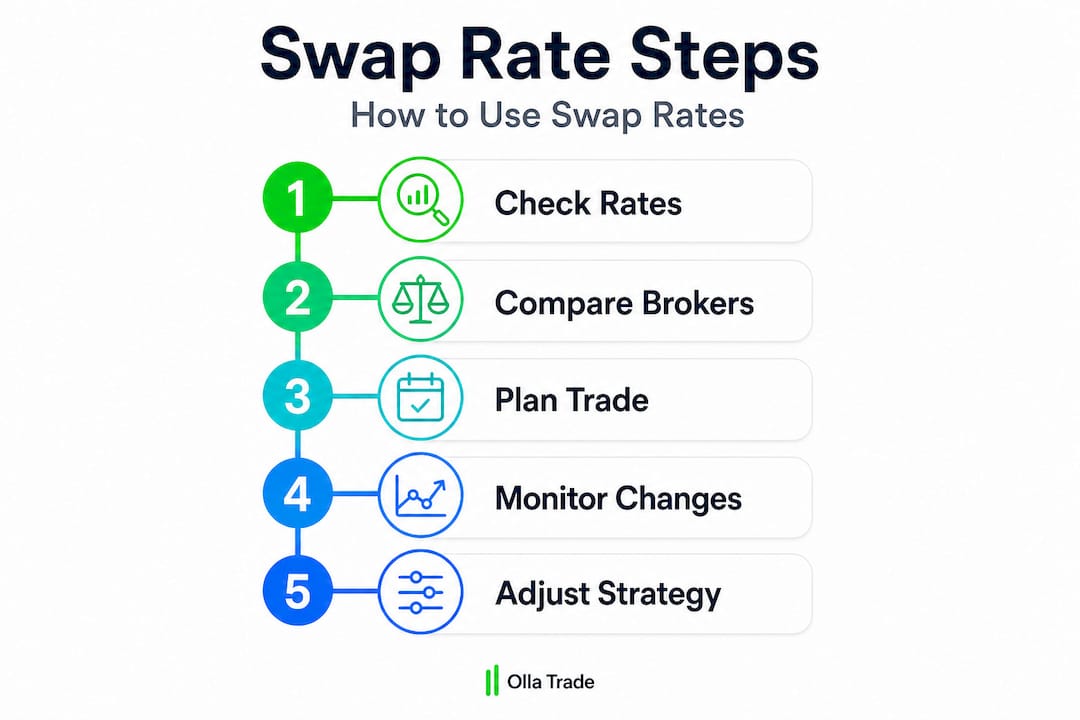
Here are practical steps to build swap awareness into every trade decision:
- Before entering a trade, look up the swap rate for the specific pair and direction in your platform’s contract specifications.
- Calculate total expected swap cost by multiplying the daily rate by your planned holding period and lot size.
- Adjust your position size or target if the swap cost meaningfully shifts your risk-reward ratio.
- Mark triple swap days on your calendar and decide in advance whether to close positions beforehand or absorb the charge.
- Review rates weekly since central bank activity can alter swap values between your entry and exit dates.
- Consider carry trades deliberately, not accidentally. Pairs like USD/JPY or those involving high-rate emerging market currencies sometimes reward patient longs with consistent swap income.
Rates vary by broker and update frequently, so checking swap rates once at account opening and then ignoring them is not a viable strategy. Build the check into your pre-trade routine the same way you check spread and margin requirements.
For traders interested in profitable pair trading, understanding which pairs generate positive carry versus which pairs consistently drain your account through negative swaps is a real competitive advantage.
Pro Tip: Set a calendar reminder for every Wednesday if you trade Forex pairs. Decide before the rollover window whether holding through the triple swap is justified by your trade thesis.
The uncomfortable truth about swap rates: They reward the prepared, punish the unaware
Most educational content on swap rates stops at definition and calculation. What rarely gets said out loud is how much swap rates actually separate seasoned traders from those who plateau. The difference is not technical knowledge. It is behavioral.
Too many traders treat swap costs as an unavoidable overhead, similar to a utility bill. They know it exists, they see the deduction, and they shrug. That approach works fine for very short holding periods, but it leaves enormous opportunity on the table for anyone trading beyond intraday timeframes.
The carry trade, one of the most documented strategies in professional Forex trading, is built entirely around exploiting swap differentials. Institutional traders allocate significant capital to long positions in high-yield currency pairs precisely because favorable swap rates compound over time. But most retail traders either do not know this is happening or, if they do, fail to monitor how detailed swap insights shift when central banks pivot.
Here is what separates the traders who master swaps from those who ignore them:
Common mistakes:
- Ignoring triple swap days and getting hit with unexpected charges
- Choosing a swap-free account without checking whether fixed admin fees are higher
- Not recalculating swap impact when central bank meetings are on the calendar
- Holding losing positions longer than planned and compounding swap losses on top of paper losses
Quick wins:
- Know your triple swap day before it arrives, not after
- Compare swap rates across account types before choosing where to hold long-term positions
- Use positive carry pairs strategically in range-bound or trending markets
- Factor total swap cost into your take-profit target from day one
The traders who treat swap rates as a strategic variable rather than background noise are the ones who find opportunities others miss. It is not glamorous work, but neither is ignoring a cost that silently erodes your returns every single night you hold a position.
Ready to optimize your trading? Explore swap-aware solutions
Equipped with understanding and strategy, take the next step with a platform designed for informed action.
At Olla Trade, we believe every trader deserves transparent access to the information that affects their bottom line, and swap rates are squarely on that list. Our platform provides clear swap rate specifications across all instruments, so you are never guessing what an overnight hold will cost before you confirm a trade.
Whether you are new to forex trading solutions or already trading CFDs across metals, indices, and energies, having the right account structure matters. We offer multiple account types so you can compare account options and find the conditions that match your strategy. If you are still exploring the mechanics of leveraged products, our guide on what CFDs are covers the fundamentals in plain language. Smarter trading starts with knowing exactly what you are working with.
Frequently asked questions
When is triple swap applied in Forex trading?
Triple swap is usually charged on Wednesdays for Forex pairs to account for weekend settlement, but this can differ by broker and instrument, with some indices using Friday instead.
Can swap rates be positive, paying income to traders?
Yes, positive swap rates are possible when the currency you buy carries a higher interest rate than the one you sell. USD/JPY buy positions can generate approximately +2,205 in annual income per lot under favorable rate conditions.
Do all brokers offer swap-free accounts?
Not all brokers offer swap-free Islamic accounts, and policies vary. Swap-free accounts may charge flat fees that replace the standard interest calculation, so always compare the total cost before choosing this account type.
How do central banks affect swap rates?
When central banks raise or cut interest rates, the differential between currency pairs shifts, causing swap rates to fluctuate with central bank decisions often immediately after a policy announcement.
Where can I check real-time swap rates for different brokers?
Most brokers display swap rates in their platform’s contract specifications or instrument details. Rates vary by broker and update regularly, so always review them before opening positions you plan to hold overnight.