











TL;DR:
- Demo trading is a risk-free but essential practice environment that helps traders develop consistent processes and habits. Focusing on process accuracy and discipline during demo sessions prepares traders for real markets, where emotional control and execution are crucial. Properly transitioning from demo to live trading requires understanding its limitations, especially during volatile conditions, and starting with small positions to manage psychological pressure effectively.
Most traders open a demo account, click around for a few days, and assume they’re ready for real money. That mindset almost guarantees a rough start in live markets. Forex demo trading is a risk-free way to practice platform mechanics, order entry, and basic execution using virtual funds, but it only works when you treat it seriously. This guide will show you how to structure your demo practice, build habits that actually transfer, understand the real gaps between demo and live results, and ultimately make the most of every minute you spend before risking a single dollar.
Table of Contents
- What is forex demo trading and why it matters
- How to structure effective demo practice
- Developing real trading habits in demo mode
- Demo vs. live trading: Key differences you must know
- What most traders miss about demo trading
- Ready to put your practice to the test?
- Frequently asked questions
Key Takeaways
| Point | Details |
|---|---|
| Practice safely | Forex demo trading lets you practice strategies without risking real money. |
| Focus on process | Treat demo trading as structured practice to develop consistent habits. |
| Master risk control | Use demo accounts to refine your position sizing and discipline before trading live. |
| Understand limitations | Demo accounts can differ from live trading during volatile events, so always be critical of results. |
What is forex demo trading and why it matters
A forex demo account is a simulated trading environment provided by brokers, where you trade virtual funds against real market prices. The platform looks and behaves like a live account. You can place market orders, set stop losses, adjust lot sizes, and read charts in real time. The only difference is that no real money changes hands.
Forex demo trading is widely offered by forex brokers as a risk-free method to practice trading mechanics, including platform usage, order entry and management, and basic execution using virtual funds. That description might sound simple, but the implications are significant. It means you can fail repeatedly, learn from those failures, and grow without any financial consequences.
Think of it like a flight simulator. Pilots don’t fly commercial aircraft without thousands of simulator hours. Demo trading is your simulator. The cockpit instruments are real, the conditions are realistic, and the stakes are temporarily removed so you can focus on learning.
Here’s what demo trading genuinely helps you accomplish:
- Practice order entry and exit mechanics without the pressure of real losses
- Test trading strategies across different market conditions before committing real capital
- Learn platform tools such as charting, drawing tools, and indicators
- Understand position sizing concepts in a consequence-free environment
- Build awareness of how markets move around major sessions and economic events
“A demo account is not a shortcut to profit. It’s a rehearsal space where the only goal is to learn how to execute without error.”
Both beginners and intermediate traders benefit from demo accounts, just for different reasons. Beginners need it to learn basic mechanics and avoid costly newbie errors. Intermediate traders use it to backtest new strategies or adapt existing approaches to changing market conditions without exposing their live capital.
Using a forex demo account effectively starts with one mindset shift: stop measuring success by profit, and start measuring it by process quality. The moment you judge your demo by how much virtual money you made, you’ve lost the plot.
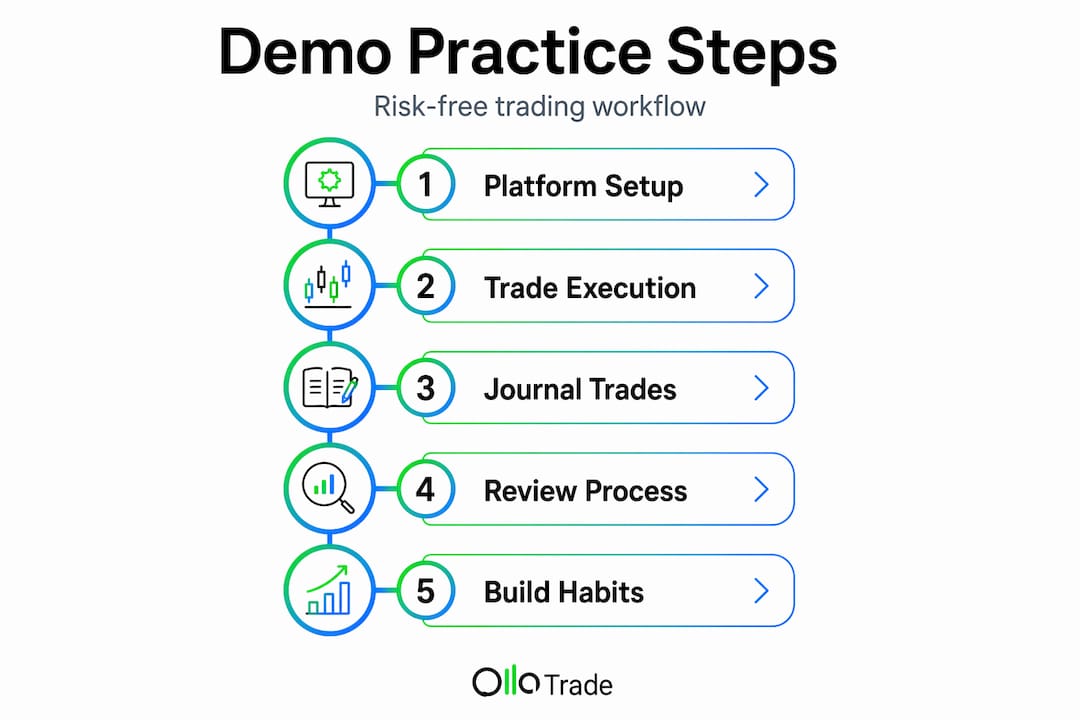
Getting your trading platform set up correctly from day one in demo mode is also critical. Learn where all the tools are, customize your workspace, and practice switching between timeframes and instruments before you ever touch a live account.
How to structure effective demo practice
Once you understand what demo trading is, you need to approach it systematically. Here’s how to run demo trading like a professional practice session rather than a casual click-fest.
The most important concept is treating demo like real trading. That means writing down your rules before you place a single trade. This sounds obvious, but most traders skip it entirely and simply react to price movements. A practical demo methodology means defining your entry condition, stop-loss method, take-profit or trailing approach, and maximum risk per trade, then running a sufficiently large number of trades before drawing any conclusions about whether the strategy works.
Here’s how to structure your demo practice effectively:
- Write your trading rules before starting. Define exactly what signals trigger an entry, where your stop loss goes, and how you’ll exit. No ambiguity.
- Set your virtual account balance to mirror your planned live deposit. If you plan to start live with $500, demo with $500, not $100,000.
- Record every trade in a journal. Note the setup, entry price, stop, target, result, and a brief explanation of your reasoning.
- Aim for at least 50 trades before evaluating your strategy. Fewer trades give you statistically meaningless results that can fool you into thinking a bad strategy works (or that a good one doesn’t).
- Review your journal on a fixed weekly schedule. Look at what went wrong in losing trades. Also look at winning trades and ask whether the process was sound or just lucky.
- Adjust only one rule at a time. If you change entry criteria, stop size, and targets simultaneously, you’ll never know what actually improved performance.
Pro Tip: Set a weekly calendar block specifically for reviewing your demo trades. Review with fresh eyes two to three days after placing the trades. Emotional distance gives you a clearer picture of whether your decisions were process-driven or impulsive.
Here’s a simple framework for tracking demo performance over time:
| Week | Trades taken | Win rate | Avg risk/reward | Process errors | Key observation |
|---|---|---|---|---|---|
| 1 | 12 | 42% | 1:1.2 | 4 | Entered before confirmation |
| 2 | 14 | 50% | 1:1.5 | 2 | Improved entry timing |
| 3 | 11 | 55% | 1:1.7 | 1 | Sizing still inconsistent |
| 4 | 13 | 54% | 1:1.8 | 0 | First clean process week |
Following a step-by-step trading workflow from the very start of your demo practice builds the repeatability that live trading demands. And when you’re ready to explore what specific strategies might fit your style, studying proven forex strategies with real examples alongside your demo work helps reinforce what you’re learning through observation.
Developing real trading habits in demo mode
Now that you’ve built a practice routine, let’s talk about transferring good habits from demo mode to real trading, especially around risk management, because this is where most traders quietly sabotage themselves.

The single most common mistake traders make in demo accounts is ignoring position sizing. Because the money isn’t real, they oversize positions, take bigger risks than they would ever take in a live account, and then feel confident when the trades work out. That confidence is false. It was built on behavior you would never realistically repeat with real money on the line.
Position sizing discipline matters on demo: use the same risk-based calculations you would use in live trading and avoid skipping sizing just because the money is virtual. If your rule is to risk 1% per trade on a live account, risk 1% per trade in demo. Period. No exceptions.
Here are the most damaging demo habits you need to avoid:
- Oversizing positions because the risk “doesn’t feel real” and then building false confidence from virtual wins
- Revenge trading after demo losses, chasing trades to recover virtual drawdowns (this habit transfers directly and devastatingly to live trading)
- Ignoring stop losses because there are no real consequences, training yourself to move stops or remove them entirely
- Skipping journaling on the assumption that you’ll “remember” what happened and why
- Not following your own defined rules, treating demo as a place to experiment randomly rather than test systematically
Each of these habits, when practiced consistently, becomes deeply ingrained. Muscle memory in trading is real. What you practice in demo, you will repeat in live. If you practice discipline, you take discipline live. If you practice recklessness, you take recklessness live.
Pro Tip: Build a pre-trade checklist and run through it for every single demo trade. Include items like “Entry signal confirmed?”, “Stop loss placed before entry?”, “Position size calculated at 1% risk?”, and “Journal entry started?”. Making this checklist automatic in demo makes it automatic in live.
The risk management steps you build into your demo routine are the same steps that protect your capital when real money is on the line. Practicing them consistently is the entire point of the exercise. You can also use platform features like alerts, automated order types, and trade templates to enforce discipline automatically during your demo sessions.
Demo vs. live trading: Key differences you must know
Understanding good practice is vital, but it’s just as important to understand demo’s limitations compared to live trading, especially during fast-moving markets.
The most significant and often overlooked gap involves order execution. Demo accounts can differ materially from live trading during extreme volatility and around news or liquidity events, particularly in how orders fill, including slippage and depth-of-market effects. In a demo, your order gets filled at the price you see on screen. In live trading during a major news release like a Non-Farm Payrolls report or a central bank decision, the price you clicked on may not be where your order actually executes.
Here’s a direct comparison of what differs between demo and live:
| Feature | Demo trading | Live trading |
|---|---|---|
| Financial risk | None | Real capital at stake |
| Order fills | Instant at quoted price | Subject to slippage and spread widening |
| Spread behavior | Usually fixed or stable | Widens significantly during news/volatility |
| Emotional pressure | Minimal | High, especially during drawdown |
| Liquidity simulation | Not realistic during extremes | Real depth of market applies |
| Habit formation | Fully applicable | Habits from demo transfer directly |
What demo does teach you well:
Your process, your rule-following ability, your journaling habits, your ability to identify setups according to your criteria, and your understanding of platform mechanics all transfer directly from demo to live. These are foundational skills.
What demo cannot fully teach you:
Emotional control under real financial pressure is something you cannot fully simulate. The physical sensation of watching a position move against you when real money is at stake is genuinely different from watching virtual numbers change. Many traders who perform excellently in demo struggle with discipline in live accounts simply because the emotional component is entirely new.
Understanding the order execution policy details of your broker before you go live is critical. Know what to expect during high-impact events. Also review what realistic demo fills look like versus what live fills can look like during volatile conditions.
This doesn’t mean demo is useless for preparing for live trading. It means you should use it for exactly what it’s good at: building a sound, repeatable process. And when you do go live, start with the smallest possible position sizes until you’ve adjusted to the psychological reality of risking real capital.
What most traders miss about demo trading
With demo’s strengths and weaknesses in mind, here’s a perspective on what really matters in demo trading for long-term success, and why the conventional advice barely scratches the surface.
Most traders approach demo trading as a profitability exercise. They want to see their virtual balance grow, take screenshots of winning streaks, and use those results as proof they’re ready for live trading. That’s almost entirely backwards.
Using demo to validate your process, including order entry correctness, stop placement logic, position sizing, and journaling, is far more valuable than using it as evidence of profitability. A trader who makes 40% virtual return in three weeks and makes zero process errors is less prepared for live trading than a trader who breaks even over 60 trades with zero process errors. The second trader has built something repeatable and reliable. The first has built confidence in an outcome that may have been random.
The traders we see succeed after the demo stage are almost never the ones who “crushed it” in demo. They’re the ones who treated demo seriously enough to catch and correct their own mistakes before those mistakes cost them real money.
There’s also a journaling insight that most guides don’t mention. The value of a trade journal isn’t in the win/loss record. It’s in the decision record. Why did you enter? What did you expect? What actually happened? Was the decision logical given the information you had at entry? A winning trade built on poor logic is a dangerous teacher. A losing trade built on sound logic is a valuable one.
Reviewing your demo account best practices with this mindset shifts demo from a confidence-building exercise into a genuine skill-development process. That’s the shift that actually prepares you for live trading.
Ready to put your practice to the test?
After building process discipline and understanding demo’s place in your trading journey, it’s time to take the next step with the tools and support you need to move forward.
At Olla Trade, we built our platform to support traders at every stage, from their first demo trade to managing live positions across forex, metals, indices, and more. Whether you’re still in Olla Trade’s forex platform exploring instruments and execution quality, working through a step-by-step forex trading guide to lock in your process, or ready for a complete forex trading guide that covers everything from market structure to live account management, we have the resources to support your growth. The groundwork you’ve built in demo is valuable. Now it’s time to put it to work with the right platform behind you.
Frequently asked questions
How long should I use a forex demo account before going live?
You should demo trade for at least 50 trades to ensure your process is consistent and that your results reflect your system rather than random short-term outcomes.
Can I practice risk management in a demo account?
Yes, demo trading is the ideal environment to develop risk-control habits like position sizing discipline and strict stop placement, as long as you practice them exactly as you would in a live account.
Are demo account results always realistic compared to live trading?
Demo results often differ during high-volatility or news events because live market slippage and spread spikes aren’t fully simulated in most demo environments.
What’s the main goal when using a forex demo account?
The primary goal is to master your process, including order entry, discipline, and journaling, rather than maximizing virtual profits, as confirmed by process validation principles used by serious traders.