











خلاصه؛ خلاصه:
- Leverage amplifies both gains and losses equally, increasing risk of rapid margin call and liquidation.
- Different markets have varying leverage limits and margin rules, affecting risk and trading strategies.
- Responsible traders use leverage cautiously, prioritizing capital preservation over maximum leverage to ensure longevity.
Many traders enter the market believing leverage is a fast track to outsized profits. The reality is more nuanced. Leverage amplifies both gains and losses equally, meaning a 2% move against your position at 50:1 leverage wipes out your entire margin in seconds. This guide breaks down exactly how leverage works, what margin requirements mean for your account, how different markets treat leverage differently, and what advanced risks even experienced traders overlook. If you want to use leverage as a precision tool rather than a gamble, this is where to start.
فهرست مطالب
- What is leverage and how does it work?
- Margin requirements and liquidation risks
- Comparing leverage across markets and instruments
- Strategic uses of leverage and advanced risks
- Why more leverage isn’t always better: a clear-eyed perspective
- Trade smarter with the right leverage tools
- سوالات متداول
نکات کلیدی
| نقطه | جزئیات |
|---|---|
| Leverage magnifies outcomes | Using leverage increases both potential profits and losses equally for each trade. |
| Margin calls prevent losses | Brokers liquidate positions if your account can’t meet minimum margin requirements. |
| Leverage rules vary by market | Different instruments like forex, stocks, and futures all have unique leverage and margin structures. |
| Survival trumps maximum gain | Practical trading focuses on risk control and survival rather than using maximum leverage for returns. |
What is leverage and how does it work?
Leverage means using borrowed capital to control a position larger than your actual account balance. When a broker offers you 10:1 leverage, a $1,000 deposit lets you control a $10,000 position. The money you put up is called margin, and it acts as collateral against the borrowed portion. Leverage allows traders to control larger positions with less capital by using margin as collateral, amplifying both profits and losses equally.
Here are the key terms every leveraged trader must understand:
- حاشیه: The deposit you provide to open a leveraged position.
- Collateral: Your account equity that backs the borrowed funds.
- Initial margin: The minimum amount required to open a trade.
- Maintenance margin: The minimum equity you must maintain to keep the position open.
- Margin call: A broker notification that your equity has dropped near the maintenance threshold.
- Liquidation: Forced closure of your position when equity falls below the required level.
Let’s make this concrete. Say you open a $10,000 forex trade using 10:1 leverage with $1,000 of your own capital. If the market moves 5% in your favor, you gain $500, a 50% return on your $1,000 margin. But if the market moves 5% against you, you lose $500, half your margin, in a single trade. A 10% adverse move wipes you out entirely. That asymmetry is what makes leverage dangerous for traders who underestimate volatility.
“Leverage is not inherently reckless. Used with discipline and proper position sizing, it is a standard institutional tool. The problem is retail traders often treat maximum leverage as a default setting rather than a ceiling.”
درک key benefits and risks before you size a position is non-negotiable. You should also build a solid foundation with leverage in trading basics before moving into complex instruments. And tracking trading equity explained helps you monitor how leverage affects your real-time account health.
نکته حرفهای: Start with leverage ratios of 5:1 or lower until you can consistently manage margin fluctuations without emotional reactions. Lower leverage gives you time to think.
Margin requirements and liquidation risks
Understanding margin is essential for risk control, so let’s explore how requirements and liquidation actually work.
There are two types of margin you need to know. Initial margin is what you deposit to open a position. Maintenance margin is the ongoing minimum your account must hold. These are not the same number. Brokers set maintenance margin below initial margin, giving you a small buffer before a margin call triggers.
Here is what happens during a margin call, step by step:
- Your open position moves against you, reducing your account equity.
- Equity drops toward the maintenance margin threshold.
- The broker issues a margin call, notifying you to deposit more funds or reduce positions.
- If you do not act quickly, the broker begins liquidating your positions automatically.
- Liquidation closes trades at current market prices, which may be far worse than your intended exit.
- You are left with whatever equity remains, sometimes less than you started with.
Falling below maintenance margin triggers liquidation, and this process can happen faster than most traders expect. In volatile markets, a position can move from healthy to liquidated within minutes. What surprises many new traders is that even a small price move, sometimes just 1% to 2%, can trigger a margin call when leverage is set at 50:1 or higher.
“The market does not care about your margin. It moves on its own logic. Your job is to size positions so that normal volatility never threatens your maintenance threshold.”
You can use the forex margin calculations tool to model exactly how much a position move affects your equity before you place the trade. Planning this in advance removes the guesswork. For a deeper look at leverage mechanics, reviewing the underlying concepts helps reinforce why these numbers matter.
نکته حرفهای: Always place a stop-loss order at a level where your account equity stays well above the maintenance margin. This prevents forced liquidation from taking the decision out of your hands.
Comparing leverage across markets and instruments
Different trading instruments follow unique leverage rules, so let’s compare them side by side.
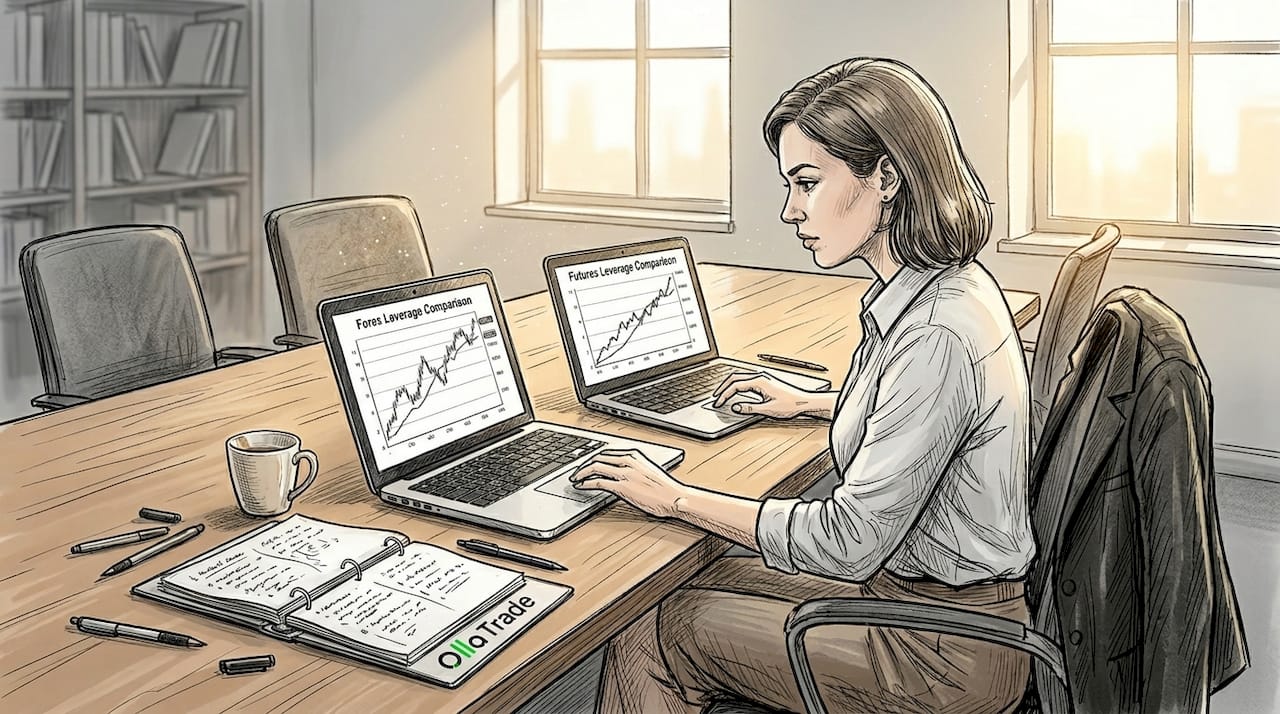
Not all markets treat leverage the same way. Forex typically allows the highest leverage, sometimes 100:1 or more in unregulated jurisdictions, while regulated retail accounts in the US are capped at 50:1 for major pairs. Stock CFDs usually carry lower leverage, and futures use a daily mark-to-market margin system. The OTC derivatives notional exceeded $700T in 2023, reaching $846T by June 2025, which illustrates just how much of the global financial system runs on leveraged instruments.
| بازار | Typical leverage | Margin type | ریسک کلیدی |
|---|---|---|---|
| Forex (retail) | Up to 50:1 (US) | Initial + maintenance | Overnight swap costs |
| Stock CFDs | 5:1 to 20:1 | Initial + maintenance | Dividend adjustments |
| معاملات آتی | Varies by contract | Daily mark-to-market | Margin calls at settlement |
| Leveraged ETFs | 2x to 3x built-in | None required | Compounding decay |
Each market carries its own quirks:
- فارکس: High leverage is available, but overnight funding costs (swap rates) can erode profits on positions held for days.
- قراردادهای CFD سهام: Lower leverage limits reduce blow-up risk, but corporate events like earnings can cause sudden gaps.
- Futures: Margins are designed to cover only one day of expected moves, making them unsuitable for long-term speculation without active management. Explore futures trading nuances to understand how contract-specific rules affect your exposure.
- Leveraged ETFs: These products use derivatives internally to deliver 2x or 3x daily returns. Over time, compounding effects cause them to diverge significantly from the underlying index, especially in sideways or volatile markets.
Reviewing a detailed leverage guide for each instrument type before trading is worth the time investment. The rules that protect you in forex do not automatically apply when you switch to futures or ETFs.
Strategic uses of leverage and advanced risks
Comparing instruments highlights why advanced traders focus on calculated, not maximum, leverage.
Professional traders use leverage for three main purposes: hedging existing positions to reduce net exposure, speculation on directional moves with defined risk, and arbitrage to exploit pricing inefficiencies across related instruments. In each case, the leverage ratio is chosen deliberately based on expected volatility and position size, not defaulted to the broker’s maximum.
Advanced risks that many retail traders underestimate include:
| Risk type | What it means | Who it hits hardest |
|---|---|---|
| Liquidation cascades | One forced closure triggers others in correlated positions | High-leverage multi-position traders |
| لغزش | Execution price differs from expected during fast markets | Traders using market orders in volatile conditions |
| Funding drag | Daily financing costs compound against long leveraged positions | Traders holding positions for weeks or months |
| Compounding decay | LETFs lose value in choppy markets even if the index is flat | Long-term LETF holders |
The Kelly criterion offers a mathematical framework for sizing leveraged bets. Full Kelly maximizes long-term growth in theory, but in practice it produces drawdowns so large that most traders abandon their strategy before recovery. Fractional Kelly is preferred by experienced traders because it sacrifices some theoretical growth in exchange for survivability. LETFs, meanwhile, offer what researchers describe as call-like payoffs: capped downside but significant compounding effects that work against you in non-trending markets.
مرور کنید افشای ریسک معاملات for any instrument before committing capital. Understanding the specific risks tied to each product is not optional, it is the baseline for responsible trading.
نکته حرفهای: Size every trade so that your worst realistic loss, not your average loss, keeps your account above the maintenance margin. Survival is the prerequisite for long-term profitability.
Why more leverage isn’t always better: a clear-eyed perspective
Here is what years of watching traders succeed and fail with leverage actually teaches: the traders who last are almost never the ones using maximum leverage. They are the ones who treat leverage as a dial they rarely turn past 20% of its maximum range.
The lure of amplified gains is psychologically powerful. A 10:1 leveraged win feels like proof of skill. But consistent profitability comes from disciplined risk limits, not from squeezing every dollar of buying power out of your margin. Many professional traders use fractional or even no leverage on a significant portion of their book, precisely because capital preservation matters more than any single trade outcome.
The uncomfortable truth is that leverage fundamentals are not complicated. What is hard is the discipline to use less than you are allowed to. Treat leverage as a risk management tool, not a profit shortcut. The traders who internalize that distinction are the ones still trading five years from now.
نکته حرفهای: Focus on surviving volatility first. A trader who loses 50% needs a 100% gain just to break even. Protecting capital is always the priority.
Trade smarter with the right leverage tools
If you want to trade with leverage responsibly, specialized resources make a real difference. Choosing a platform that gives you clear visibility into your margin levels, leverage settings, and real-time equity is the first step toward disciplined execution.
At Olla Trade, you get access to a full suite of tools designed for traders who take risk management seriously. Start with CFD trading explained to understand the instrument mechanics, then work through the راهنمای گام به گام فارکس to see how leverage applies in live market conditions. For a broader view of how leveraged instruments behave across different market environments, explore the leveraged trading insights section. Knowledge applied through the right platform is what separates informed traders from the rest.
سوالات متداول
How does leverage increase both risk and reward?
Leverage amplifies gains and losses equally, so a 1% market move becomes a 10% gain or loss on your margin at 10:1 leverage. The same mechanism that accelerates profits accelerates losses at exactly the same rate.
What triggers liquidation in leveraged trading?
Falling below maintenance margin triggers liquidation, which means the broker automatically closes your positions to prevent further losses beyond your deposited margin.
How does leverage differ between forex, futures, and LETFs?
Forex allows high leverage with relatively low margin requirements, futures margins cover short-term moves and require daily settlement, while LETFs deliver built-in leverage with compounding effects that diverge from the index over time.
What is the Kelly criterion and how does it relate to leverage?
Full Kelly maximizes growth but causes large drawdowns, so most experienced traders use a fraction of the Kelly-recommended size to balance growth potential with the practical need to survive losing streaks.
توصیه شده
- Leveraged Instruments Trading: Key Benefits and Risks – Olla Trade
- هر آنچه که باید در مورد اهرم در معاملات بدانید - اولا ترید
- ارزش ویژه در معاملات چیست؟ راهنمای ضروری برای معاملات هوشمندانهتر
- بهترین شیوههای برتر برای معاملهگران: افزایش عملکرد در سال 2026
- Crypto trading risk checklist: 1-2% rule for safer trades