











You want to grow your money through trading but feel overwhelmed by the sheer number of markets, platforms, and strategies out there. Should you trade forex, stocks, or cryptocurrencies? How do you even start? This comprehensive guide breaks down the essentials of online trading for beginners, covering the fundamentals of forex, stocks, and crypto markets, how to choose the right platform, and practical strategies to help you take your first confident steps into the world of trading. By the end, you’ll understand the basics and be ready to start trading with clarity and control.
Table of Contents
- Key takeaways
- Understanding the basics: what is online trading?
- Preparing to trade: choosing your market and platform
- Starting your first trades: strategies and risk management
- Monitoring progress and avoiding common pitfalls
- Discover smart trading with Olla Trade
- Frequently asked questions
Key Takeaways
| Point | Details |
|---|---|
| Market differences | Forex is the largest 24 hour market with high liquidity, stocks trade during set hours and hinge on company fundamentals, while cryptocurrencies trade around the clock with extreme volatility. |
| Platform matters | Choosing a platform with reliable execution, solid charts, and beginner friendly tools is crucial for starting strong. |
| Risk management | Learn basic risk controls such as position sizing, stop losses, and avoiding excessive leverage to protect capital. |
| Strategy selection | Start with a simple, rule based strategy and test it on a demo before applying it to real trades. |
| Demo practice | Use a demo account for at least two weeks to learn mechanics and build confidence without risking real money. |
Understanding the basics: what is online trading?
Online trading enables buying and selling financial assets through internet-based platforms without needing a traditional broker on the phone. You access markets directly from your computer or smartphone, executing trades in real time. This democratization of finance has opened investing to millions who previously lacked access.
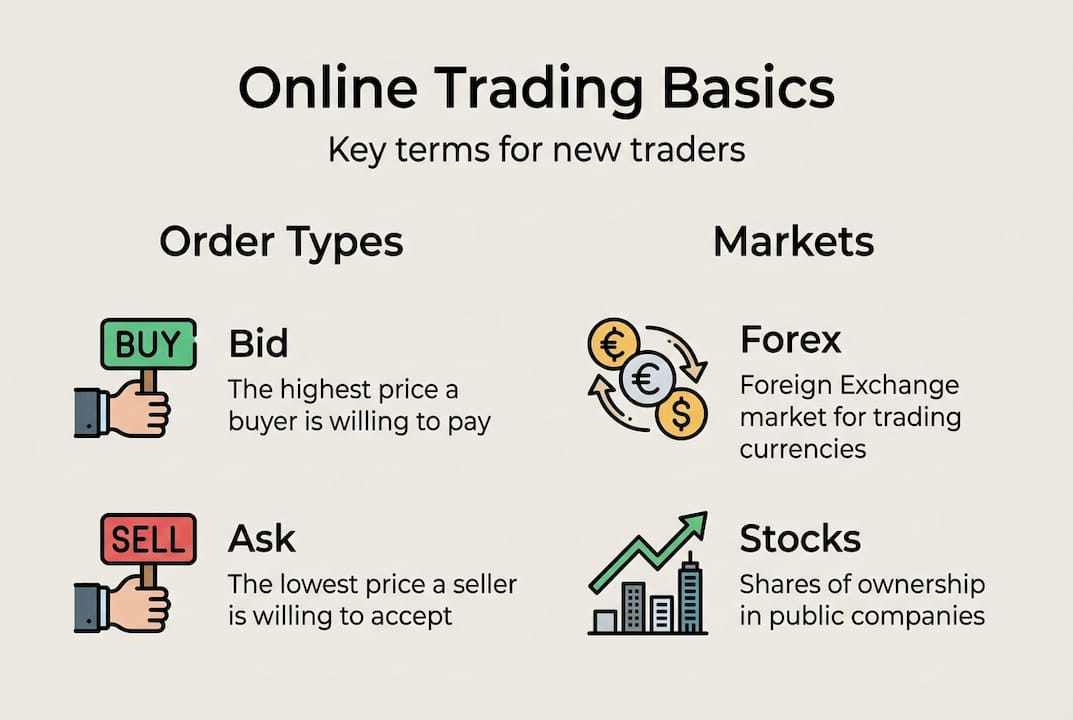
Forex trading involves exchanging one currency for another in pairs like EUR/USD or GBP/JPY. It’s the largest financial market globally, with over $7.5 trillion traded daily. The forex market operates 24 hours a day, five days a week, across major financial centers from Sydney to New York. Currency values fluctuate based on economic data, geopolitical events, and central bank policies.
Stocks represent ownership shares in publicly traded companies. When you buy Apple or Tesla stock, you own a tiny piece of that business. Stock prices rise and fall based on company performance, earnings reports, and broader market sentiment. Unlike forex, stock markets have set trading hours, typically 9:30 AM to 4:00 PM Eastern Time for U.S. exchanges.
Ccryptocurrencies are digital assets that use blockchain technology for secure, decentralized transactions. Bitcoin, Ethereum, and thousands of altcoins trade around the clock, seven days a week. Crypto markets exhibit extreme volatility, with prices sometimes swinging 10-20% in a single day. This volatility creates opportunities but also significant risks for inexperienced traders.
Key trading terms you need to know: The bid is the highest price a buyer will pay, while the ask is the lowest price a seller will accept. The spread is the difference between these two. Leverage allows you to control larger positions with less capital, magnifying both gains and losses. A pip measures price movement in forex pairs.
Trading platforms are software applications that connect you to markets and execute your orders. They display real-time prices, charting tools, news feeds, and order entry systems. Modern platforms offer mobile apps, advanced analytics, and automated trading capabilities. Choosing the right platform is crucial for your success as a beginner.
Pro Tip: Before risking real money, spend at least two weeks practicing on a demo account to learn basic about online trading mechanics without financial pressure. This builds muscle memory for order entry and helps you understand how markets move.
Preparing to trade: choosing your market and platform
Selecting your first market depends on your schedule, risk tolerance, and interests. Forex suits traders who want 24-hour access and prefer analyzing economic data over company fundamentals. The major currency pairs like EUR/USD offer tight spreads and high liquidity, making them ideal for beginners. Forex also requires less capital to start compared to stocks.
Stocks appeal to those interested in company performance and long-term investing alongside active trading. You can research businesses, read earnings reports, and make informed decisions based on tangible products and services. Stock trading during set hours fits well with a day job. However, individual stocks can gap up or down dramatically on news, creating overnight risk.
Cryptocurrencies attract traders comfortable with extreme volatility and 24/7 markets. The crypto space moves fast, with new projects launching constantly. You can trade tiny fractions of expensive coins like Bitcoin, making it accessible with small capital. But the lack of regulation and wild price swings make crypto the riskiest option for beginners.
Platform features matter enormously for your trading experience and safety. Look for an intuitive interface that doesn’t overwhelm you with unnecessary complexity. Security features like two-factor authentication and encryption protect your funds. Regulatory compliance ensures the platform follows financial laws and maintains segregated client accounts.
Fees significantly impact profitability, especially for active traders. Compare spreads, commissions, overnight financing charges, and withdrawal fees across platforms. Some brokers offer commission-free trading but widen spreads to compensate. Calculate total costs based on your expected trading frequency.
| Platform Type | Best For | Key Advantages | Main Drawbacks |
|---|---|---|---|
| Full-service brokers | Stock traders wanting research | Comprehensive tools, analyst reports, customer support | Higher fees, complex interfaces |
| Forex specialists | Currency traders | Tight spreads, high leverage, 24/5 access | Limited to forex and CFDs |
| Crypto exchanges | Digital asset traders | Wide coin selection, 24/7 trading | High volatility, less regulation |
| Multi-asset platforms | Diversified beginners | One account for multiple markets | May lack specialized features |
Regulatory oversight protects you from fraud and ensures fair treatment. In the U.S., look for SEC registration for stock brokers or CFTC/NFA membership for forex dealers. European traders should verify FCA, CySEC, or other EU regulator authorization. Check the regulator’s website directly, not just the broker’s claims.
Account setup requires identity verification to comply with anti-money laundering laws. Prepare a government ID, proof of address like a utility bill, and sometimes bank statements. Most platforms approve accounts within 24-48 hours. Minimum deposits range from $50 to $500 depending on the broker and account type.
Pro Tip: Test multiple platforms using their demo accounts before committing real money. This lets you compare interfaces, execution speed, and available tools risk-free. Follow the safe trading account checklist to verify legitimacy and ensure you understand the complete guide to trading platforms before funding your account.
Starting your first trades: strategies and risk management
Placing your first trade involves several clear steps. First, analyze the market using charts and news to identify a potential opportunity. Decide whether you expect the price to rise (go long) or fall (go short). Choose your position size based on your risk tolerance and account balance. Select an order type: market orders execute immediately at current prices, while limit orders trigger only at your specified price.
Enter your trade through the platform’s order entry screen, specifying the asset, direction, size, and order type. Always set a stop-loss order simultaneously to limit potential losses. This automatic exit closes your position if the price moves against you by a predetermined amount. Confirm all details before clicking the final execute button.
Trend following is the simplest beginner strategy. You identify an existing price trend using moving averages or trendlines, then trade in that direction. If EUR/USD has been rising steadily, you look for opportunities to buy on small pullbacks. The logic is simple: trends tend to continue longer than most traders expect. Exit when the trend shows signs of reversing.
Range trading works in sideways markets where prices bounce between support and resistance levels. You buy near support and sell near resistance, profiting from predictable oscillations. This strategy requires patience and works best in calm market conditions. Range trading fails when prices break out of the established boundaries.
CFD trading strategies offer flexibility for beginners exploring different timeframes. Day trading involves opening and closing positions within a single session, avoiding overnight risk. Swing trading holds positions for days or weeks to capture larger price moves. Choose based on how much time you can dedicate to monitoring markets.
- Start with a trading plan that defines your strategy, risk per trade, and daily loss limits.
- Analyze the market using technical indicators like moving averages, RSI, or support and resistance.
- Wait for your setup to appear rather than forcing trades out of impatience.
- Enter the trade with proper position sizing, never risking more than 1-2% of your account.
- Set your stop-loss immediately to protect against unexpected moves.
- Monitor the trade but avoid micromanaging every tiny price fluctuation.
- Take profit at your predetermined target or when your strategy signals an exit.
- Record the trade details in your journal for later review.
Position sizing determines how many units or contracts you trade. Calculate this based on your stop-loss distance and risk percentage. If you have a $1,000 account and risk 2% ($20) per trade, with a 20-pip stop-loss on EUR/USD, you can trade approximately 0.1 lots. Never risk more than you can afford to lose.
Common beginner mistakes include overtrading due to excitement or boredom. Each trade should meet your strategy criteria, not just fill time. Ignoring market news leads to getting caught in volatile moves around economic releases. Check the economic calendar daily. Revenge trading after losses compounds problems by adding emotional decisions to poor judgment.
Pro Tip: Keep a detailed trading journal documenting every trade’s entry price, exit price, reasoning, and emotional state. Review it weekly to identify patterns in your winners and losers. This self-awareness accelerates improvement faster than any course or book. Understanding the forex vs CFDs comparison helps you choose instruments matching your risk profile.
Monitoring progress and avoiding common pitfalls
Tracking your trading performance reveals what’s working and what needs adjustment. Use a spreadsheet or specialized trading journal software to record every trade. Include entry and exit prices, position size, profit or loss, strategy used, and market conditions. Calculate your win rate, average win size, average loss size, and overall profitability weekly.
Key performance metrics tell the real story of your trading. Win rate alone is misleading; a 40% win rate with large winners and small losers can be very profitable. Your risk-reward ratio shows whether you’re making more on winners than losing on losers. Aim for at least 1:2, risking $1 to make $2. Maximum drawdown measures your largest peak-to-valley account decline, indicating how much heat you can handle.
Common pitfalls destroy beginner accounts faster than lack of knowledge. Chasing losses by increasing position sizes to recover quickly almost always leads to bigger losses. Your emotions take over, and rational decision-making disappears. Accept losses as part of trading and stick to your predetermined risk limits.
Emotional trading manifests as fear and greed. Fear causes you to exit winning trades too early or avoid valid setups after a loss. Greed makes you hold losers hoping they’ll turn around or risk too much on a single trade. Recognize these emotions and follow your plan regardless of how you feel.
| Common Mistake | Impact on Trading | Solution |
|---|---|---|
| Overtrading | Increases transaction costs, leads to exhaustion and poor decisions | Set maximum daily trades, only trade high-probability setups |
| No stop-loss | Single bad trade can wipe out weeks of gains | Always set stop-loss before entering, never move it further away |
| Ignoring news | Unexpected volatility causes large losses | Check economic calendar for traders daily, avoid trading during major releases |
| Risking too much | One or two losses devastate account, creates emotional pressure | Limit risk to 1-2% per trade, never exceed 5% total market exposure |
| Lack of plan | Random decisions lead to inconsistent results | Write detailed trading plan with entry, exit, and risk rules |
Staying informed requires daily market preparation. Check the economic calendar for upcoming data releases that could cause volatility. Read market analysis from reputable sources to understand current themes driving prices. Follow central bank announcements and geopolitical developments affecting your chosen markets.
Adjusting your strategy happens gradually based on data, not emotions. If your win rate drops below historical averages for 20+ trades, something changed. Perhaps market conditions shifted from trending to ranging, requiring a strategy adjustment. Or you’re entering trades too early, needing better confirmation signals. Make small tweaks and test them over adequate sample sizes.
Realistic goal setting prevents frustration and reckless trading. Expecting to double your account monthly leads to excessive risk-taking. Professional traders often target 2-5% monthly returns consistently. Focus on process goals like following your plan perfectly rather than outcome goals like specific dollar amounts. You can’t control market results, only your actions.
Pro Tip: Review your trading journal every Sunday for 30 minutes. Identify your three best and three worst trades of the week. What did you do right? What mistakes did you make? Write down one specific improvement to focus on in the coming week. This deliberate practice compounds into significant skill development. Understanding risk disclosures helps you maintain realistic expectations and avoid common errors.
Discover smart trading with Olla Trade
Ready to put your new knowledge into practice? Olla Trade provides everything beginners need to start trading confidently across forex, stocks, and cryptocurrencies. Our intuitive platform combines powerful tools with educational resources designed specifically for traders taking their first steps into financial markets.
Access comprehensive guides covering every aspect of trading, from understanding trading platforms to mastering key platform features that improve your results. Practice risk-free with demo accounts before committing real capital. Our platform offers tight spreads, fast execution, and advanced charting tools that grow with your skills. Join thousands of traders who trust Olla Trade’s comprehensive trading environment to support their journey from beginner to confident trader.
Frequently asked questions
What is the minimum amount to start online trading?
Minimum deposits vary significantly by platform and market, with some forex brokers accepting as little as $50 while stock brokers may require $500 or more. However, starting with at least $500-$1,000 gives you enough capital to properly manage risk using the 1-2% rule per trade. Smaller accounts force you to either risk too much percentage-wise or trade such tiny positions that transaction costs eat up profits. Begin with an amount you can afford to lose completely while learning.
How do I manage risk when trading cryptocurrencies?
Crypto’s extreme volatility demands strict risk management to survive inevitable drawdowns. Always use stop-loss orders placed at logical technical levels, not arbitrary percentages. Limit each crypto position to 1% of your account or less given the potential for 20-30% daily swings. Diversify across multiple coins rather than concentrating in one. Stay informed about regulatory news and major developments that trigger massive price moves. Never let emotions override your predetermined exit strategy.
Can I trade multiple markets at the same time?
Yes, experienced traders often diversify across forex, stocks, and crypto simultaneously to spread risk. However, beginners should master one market completely before adding others. Each market has unique characteristics, trading hours, and drivers requiring dedicated study. Splitting attention too early dilutes your focus and slows skill development. Once you’re consistently profitable in one market for at least six months, gradually add a second market while maintaining strict risk limits across your entire portfolio.
What are common mistakes beginners should avoid?
Overtrading ranks as the top beginner mistake, driven by excitement or the need to constantly be in the market. This generates excessive transaction costs and leads to trading low-probability setups. Emotional decision-making, especially revenge trading after losses, compounds problems by abandoning your strategy when discipline matters most. Neglecting stop-loss orders exposes you to catastrophic losses that wipe out weeks of gains in minutes. Poor position sizing, particularly risking 5-10% per trade, ensures that a normal losing streak devastates your account before you develop skills.