










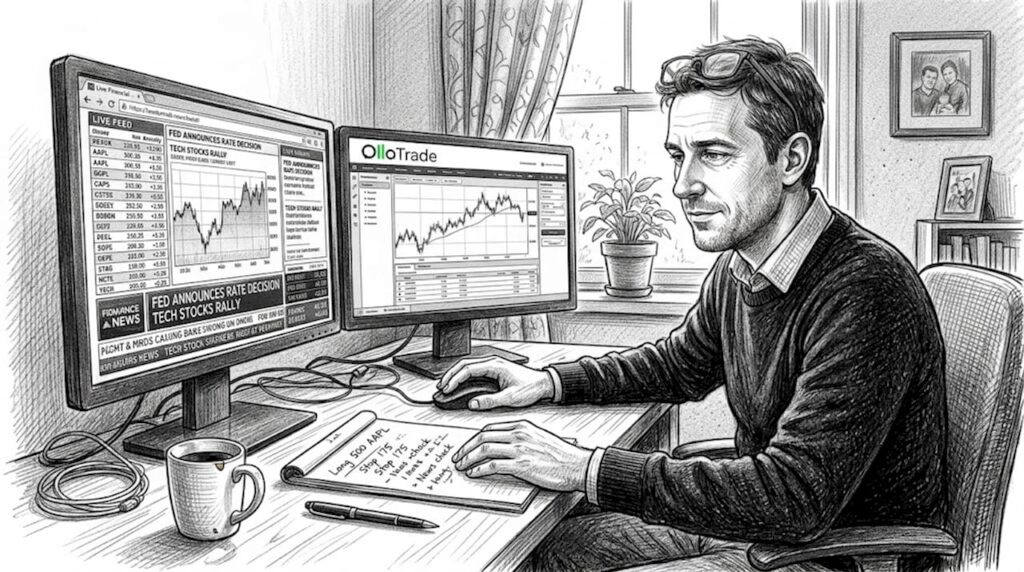
باختصار شديد:
- Market news influences prices through scheduled releases and unscheduled events, creating different levels of volatility.
- Properly analyzing market sentiment and preparing for news events can offer strategic trading advantages.
- Overreacting to headlines and trading without context increase risks, making disciplined filtering essential.
Most traders assume that following market news closely always leads to better decisions. That assumption is worth questioning. Media bias often causes days with heavy news coverage to show outsized price drops compared to the actual underlying trend, meaning the relationship between news and price isn’t as straightforward as it looks. Understanding كيف to use market news, not just whether to follow it, is what separates traders who profit from volatility and those who get burned by it. This article breaks down the mechanisms, the real benefits, the hidden risks, and the practical frameworks you need to trade news events with confidence.
جدول المحتويات
- How market news impacts traders and price movements
- The real benefits of monitoring market news
- Risks and pitfalls of news-driven trading
- Best practices for monitoring market news efficiently
- Expert perspective: Why market news isn’t always the answer
- Optimize your trading with professional tools
- الأسئلة الشائعة
أهم النقاط
| نقطة | تفاصيل |
|---|---|
| Focus on high-impact news | Trading around scheduled releases is where news monitoring delivers the greatest risk and opportunity. |
| Sentiment analysis adds edge | Combining news sentiment and trading volume data can enhance prediction and profitability for active traders. |
| Beware emotional trading | Retail traders who react to daily news often lose more, so filtering for relevance and using risk controls is critical. |
| Use smart tools | Economic calendars, real-time alerts, and news platforms help traders stay prepared and reduce avoidable losses. |
| News is not always beneficial | Both novice and seasoned traders must learn when to tune out headlines and rely on strategic frameworks. |
How market news impacts traders and price movements
Market news moves prices through two main channels: scheduled economic releases and unscheduled breaking events. Both create volatility, but they require very different preparation strategies.
Scheduled releases are the backbone of economic calendars. Events like CPI (Consumer Price Index), NFP (Non-Farm Payrolls), GDP reports, and central bank interest rate decisions are known in advance. Traders can prepare positions, set alerts, and plan entries or exits around them. High-impact releases like these cause extreme volatility, which is why checking economic release schedules before trading is a non-negotiable habit for serious traders.
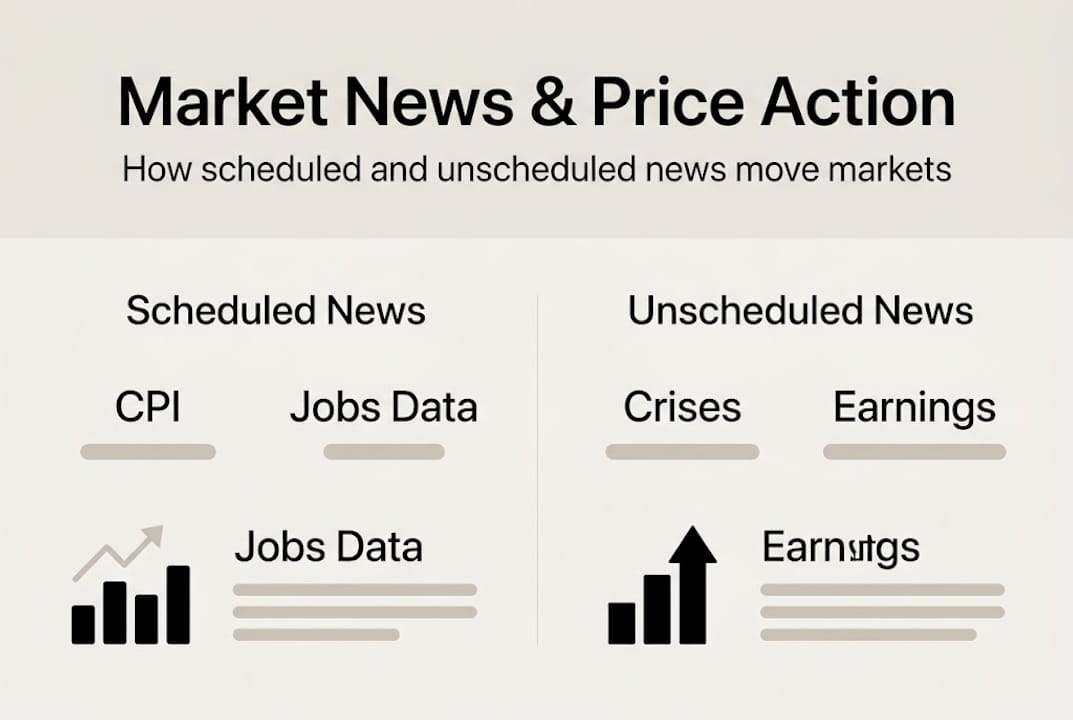
Unscheduled events are harder to plan for. Geopolitical crises, surprise corporate earnings, regulatory announcements, or sudden central bank commentary can trigger sharp moves with almost no warning. These events test your risk management setup more than your analysis skills.
One of the most widely used news-based tactics is “buy the rumor, sell the news.” This strategy exploits the sentiment shift that happens when anticipated good news is finally confirmed, often causing prices to reverse as traders who bought in early take profits. The result? A price drop on what looks like great news.
Here’s a quick breakdown of common news types and their typical market impact:
| News type | Scheduled? | Typical volatility | Key instruments affected |
|---|---|---|---|
| CPI / Inflation data | نعم | مرتفع جداً | Forex, indices, bonds |
| NFP (Non-Farm Payrolls) | نعم | مرتفع جداً | USD pairs, gold |
| Central bank decisions | نعم | Extreme | All major assets |
| الأحداث الجيوسياسية | لا | High to extreme | Safe havens, oil |
| Corporate earnings | نعم | عالي | Stocks, indices |
| Regulatory announcements | لا | Moderate to high | Sector-specific |
Key ways news shapes trading conditions:
- Spread widening: Brokers widen spreads during high-impact releases, increasing your cost per trade.
- Stop-loss hunting: Sudden spikes can trigger stops before price reverses to your original direction.
- Liquidity gaps: Thin markets around releases can cause slippage, meaning your order fills at a worse price than expected.
- Sentiment shifts: A single headline can flip market mood from risk-on to risk-off within seconds.
Using a market news platform alongside solid نصائح سوق الفوركس gives you the context to read these moves rather than react blindly to them.
The real benefits of monitoring market news
Monitoring news isn’t just about knowing what happened. It’s about reading what the market expects to happen and positioning yourself accordingly.
Research on news sentiment signals shows that high media pessimism predicts lower prices followed by a reversion, and sentiment extremes predict spikes in trading volume. Long-short strategies built on sentiment data have historically earned strong returns, giving disciplined traders a measurable edge.
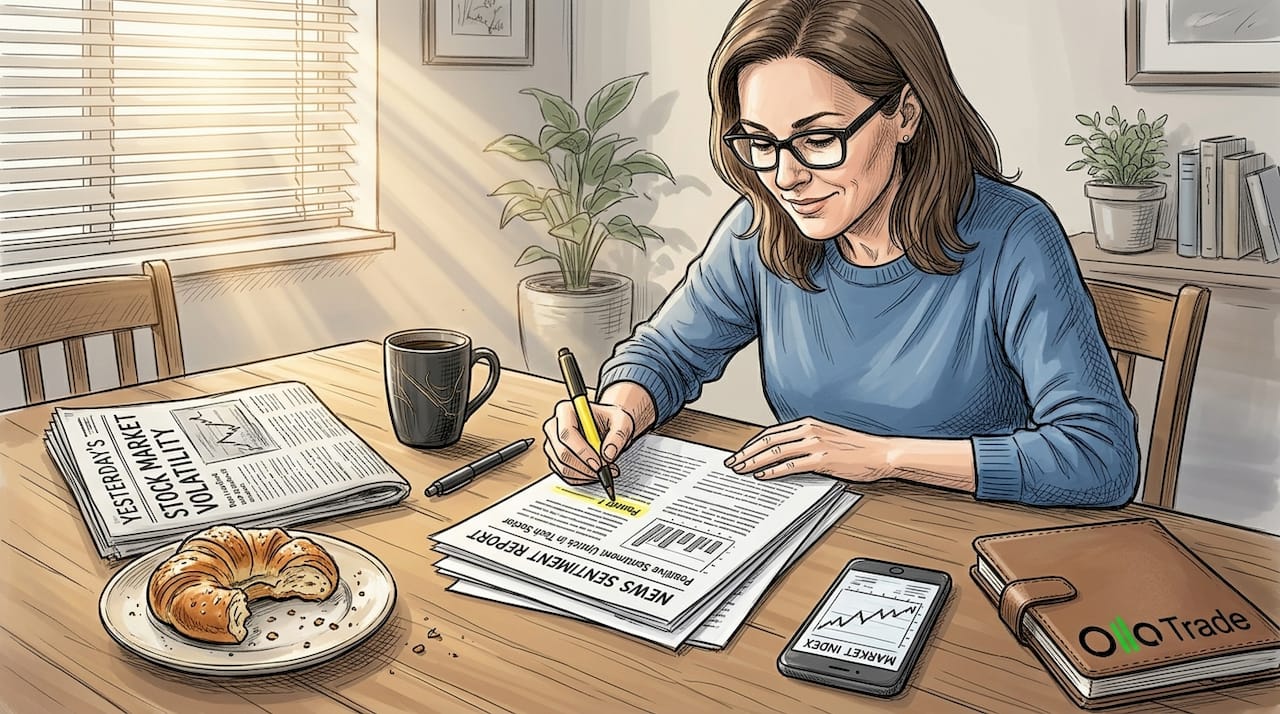
For equity traders specifically, a study covering European stocks from 2010 to 2021 found that high investor sentiment stocks showed returns persisting for up to three months, with the effect being stronger for small-cap stocks. Positive news also takes longer to be priced in than negative news, which creates a window for informed traders to act.
| Benefit | How it helps you |
|---|---|
| Sentiment extremes | Signal potential reversals and volume surges |
| Slow pricing of positive news | Creates multi-session entry opportunities |
| Small-cap sensitivity | Higher return potential from news-driven moves |
| Long-short sentiment strategies | Outperform passive approaches in empirical studies |
Practical benefits of active news monitoring:
- Identify high-probability trade setups before a release, not after.
- Adjust position sizing ahead of volatile events to protect capital.
- Recognize when a market is overreacting and fading the move becomes the smarter play.
- Spot sector rotation early by tracking which industries news is favoring.
Pro Tip: Don’t just read headlines. Track the direction of sentiment over several days before a major release. A consistent shift in tone often signals where smart money is positioning before the official announcement.
Applying news-based trading strategies إلى جانب monitoring trading volume gives you two confirming signals instead of one, which dramatically improves trade quality.
Risks and pitfalls of news-driven trading
News trading carries real dangers that catch many retail traders off guard. The biggest mistake is treating every headline as a trading signal.
“For retail traders, daily news is often noise. Active traders who react to it underperform by an average of 6.5% per year compared to more passive approaches.”
The core risks you need to manage:
- Misinterpretation: A strong jobs report can be bearish if the market expected an even stronger number. Context always matters more than the headline figure.
- Rapid reversals: Prices can spike in one direction and reverse completely within minutes of a release, stopping out traders who entered too early.
- Widened spreads and slippage: During peak volatility, execution costs surge and your actual fill price may differ significantly from what you intended.
- Counterintuitive reactions: “Buy the rumor, sell the news” means good news can trigger sell-offs if it was already priced in, catching unprepared traders on the wrong side.
- Emotional overtrading: Constant news exposure triggers fear and greed cycles, leading to impulsive trades that break your strategy rules.
Pro Tip: If you’re not sure how a release will affect your open positions, reduce size قبل the event rather than scrambling to exit during the spike. Smaller positions survive volatility. Large ones get liquidated.
مراجعة أفضل ممارسات التداول helps you build the discipline to step back when news creates chaos rather than clarity. Understanding managing leverage is equally critical because high leverage during news events amplifies losses as fast as it amplifies gains. And always remember: the first job is to احمِ رأس مالك before chasing any news-driven opportunity.
Best practices for monitoring market news efficiently
The goal isn’t to consume more news. It’s to consume the right news at the right time, filtered through a clear framework.
Here’s how to build an efficient news monitoring routine:
- Use an economic calendar daily. Check the economic calendar tool every morning before you open a position. Know which releases are scheduled, their expected values, and their historical impact on your instruments.
- Set targeted alerts. Don’t watch every news feed all day. Set alerts for high-impact events relevant to the markets you trade. This keeps you informed without creating constant distraction.
- Filter by relevance. A rate decision from the European Central Bank matters enormously for EUR pairs and European indices. It’s background noise for crude oil traders. Match your news filters to your instruments.
- Combine news with volume data. A news event with a volume spike confirms market participation. The same event with low volume often fades quickly. Volume is your confirmation layer.
- Log news events in your trade journal. Recording which releases affected your trades and how builds a personal database that improves your future reactions.
- Use sentiment screening tools. Real-time news feeds paired with sentiment indicators help you identify when the market is leaning too far in one direction, a setup that often precedes a reversal.
Pro Tip: After a major release, wait for the initial spike to settle before entering. The fading strategy, entering against the initial move once volatility calms, is one of the most reliable news-trading approaches for experienced traders.
Building these habits turns news from a source of anxiety into a structured input for better decision-making.
Expert perspective: Why market news isn’t always the answer
Here’s the uncomfortable truth most trading content won’t tell you: for the majority of retail traders, obsessing over daily news makes performance worse, not better. The 6.5% annual underperformance gap isn’t random. It’s the direct result of emotional reactions to headlines that professionals have already priced in or deliberately ignored.
Professional traders don’t chase headlines. They use economic calendars to plan around known events, sentiment tracking tools to gauge market positioning, and strict filtering rules to separate signal from noise. They’re not more informed than you. They’re more disciplined about what they act on.
The real edge in news trading comes from preparation and patience, not speed. Knowing that a CPI release is coming next Tuesday and sizing down your positions accordingly is smarter than scrambling to react in the 30 seconds after the number drops. Applying news-driven strategies with a structured framework beats reactive headline chasing every time.
If you find yourself checking news constantly and second-guessing your trades, that’s a signal to simplify, not to consume more information. The best traders we’ve seen use news as one input among many, never as the sole driver of a decision.
Optimize your trading with professional tools
Understanding the theory behind news trading is only half the work. The other half is having the right tools to act on it without hesitation.
At Olla Trade, we give you direct access to a real-time economic calendar so you never get caught off guard by a scheduled release. Our موارد تداول العملات الأجنبية cover the instruments most sensitive to news events, from major currency pairs to commodities and indices. And if you’re building your foundation, our دليل التداول خطوة بخطوة walks you through how to integrate news awareness into a complete trading workflow. Better information, better timing, better outcomes.
الأسئلة الشائعة
What types of market news create the most volatility?
Scheduled economic releases like CPI, NFP, GDP, and central bank decisions are typically the biggest drivers of price volatility. High-impact releases cause extreme, rapid price moves across forex, indices, and commodities.
Is it riskier to trade during news events?
Yes. Trading during news events increases the chance of rapid reversals, wider spreads, and unexpected losses. Risks include slippage and counterintuitive price reactions that catch unprepared traders on the wrong side.
Does every trader need to monitor market news daily?
Not necessarily. Long-term traders may benefit from filtering out daily noise, while active day traders need real-time awareness. Daily news can be noise that leads to overtrading and worse returns for retail participants.
How can traders filter useful news from noise?
Use economic calendars, set alerts for high-impact events, and combine news analysis with sentiment and volume tools. Economic calendars and sentiment tools help you focus on actionable signals rather than reacting to every headline.
Why do some news events have counterintuitive price reactions?
Markets often price in expected outcomes before the announcement, so when the news confirms expectations, early buyers sell into the release. Good news triggering sell-offs is a classic example of markets moving on positioning, not just the headline itself.