












TL;DR:
- Effective trading goals focus on discipline, risk management, and behavior rather than profit targets.
- Using SMART criteria helps traders set specific, measurable, achievable, relevant, and time-bound objectives.
- Regular journaling and periodic reviews reinforce consistent habits and improve long-term trading performance.
Most new traders open their first account with a single goal in mind: make money fast. That mindset is precisely why so many blow up their accounts within the first few months. Without a structured framework for setting and tracking goals, trading becomes little more than expensive guesswork. This guide walks you through a proven approach to building trading goals that sharpen your discipline, protect your capital, and create the kind of consistency that actually compounds into long-term results.
Table of Contents
- Why goal setting matters in trading
- Essential elements of actionable trading goals
- How to set your trading goals step by step
- Monitoring progress and adjusting your goals
- Common mistakes and troubleshooting for trading goals
- Our perspective: Why most traders get goals wrong
- Level up your trading with the right resources
- Frequently asked questions
Key Takeaways
| Point | Details |
|---|---|
| Process over profits | Process goals like risk and discipline deliver better long-term results than pure profit targets. |
| Make goals SMART | Use the SMART framework for goals that are specific, measurable, achievable, relevant, and time-bound. |
| Track and adjust | Review and update your goals at least quarterly using journals and checklists. |
| Avoid common mistakes | Don’t obsess over profits or ignore risk; start with strong habits and a clear plan. |
Why goal setting matters in trading
Here is a hard truth. The majority of retail traders never define what success actually looks like beyond a vague idea of profit. They chase price moves, react to news headlines, and measure every session purely by whether they made or lost money. That approach disconnects performance from behavior, which is where real skill lives.
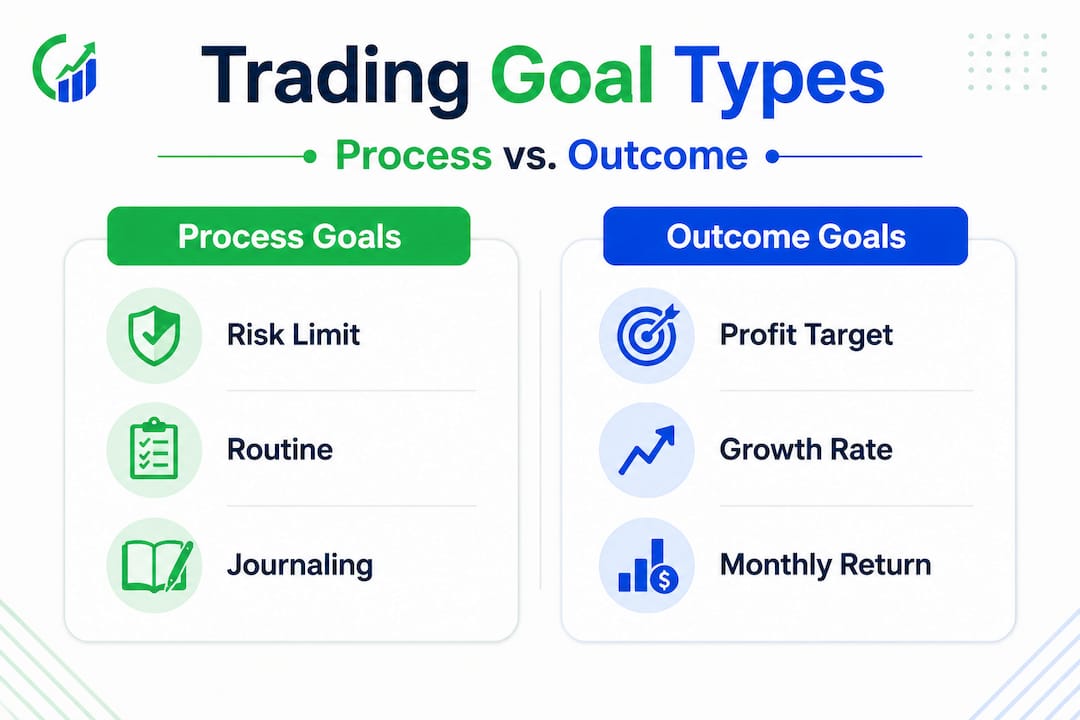
The core problem is the obsession with outcome goals, meaning targets tied to profit or account growth. Outcome goals sound motivating, but they are almost entirely outside your control. You cannot control whether the market moves in your favor. You can control whether you follow your entry rules, stick to your stop-loss levels, and document every trade properly.
Process goals focused on discipline and risk rules consistently outperform profit targets for beginners, because outcomes are uncontrollable. Experts emphasize psychology and consistency over chasing profit and loss numbers. That shift in perspective is not minor. It fundamentally changes how you measure progress and how you feel about trading day to day.
Understanding trading psychology is inseparable from this. Emotions like fear, greed, and overconfidence are the primary reasons technically capable traders still lose money. Structured goals act as a guardrail against those impulses.
Here are the key benefits of having structured trading goals:
- Clarity: You know exactly what you are working toward each session, removing ambiguity
- Accountability: A written goal is harder to rationalize away than a mental one
- Consistency: Process goals reinforce the same behaviors repeatedly, building habits
- Reduced stress: When your goal is to follow your rules rather than make a set amount, a losing trade does not feel like failure
- Measurable progress: You can actually track whether you are improving, not just whether the market cooperated
“Success in trading depends far more on discipline and psychological consistency than on predicting market outcomes. Traders who master their process before chasing their P&L almost always outlast those who don’t.” — Common insight among professional trading educators
Essential elements of actionable trading goals
With the value of proper goal setting established, let’s dive into how you craft them for consistent results.
The most reliable structure for building effective trading goals is the SMART framework. SMART stands for Specific, Measurable, Achievable, Relevant, and Time-bound. Originally developed for corporate project management, it translates almost perfectly into trading, because it forces you to move from wishful thinking to concrete commitments.
Here is what each element means in a trading context:
- Specific: Clearly state what behavior or metric you are targeting, not just “trade better”
- Measurable: Attach a number or trackable output so you can verify completion
- Achievable: Set goals that challenge you without being impossible given your current skill and capital
- Relevant: Connect each goal to your actual trading style and the markets you trade
- Time-bound: Set a deadline or review window, whether that is daily, weekly, or monthly
The contrast between a SMART process goal and a vague profit goal is stark:
| Criteria | SMART process goal | Vague profit goal |
|---|---|---|
| Specific | “Risk no more than 1% per trade” | “Make more money” |
| Measurable | Track every trade’s risk percentage | No clear metric |
| Achievable | Within any trader’s control | Market-dependent |
| Relevant | Directly tied to survival and growth | Outcome-focused only |
| Time-bound | “For the next 30 trading sessions” | Open-ended |
When you put a goal through this filter, weaknesses surface immediately. That is the point. Part of creating a trading plan is identifying gaps before they cost you capital.
Strong examples of SMART trading goals for beginners include:
- “I will risk no more than 1% of my account on any single trade for the next 3 months”
- “I will log the entry price, exit price, setup type, and emotional state for every trade I take this week”
- “I will review my open positions at the same time each day and not add to losing trades for 30 days”
- “I will complete a weekly chart review every Sunday for 8 consecutive weeks”
- “I will paper trade my strategy for 4 weeks before committing real capital to it”
Notice that none of these mention a specific dollar return. That is intentional. New traders who focus their goals on habits, risk management, and review routines build the foundation that eventually produces consistent profits.
How to set your trading goals step by step
Once you know what makes trading goals effective, the next step is implementing them with a structured workflow.
Building a goal framework does not need to be complicated, but it does need to be written down. Traders who document their goals are far more likely to follow through than those who keep everything in their head. According to written trading plans, defining clear objectives, risk tolerance, time horizon, and trading style is essential, and that means including specific entry and exit rules, position sizing guidelines, and stop-loss levels.
Here is a practical step-by-step process to get your goals on paper and into action:
-
Assess your current skills and weaknesses. Before setting any goal, be honest about where you are. Are you consistently breaking your own stop-loss rules? Do you overtrade? Do you exit winners too early? Your goals should address your actual weak points, not generic trading advice.
-
Define your risk parameters and capital limits. Decide the maximum percentage you will risk per trade and the maximum total open risk at any one time. This is not optional. It is the foundation that everything else rests on.
-
Choose two to three process goals. Do not set ten goals at once. Pick the two or three behaviors that will have the biggest impact on your trading quality right now.
-
Document everything in a written trading plan. Write your goals in full sentences, include your rationale, and store them somewhere you review regularly. A notebook, a digital doc, or a journal app all work.
-
Create a daily or weekly checklist. Convert your goals into checklist items so every session begins with a quick review of what you are committed to doing.
Here is how a few example goals map to specific activities and tracking methods:
| Goal | Trading activity | How to track |
|---|---|---|
| Risk no more than 1% per trade | Position sizing before every entry | Spreadsheet or broker statement |
| Log every trade with notes | Trade journaling after each session | Dedicated trading journal or app |
| No trading during high-impact news | Check economic calendar daily | Mark news events on your calendar |
| Review weekly charts every Sunday | Technical analysis session | Screenshot comparison over weeks |
| Maximum 3 trades per day | Session discipline | Daily tally in your journal |
Pro Tip: Create a simple pre-session checklist with your top three process goals at the top. Before you place a single trade, run through it. This habit alone dramatically reduces impulsive decisions because it anchors your attention on behavior rather than potential profits.
Reference your beginner trading workflow if you want a structured sequence to layer these habits into.
Monitoring progress and adjusting your goals
Setting goals is only the start; making them work means tracking progress and refining your approach.

Many traders put effort into creating goals and then never look at them again. That is not goal setting. That is wishful thinking with extra steps. Accountability requires a feedback loop, which means scheduled reviews where you measure your behavior against your stated commitments.
Quarterly goal reviews using trading journal data are the standard recommended by experienced traders. But quarterly reviews only work if you are logging consistently throughout that period. Here is how to make the review process work:
-
Log every trade in your journal immediately after closing it. Include the setup type, your emotional state before entry, whether you followed your rules, and the outcome. Do not skip this step, even on bad days, especially on bad days.
-
Conduct a brief weekly self-assessment. At the end of each trading week, answer three questions: Did I follow my process goals? What was my biggest discipline lapse? What will I do differently next week?
-
Run a full monthly review. Pull your journal data and look for patterns. Are you following your 1% risk rule? Are you avoiding the market conditions you identified as problematic? Use actual numbers, not impressions.
-
Adjust goals at the quarterly mark. If you have consistently hit a goal, that behavior has likely become a habit. Graduate it and introduce a new challenge. If you are still struggling with the same goal after three months, break it into a smaller step.
-
Update your written trading plan. Every adjustment should be reflected in your documented plan. A plan that never changes is not a living document. It is a relic.
Check out these best trader performance practices and a practical forex trading checklist to support your review cycles.
Pro Tip: Schedule your quarterly goal review as a recurring calendar event right now, before you forget. Treat it like a business meeting with yourself. Block two hours, close distractions, and bring your journal data. Accountability without a scheduled moment to act on it tends to fade within weeks.
Common mistakes and troubleshooting for trading goals
Even the best-laid plans can run into problems. Here is how to identify and correct issues early.
Knowing what to aim for is useful. Knowing what to avoid is equally important. These are the most common goal-setting mistakes new traders make:
- Setting profit-only goals: Targeting a specific dollar amount or percentage return without any process goals to support it creates pressure that leads to overtrading and rule-breaking
- Setting too many goals at once: Trying to change five behaviors simultaneously usually means changing none of them; focus is a limited resource
- Moving the goalposts mid-period: Changing your goals after a losing streak to feel better about your performance destroys the integrity of the entire exercise
- Skipping documentation: Mental goals are not goals; they are preferences, and they evaporate under pressure
- Ignoring risk rules when results look good: A winning streak often produces overconfidence, and that is exactly when risk discipline matters most
- Never reviewing progress: Goals with no accountability mechanism are decorative, not functional
“Before you set any income target, make sure your risk management framework is solid. Keeping each trade’s risk at or below 1%, and total open risk under 5%, is not a conservative suggestion for beginners. It is the floor, not the ceiling.” — Core principle from experienced retail trading educators
When you notice you are off track, the fix is usually simpler than you expect. Managing trading positions correctly starts with reducing complexity. Strip back to one or two core goals, honor them for two weeks, and then layer back in the rest. Rebuilding consistency is always easier with fewer moving parts.
The 1% risk per trade rule with a 5% maximum open risk is the industry-standard starting point for new traders. Ignoring it in pursuit of faster gains is the single most common reason accounts fail in the first year.
Our perspective: Why most traders get goals wrong
Step back and look at how most retail traders actually use goals, and a pattern emerges that explains a lot of preventable losses.
The market is framed everywhere, in advertising, in social media content, in trading forums, as a place to generate income. That framing is not wrong exactly, but it creates a distorted starting point. New traders arrive expecting the market to reward their desire to make money. The market is indifferent to what you want. It rewards behavior, specifically disciplined, rule-based behavior applied consistently over a long enough time horizon.
When a trader sets a goal like “make $500 this week,” they are anchoring their psychology to an outcome that the market controls. Every session becomes a report card graded by something external. That produces anxiety during drawdowns, euphoria during winning streaks, and eventually emotional decision-making that overrides any technical edge they might have built.
What professional traders and experienced educators consistently emphasize is something far less glamorous: process metrics. Win rate across a sample size of 100 or more trades. Average risk-to-reward ratio. Percentage of sessions where risk rules were followed. These numbers tell you whether you are actually improving as a trader, independent of short-term market noise.
The uncomfortable truth is that incremental improvement in behavior is the actual product you are building in your first year of trading. Profits are a byproduct of that improvement, not the target itself. Traders who internalize this early tend to survive long enough to become consistently profitable. Those who resist it spend years wondering why they keep making the same costly mistakes.
Our proven trader tips reinforce this philosophy: build the right habits first, and the results follow. Not the other way around.
Level up your trading with the right resources
Ready to move from theory to action? These resources will accelerate your progress.
Building sound trading goals is a skill, and like any skill, it develops faster with the right tools and environment around you.

At Olla Trade, we designed our platform to support exactly the kind of structured, disciplined trading that goal-setting frameworks require. From MetaTrader 4 integration with advanced charting to real-time market news and economic calendars, everything you need to execute and review your plan is in one place. If you are new and want a clear starting point, our step-by-step forex trading guide walks you through opening trades, managing risk, and building your first plan. Brush up on key concepts using our forex glossary, then explore everything the Olla Trade platform has to offer for traders at every level.
Frequently asked questions
What is the best type of trading goal for a beginner?
Beginners should prioritize process goals like sticking to risk limits or journaling every trade, not profit targets, since behaviors are controllable and profits are not.
How often should I review my trading goals?
Review your goals quarterly at minimum using your trading journal data, but a brief weekly self-check keeps you accountable between full reviews.
Should profit targets be included in initial trading goals?
Profit goals are best avoided early on. Focus entirely on risk management and process targets until your behavior becomes consistent, then consider adding performance benchmarks.
What is a good example of a SMART trading goal?
A strong SMART goal example is: “Risk no more than 1% of my account per trade and log every entry and exit in my journal for 3 consecutive months.” It is specific, measurable, and entirely within your control.