












Swing trading sits between day trading’s frantic pace and buy-and-hold investing’s patience, but it’s not the quick money machine beginners imagine. Success demands disciplined strategy, technical skill, and realistic expectations about capturing intermediate price moves. This guide clarifies swing trading fundamentals, debunks myths, and walks you through proven 2026 strategies for Forex, stocks, and cryptocurrencies.
مندرجات کا جدول
- Introduction To Swing Trading
- Core Principles And Strategies Of Swing Trading
- Tools And Technical Indicators Used In Swing Trading
- Comparison With Other Trading Styles
- Common Misconceptions And Mistakes In Swing Trading
- Practical Implementation And Risk Management
- Adapting Swing Trading Across Markets: Forex, Stocks, And Cryptocurrencies
- Explore Swing Trading With Olla Trade
- Frequently Asked Questions
Key takeaways
| نقطہ | تفصیلات |
|---|---|
| Time horizon | Swing trading holds positions for days to weeks, balancing active and passive styles. |
| Technical analysis | Multiple indicators like RSI and moving averages improve entry and exit timing. |
| Risk management | Stop-loss orders and position sizing protect capital from downside moves. |
| Market adaptability | Strategies adjust across Forex, stocks, and crypto based on volatility and liquidity. |
| Realistic expectations | Avoid myths of guaranteed quick profits; success requires discipline and systematic review. |
Introduction to swing trading
Swing trading involves holding positions from days to weeks to capture intermediate market moves. Unlike day traders who close all positions before the market shuts, swing traders hold overnight and through market fluctuations to profit from multi-day price swings. Position traders, by contrast, hold for months or years. Swing trading occupies the middle ground, appealing to traders who want active engagement without constant screen monitoring.
Common markets for swing trading include:
- Forex pairs like EUR/USD, GBP/USD, and USD/JPY with high liquidity
- Individual stocks across sectors like technology, healthcare, and energy
- Cryptocurrencies such as Bitcoin, Ethereum, and altcoins
- Indices like S&P 500, Nasdaq, and Dow Jones
Typical holding periods range from two days to three weeks. Trading objectives center on capturing 5-15% moves in stocks or 100-300 pip swings in Forex. You need basic market understanding, chart reading skills, and familiarity with technical indicators to start. Unlike scalping or high-frequency trading, swing trading doesn’t demand split-second decisions, making it accessible for traders with full-time jobs or other commitments.
Pro Tip: Start with liquid markets and clear trends when learning swing trading. Thin markets create slippage and unpredictable fills that erode profits.
Core principles and strategies of swing trading
Identifying market trends and corrections enables timely trade entries and exits. The foundation of swing trading rests on recognizing when price retraces within a larger trend, offering low-risk entry points. Traders look for pullbacks in uptrends or bounces in downtrends, entering positions when momentum resumes in the dominant direction.
Technical indicators provide the data-driven signals swing traders rely on:
- Moving averages confirm trend direction and act as dynamic support/resistance
- Relative Strength Index (RSI) identifies overbought conditions above 70 or oversold below 30
- MACD crossovers signal momentum shifts and potential reversals
- Fibonacci retracements pinpoint likely support/resistance zones during corrections
Risk-to-reward ratios determine whether trades are worth taking. Aim for at least 1:2, meaning you risk $100 to potentially gain $200. Calculate this before entering by measuring distance to your stop-loss versus your profit target. If the math doesn’t favor you, skip the trade. Position sizing follows logically, limiting each trade to 1-2% of your total capital to survive losing streaks without devastating your account.

Trade management separates consistent winners from frustrated quitters. Place stop-losses below recent swing lows in uptrends or above swing highs in downtrends. Adjust stops to break-even once the trade moves in your favor. Take partial profits at key resistance levels and let runners capture extended moves. Review your trades weekly, noting what worked and what didn’t, then refine your approach systematically.
Pro Tip: Use alerts instead of watching charts constantly. Set price notifications at key levels so you can maintain work-life balance while staying responsive to opportunities.
Tools and technical indicators used in swing trading
Combining volume and momentum indicators improves swing trade signal accuracy. Volume confirms whether breakouts and reversals have genuine participation or are likely false moves. Rising volume on breakouts suggests strong conviction, while low volume signals weak moves prone to failure.
Key indicator combinations include:
- RSI divergence with price action reveals hidden momentum shifts before reversals
- Moving average crossovers (50-day crossing 200-day) confirm trend changes
- Bollinger Bands expansion indicates volatility spikes and potential breakout opportunities
- Stochastic oscillator provides early signals in ranging markets
Adjust indicator settings for different markets. Forex’s 24-hour nature and high liquidity work well with standard settings (14-period RSI, 20-period moving averages). Stocks benefit from slightly longer periods to filter daily noise. Cryptocurrencies require shorter settings due to extreme volatility, often using 7-9 period indicators instead of 14.
Contextual analysis matters more than any single signal. Check multiple timeframes: the daily chart for overall trend, the 4-hour for swing entries, and the 1-hour for precise timing. Confirm signals across indicators before committing capital. A bullish RSI divergence means little if volume is declining and the broader trend is bearish.
Charting platforms provide the infrastructure. MetaTrader 4 offers robust tools for Forex and CFDs. TradingView delivers advanced charting with social features. Platform choice depends on your markets, but focus on clean interfaces, customizable indicators, and reliable execution. Access professional indices trading tools to analyze market breadth and sector rotation patterns that influence individual swing trades.
Comparison with other trading styles
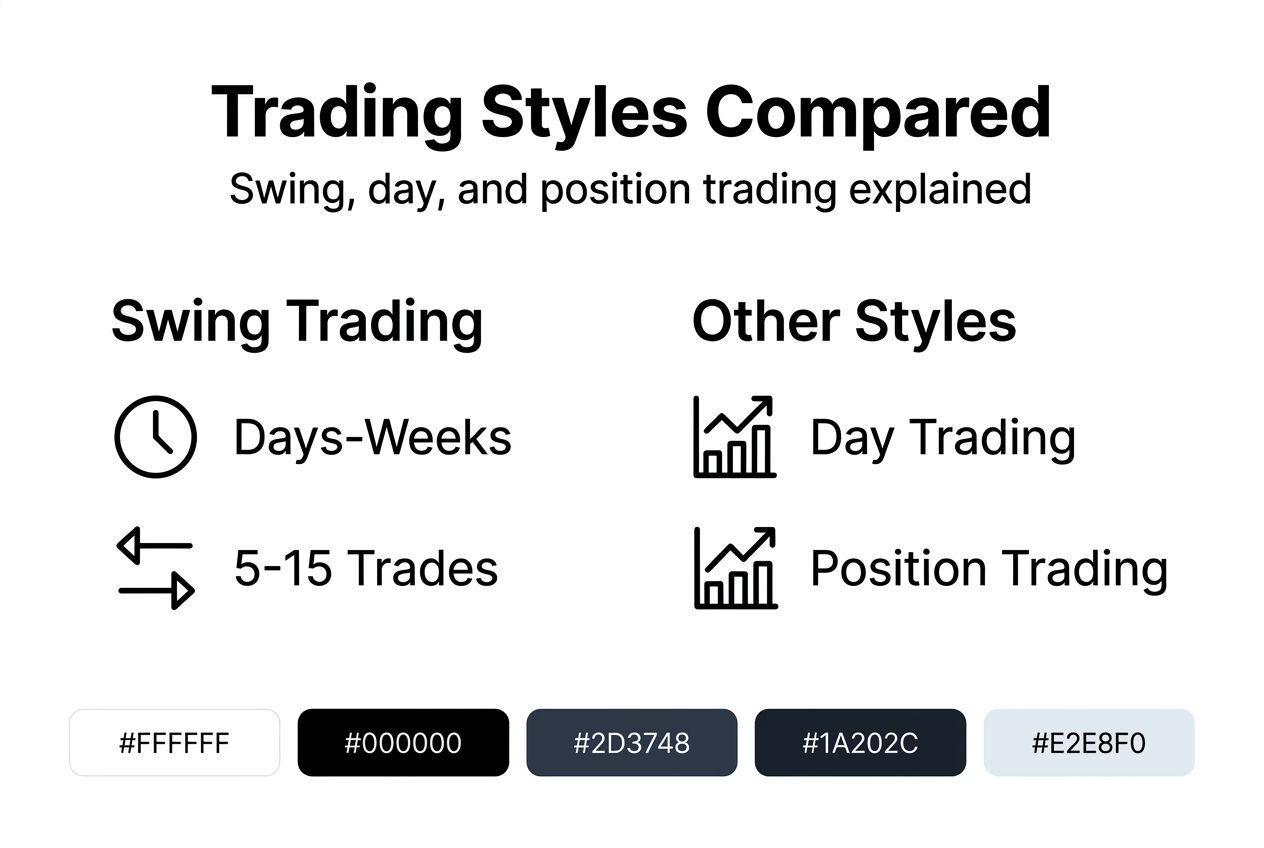
Swing trading requires less screen time than day trading but more active management than position trading. Understanding these distinctions helps you choose the right approach for your lifestyle and goals.
| Trading Style | Time Horizon | Daily Monitoring | Capital Requirements | Risk Profile |
|---|---|---|---|---|
| Day Trading | Minutes to hours | Constant (4-8 hours) | High (pattern day trader rules) | High (leverage, rapid moves) |
| سوئنگ ٹریڈنگ | Days to weeks | Moderate (30-60 min daily) | Medium (flexible) | Medium (overnight risk) |
| Position Trading | Weeks to months | Low (weekly checks) | Lower (less leverage) | Lower (long-term outlook) |
Day traders close all positions before market close, avoiding overnight gap risk but demanding intense focus and quick decisions. They typically make 5-20 trades daily, requiring $25,000 minimum in U.S. stock accounts due to pattern day trader regulations. Emotional intensity runs high with rapid wins and losses.
Swing traders hold through overnight moves and multi-day fluctuations. You’ll make 5-15 trades monthly, dedicating 30-60 minutes daily to chart review and order management. Capital requirements are flexible, though $5,000-$10,000 provides reasonable position sizing. Overnight risk exists, but stop-losses mitigate gap danger.
Position traders analyze weekly or monthly charts, holding for major trend moves. They make 3-8 trades yearly, checking positions weekly. Lower leverage reduces risk but also limits profit potential. This style suits investors focused on fundamental analysis alongside technical patterns.
Swing trading benefits traders who want active participation without quitting their jobs. If you can dedicate morning or evening time to analysis, handle moderate risk, and remain patient through multi-day positions, swing trading fits your profile.
Common misconceptions and mistakes in swing trading
Overreliance on single indicators without market context leads to poor swing trading decisions. Beginners often chase the perfect indicator or strategy, missing the bigger picture of market structure and risk control.
Myth: Swing trading guarantees quick profits. Reality demands months of practice, disciplined risk management, and acceptance of losing trades. No strategy wins 100% of the time. Professional swing traders aim for 50-60% win rates with strong risk-to-reward ratios, not home runs on every trade.
Common novice mistakes include:
- Skipping stop-loss orders, exposing accounts to catastrophic losses on single trades
- Relying solely on RSI or MACD without confirming signals across timeframes
- Ignoring broader market trends while focusing only on individual stock patterns
- Overtrading during choppy, rangebound markets instead of waiting for clear setups
- Letting emotions override trading plans after consecutive losses
Risk management and systematic review separate sustainable trading from gambling. Set maximum daily or weekly loss limits. When you hit them, stop trading and analyze what went wrong. Keep a trading journal documenting entry reasoning, exit execution, and emotional state. Review monthly to identify patterns in your decision-making.
Market conditions matter as much as technical signals. Strong trending markets offer cleaner swing setups. Choppy, news-driven volatility creates false breakouts and whipsaws. During uncertain periods, reduce position sizes or step aside entirely. Preservation of capital during unfavorable conditions enables you to capitalize when clarity returns.
Pro Tip: Paper trade new strategies for at least 30 trades before risking real capital. Track results honestly to see if your edge is genuine or imagined.
Practical implementation and risk management
Setting clear entry and exit rules and using stop-loss orders are essential for managing downside risk in swing trading. Follow this step-by-step process for disciplined execution:
- Identify the dominant trend on the daily chart using moving averages or trendlines.
- Wait for a pullback or correction against the trend, confirming with RSI or stochastic signals.
- Set entry orders at key support (in uptrends) or resistance (in downtrends) levels.
- Place stop-loss orders 1-2% below entry in uptrends or above in downtrends.
- Calculate position size based on stop distance, risking only 1-2% of total capital per trade.
- Set initial profit targets at 2-3 times your risk, adjusting based on key resistance/support zones.
- Monitor trades daily without micromanaging, adjusting stops to break-even once profitable.
- Review closed trades weekly, documenting what worked and what needs improvement.
Position sizing protects you from ruin during losing streaks. If your account is $10,000 and you risk 2% per trade, your maximum loss is $200. With a 50-pip stop-loss in Forex, calculate lot size to match that dollar risk. Most platforms offer position size calculators to simplify this math.
Monitoring trades requires balance. Check positions morning and evening, but avoid obsessive chart-watching that leads to impulsive decisions. Set alerts at key levels so the market notifies you when action is needed. This approach maintains discipline while preserving mental energy.
Regular strategy review improves performance over time. After 20-30 trades, analyze win rate, average win versus average loss, and maximum drawdown. If you’re winning 55% of trades but average losses exceed average wins, adjust profit targets or tighten stop-losses. Access Forex trading smart strategies and understand آرڈر پر عملدرآمد کی پالیسیاں to optimize your trading approach.
Maintaining discipline through drawdowns tests every trader. Expect losing streaks of 4-6 trades even with solid strategies. Resist the urge to double position sizes to recover losses quickly. Stick to your risk rules, and statistical edges reassert themselves over sufficient sample sizes.
Adapting swing trading across markets: Forex, stocks, and cryptocurrencies
Swing trading in Forex requires consideration of leverage and 24-hour market dynamics compared to stocks and crypto. Each market’s unique characteristics demand strategic adjustments for optimal results.
| بازار | Typical Volatility | Holding Period | Leverage Available | تجارتی اوقات |
|---|---|---|---|---|
| فاریکس | Moderate (50-150 pips/day) | 3-7 days | Up to 1:500 | 24/5 |
| اسٹاکس | Low to Moderate (1-5% daily) | 5-15 days | Up to 1:4 (U.S.) | Market hours only |
| کرپٹو | High (5-20% daily) | 2-5 days | Up to 1:100 | 24/7 |
Forex pairs trade around the clock during weekdays, creating gap risk only over weekends. High leverage amplifies both gains and losses, requiring tighter risk control. Major pairs like EUR/USD offer tight spreads and deep liquidity, ideal for swing trading. Exotic pairs provide larger moves but wider spreads that eat into profits.
Stocks close daily, creating overnight gap risk from earnings reports or news. Lower leverage limits position sizes but also reduces catastrophic loss potential. Sector-specific patterns emerge: technology stocks trend strongly during innovation cycles, while defensive sectors like utilities offer steadier, smaller swings. Earnings seasons create volatility spikes that either boost or disrupt swing setups.
Cryptocurrencies never sleep, with 24/7 trading creating constant price action. Extreme volatility demands wider stop-losses (5-10% versus 2-3% in stocks) to avoid premature exits from normal noise. Bitcoin and Ethereum dominate liquidity, while altcoins offer explosive moves alongside severe drawdown risk. Weekend trading continues, eliminating the safety of market closures.
Adjust holding periods based on volatility. Forex swings typically develop over 3-7 days. Stocks need 5-15 days for patterns to play out fully. Crypto moves faster, with 2-5 day holds capturing significant trends before reversals strike.
Practical tips for market-specific success:
- In Forex, trade major sessions (London, New York overlap) for tightest spreads and clearest trends
- For stocks, avoid earnings weeks unless specifically trading volatility strategies
- With crypto, set alerts for critical support/resistance as prices move constantly
Explore trading stocks and CFDs alongside cryptocurrency trading options to diversify your swing trading approach across complementary markets.
Explore swing trading with Olla Trade
Ready to apply these swing trading strategies in real markets? Olla Trade provides advanced platforms tailored for فاریکس, stocks, and cryptocurrency trading with tools designed for swing traders. Access real-time charts, technical indicators, and customizable alerts that support informed decision-making without constant monitoring.
The platform integrates MetaTrader 4 for sophisticated analysis, tight spreads for cost-effective trading, and fast execution to capture your planned entries. Risk management features include customizable stop-loss and take-profit orders, protecting your capital during volatile swings. Whether you’re trading currency pairs, individual stocks, or crypto assets, Olla Trade’s multi-device compatibility lets you monitor positions from desktop or mobile.
New to swing trading? Access professional trading education resources that build your skills systematically. Learn to combine technical indicators, manage risk effectively, and adapt strategies across different market conditions. Start practicing swing trading confidently with a platform built for both beginners developing their skills and experienced traders executing advanced strategies.
Frequently asked questions
What is swing trading?
Swing trading is a medium-term trading style that holds positions for days to weeks to capture intermediate price moves. Unlike day traders who close all positions daily, swing traders hold through overnight periods and multi-day fluctuations. The goal is profiting from predictable price swings within larger trends, typically targeting 5-15% moves in stocks or 100-300 pips in Forex.
How long do swing traders hold positions?
Typical holding periods range from two days to three weeks, depending on market conditions and specific trade setups. Forex swings often develop over 3-7 days, while stock positions may extend 5-15 days for patterns to complete. Cryptocurrency swing trades tend to be shorter, around 2-5 days, due to higher volatility and faster price movements.
How does swing trading differ from day trading and investing?
Swing trading sits between day trading’s rapid pace and investing’s long-term horizon. Day traders make multiple trades daily, closing all positions before market close, requiring constant monitoring. Investors hold positions for months or years based on fundamental value. Swing traders hold days to weeks, checking positions 30-60 minutes daily, balancing active engagement with manageable time commitment.
What are the main risks in swing trading?
Overnight and weekend gap risk exposes swing traders to sudden price changes when markets reopen. Leverage amplifies both gains and losses, potentially wiping out accounts if uncontrolled. Emotional decision-making during losing streaks leads to revenge trading and rule violations. Proper risk management through stop-losses, position sizing at 1-2% of capital per trade, and disciplined adherence to trading plans mitigates these dangers.
Who is swing trading best suited for?
Swing trading fits traders who want active market participation without quitting their jobs or monitoring screens constantly. If you can dedicate 30-60 minutes daily to analysis, handle moderate risk including overnight exposure, and maintain patience through multi-day positions, this style matches your profile. It requires basic technical analysis skills and emotional discipline to follow systematic rules during both winning and losing periods.