












TL؛ DR:
- A market order instructs traders to buy or sell assets immediately at the best available price, prioritizing execution speed over price certainty. Its success depends on liquidity, order size, and market conditions, with slippage being a primary risk, especially in illiquid assets. Combining market orders with stop-loss tools and understanding order routing strategies improves risk management and trading effectiveness.
A market order is a trading instruction to buy or sell an asset immediately at the best available price. It is the most direct order type in financial markets, prioritizing execution speed over price certainty. This guide to market orders covers everything retail and professional traders need: how market orders work, how they compare to limit and stop orders, what risks they carry, and how to use them alongside stop-loss tools for smarter risk control. Brokers, exchanges, and regulatory frameworks like Regulation NMS all shape what happens the moment you click “buy” or “sell.”
How do market orders work step by step?
A market order triggers an immediate search for the best available price on the exchange’s order book. Market orders execute by matching with existing limit orders sitting on the opposite side of the book. That matching process happens in milliseconds under normal conditions.
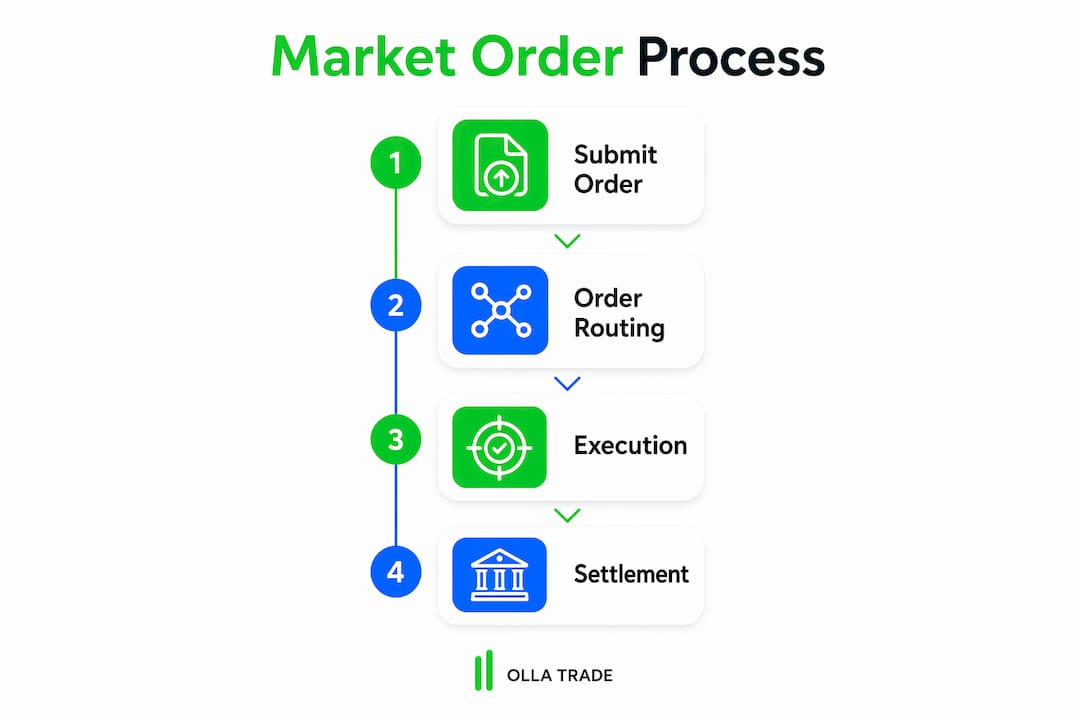
Here is what happens after you submit a market order:
- Your broker receives the order and routes it to a market center or exchange.
- The exchange scans its order book for the best available limit orders on the opposite side.
- Your order fills against those limit orders at the current bid (if selling) or ask (if buying).
- If your order size exceeds available volume at one price level, the remainder fills at the next available price.
- Your broker confirms the fill and reports the executed price back to you.
Execution is guaranteed under normal market conditions. The exact price, however, is not. That distinction matters more than most traders realize.
Regulation NMS Rule 611 prevents brokers from routing orders to venues where execution would be worse than the National Best Bid and Offer (NBBO). The NBBO represents the best displayed bid and ask prices across all registered exchanges at any given moment. Rule 611 protects against trading through a better price on another venue, but it does not freeze the price at the moment you submit your order. Liquidity can shift between submission and fill.

Order execution quality also depends on broker routing policies and market microstructure. Two traders submitting identical market orders at the same millisecond can receive different fill prices depending on which venue their broker routes to. Understanding order execution mechanics is the foundation for using market orders effectively.
پرو ٹپ: Check your broker’s best-execution policy before trading. Some brokers route to venues that pay for order flow, which can affect the quality of your fill even when the NBBO is protected.
What are the main types of orders and how do market orders compare?
Understanding market orders requires knowing where they sit among the four core order types every trader uses.
- مارکیٹ آرڈر: Executes immediately at the best available price. Execution is guaranteed; price is not. Best for liquid assets where speed matters most.
- حکم کی حد: Executes only at a specified price or better. Price is controlled; execution is not guaranteed. Best when you have a target entry or exit price.
- Stop order: Sits dormant until a trigger price is reached, then converts to a market order. Useful for cutting losses or entering breakouts, but carries slippage risk after the trigger fires.
- Stop-limit order: Converts to a limit order at the trigger price instead of a market order. Offers price control after the trigger but risks non-execution if the market moves past the limit.
| Order type | عملدرآمد کی رفتار | Price certainty | Execution guarantee | بہترین استعمال کیس |
|---|---|---|---|---|
| بازار | فوری | کوئی نہیں۔ | Yes (normal conditions) | Liquid assets, urgent entries/exits |
| Limit | Conditional | اعلی | نہیں | Targeted entries, illiquid assets |
| Stop | Conditional | None after trigger | نہیں | Loss control, breakout entries |
| Stop-limit | Conditional | High after trigger | نہیں | Controlled exits in volatile markets |
The market order’s core advantage is speed. When you need to enter or exit a position without delay, no other order type matches it. The trade-off is that you accept whatever price the market offers at that moment. For highly liquid stocks like AAPL or ETFs like SPY, that trade-off is minimal because bid-ask spreads are tight. For thinly traded assets, the cost of that speed can be significant.
What factors affect market order outcomes and risks?
Slippage is the primary risk with market orders. Slippage occurs when your order fills at a price different from the quote you saw when you submitted it. Large market orders in illiquid stocks can fill at multiple price levels, producing an average price meaningfully worse than the displayed quote. Price differences of $0.10 to $0.20 per share are possible with penny stocks or low-volume assets.
Several variables determine how much slippage you face:
- لیکویڈیٹی: High-liquidity assets like AAPL and SPY have tight bid-ask spreads and deep order books, minimizing slippage. Low-volume stocks have wide spreads and shallow books, amplifying it.
- Order size: A 100-share market order in a liquid stock fills cleanly. A 10,000-share order in the same stock may sweep through multiple price levels.
- اتار چڑھاؤ: Fast-moving markets widen spreads and thin out order books. A market order submitted during a news spike can fill far from the pre-news price.
- دن کا وقت: The first and last 30 minutes of a trading session carry higher volatility and wider spreads. Mid-session liquidity is typically deeper.
- مارکیٹ کی ساخت: Fragmented liquidity across venues means identical quotes on two exchanges can yield different fill prices depending on routing speed and venue depth.
Professional traders model realistic fill prices before entering positions. They do not assume the displayed quote is the execution price. Retail traders who skip this step often discover slippage only after the fact, when the fill confirmation arrives.
پرو ٹپ: Before placing a market order on any asset, check the Level 2 order book. If the bid-ask spread is wider than two cents on a stock, consider a limit order instead. Speed is only worth paying for when the spread cost is small.
How to place market orders and manage risk effectively
Placing a market order correctly takes less than a minute, but the preparation before you click matters more than the click itself.
- Verify your account is funded and active. Most brokers require settled cash or available margin before accepting orders.
- Confirm market hours. Market orders placed outside regular trading hours may queue for the open or execute in pre-market or after-hours sessions with lower liquidity.
- Select the asset and order direction. Choose buy or sell, then select “market order” as the order type.
- Set your quantity. Enter the number of shares, contracts, or lots. For large positions, consider splitting into smaller orders to reduce price impact.
- Review and submit. Most platforms show the current bid-ask spread before you confirm. Check it. If the spread is unusually wide, pause and reassess.
Market orders work best when combined with risk management tools rather than used alone. Stop orders that convert to market orders are the standard method for capping losses on open positions. You enter a position with a market order, then immediately place a stop order below your entry (for long positions) to define your maximum loss. Pairing these two order types is a core discipline in risk management for traders.
| منظر نامہ | Recommended approach | Risk control tool |
|---|---|---|
| Entering a liquid stock quickly | Market order at mid-session | Stop order below entry |
| Exiting a losing position fast | Market order | None needed; speed is the priority |
| Entering a volatile asset | Limit order preferred | Stop-limit after fill |
| Managing a breakout trade | Market order at trigger | Trailing stop order |
Experienced traders use stop-limit orders rather than pure stop orders when they need exit price control in volatile conditions. A stop-limit order avoids the slippage risk of a stop-to-market conversion, though it introduces the risk of non-execution if the market gaps through the limit price. Knowing which tool fits which scenario is what separates disciplined traders from reactive ones. For a deeper look at timing and execution, Ollatrade’s guide on fast execution advantages covers the mechanics in detail.
کلیدی ٹیک ویز
Market orders guarantee execution but never price, making liquidity and order sizing the two variables every trader must assess before submitting.
| نقطہ | تفصیلات |
|---|---|
| Execution vs. price guarantee | Market orders fill immediately under normal conditions but do not lock in a specific price. |
| NBBO protection has limits | Regulation NMS Rule 611 prevents trade-throughs but does not freeze your fill price at submission. |
| Liquidity determines slippage | Liquid assets like AAPL and SPY minimize slippage; illiquid or volatile assets amplify it. |
| Combine with stop orders | Pairing market orders with stop-loss orders caps downside risk on every open position. |
| Order size affects fill quality | Large orders in thin markets fill across multiple price levels, worsening the average price. |
What I’ve learned about market orders after years at the screen
Most traders treat market orders as the default and limit orders as the advanced option. I think that framing is backwards. A market order is actually the highest-stakes order type because you surrender all price control the moment you submit it. Limit orders give you control. Market orders give you certainty of execution. Those are two very different things.
The misconception I see most often is that the NBBO price shown on screen is the price you will get. It is the best price available at that instant across registered exchanges. By the time your order routes, matches, and confirms, that price may have moved. In a calm, liquid market the difference is negligible. In a fast-moving market or a thinly traded asset, it can be the difference between a good trade and a painful one.
My practical rule: use market orders when you need to be in or out of a position and the cost of delay exceeds the cost of slippage. Use limit orders when the cost of a bad fill exceeds the cost of missing the trade. That calculation changes with every asset and every market condition. Traders who apply it consistently make fewer reactive, emotion-driven mistakes. Reviewing تاجر کے بہترین طریقوں alongside your order type discipline is time well spent.
- ایف ایکس
Ollatrade’s platform for fast, reliable order execution
Traders who need fast market order execution require a platform built for speed and clarity. Ollatrade provides access to Forex, CFDs on metals, indices, stocks, energies, and cryptocurrencies through a platform that integrates MetaTrader 4, real-time charting, and expert advisors.
Stop-loss and take-profit order tools are built directly into the platform, so traders can pair every market order entry with a risk control layer in the same workflow. Tight spreads and fast execution reduce the slippage cost that makes market orders risky on slower platforms. Ollatrade’s فاریکس ٹریڈنگ پلیٹ فارم is designed for traders who treat execution quality as a competitive edge, not an afterthought. Account setup is straightforward, and multiple deposit options get you trading without unnecessary delays.
اکثر پوچھے گئے سوالات
What is a market order in trading?
A market order is an instruction to buy or sell an asset immediately at the best available price. Execution is guaranteed under normal market conditions, but the exact fill price is not.
How does a market order differ from a limit order?
A market order fills immediately at whatever price is available. A limit order fills only at a specified price or better, offering price control but no guarantee of execution.
What is slippage and why does it affect market orders?
Slippage is the difference between the price you expected and the price you received. Large orders in illiquid assets can fill across multiple price levels, producing an average price worse than the displayed quote.
When should I use a market order instead of a stop or limit order?
Use a market order when execution speed is the priority and the asset is liquid with a tight bid-ask spread. For volatile or thinly traded assets, a limit order or stop-limit combination gives better price control.
Does Regulation NMS guarantee my market order fills at the NBBO price?
No. Rule 611 of Regulation NMS prevents brokers from routing orders to venues with worse prices than the NBBO, but it does not freeze the NBBO price at the moment you submit your order.