












TL؛ DR:
- Trading oscillators are bounded indicators that measure momentum and identify overbought or oversold market conditions to assist traders in timing entries and exits more accurately. Different oscillators like RSI, Stochastic, MACD, MFI, and CCI serve specific purposes depending on market conditions, with volume-weighted tools offering higher accuracy in liquid markets. To maximize effectiveness, traders should combine oscillators with trend filters, support resistance, and price action, avoiding indicator overload and relying on divergence signals for high-confidence reversals.
Trading oscillators are bounded technical indicators that measure momentum and identify overbought or oversold market conditions to help traders time entries and exits with greater precision. Unlike trend-following tools, oscillators fluctuate within a fixed range, typically 0–100, making them ideal for spotting exhaustion points in price moves. The most widely used momentum indicators in this category include the RSI, Stochastic Oscillator, MACD, Money Flow Index, and CCI. Understanding how each one works, and when to apply it, separates traders who use these tools effectively from those who get burned by false signals.
1. what are the top trading oscillators for retail traders?
The five oscillators below cover the full spectrum of retail trading needs, from pure momentum measurement to volume-weighted confirmation. Each has a distinct edge depending on market conditions.
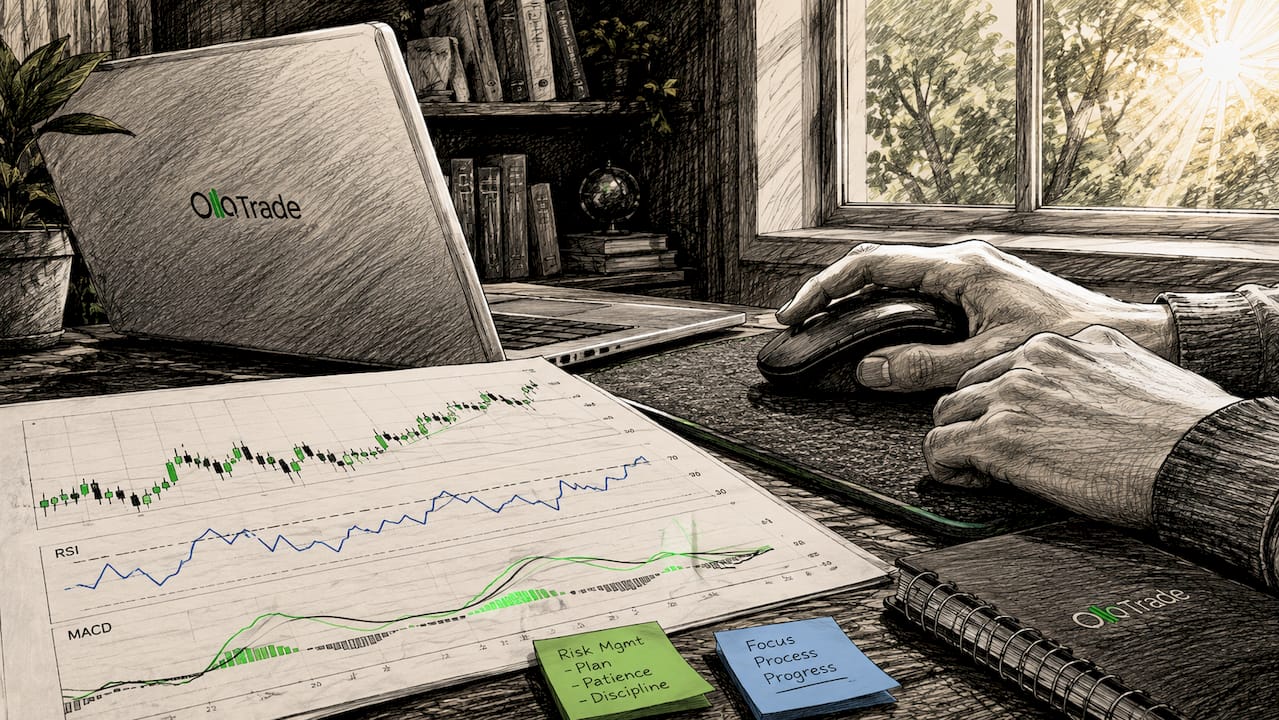
RSI (relative strength index)
RSI is the most widely used momentum oscillator in retail trading. It runs on a 14-period default and measures the speed and magnitude of recent price changes on a 0–100 scale. Readings above 70 signal overbought conditions; readings below 30 signal oversold. RSI carries a 52.3% overall win rate, rising to 68.9% in range-bound markets. That gap tells you everything about when to deploy it and when to step back.
Stochastic oscillator
The Stochastic Oscillator compares a closing price to its price range over a set period, producing two lines: %K (fast) and %D (slow). It excels in range-bound and intraday setups where price bounces between clear support and resistance. The 14-period default balances signal responsiveness with reliability. Shorter periods like 5–7 generate far more noise than usable signals.
MACD (moving average convergence divergence)
MACD is technically a trend-following momentum indicator built from two exponential moving averages, typically the 12-period and 26-period EMAs, plus a 9-period signal line. It performs best in trending markets, where it achieves a 61.8% win rate. Its lagging nature makes it less useful for precise entry timing but strong for confirming the direction of an existing trend.
Money flow index (MFI)
MFI is a volume-weighted oscillator that factors in both price and volume to measure buying and selling pressure. This gives it a structural edge over price-only tools. MFI signals on daily charts are 8–12% more accurate than standard RSI, and failure swings in MFI produce 72–75% win rates. If you trade liquid stocks or major forex pairs, MFI deserves a spot on your chart.
CCI (commodity channel index)
CCI measures how far price has deviated from its statistical average. Readings above +100 suggest overbought conditions; readings below -100 suggest oversold. It is less common than RSI or Stochastic but useful for identifying cyclical turning points across commodities, indices, and forex. CCI works best when combined with a trend filter rather than used in isolation.
پرو ٹپ: Start with RSI and Stochastic before adding MFI or CCI. Mastering two oscillators thoroughly beats having five on your chart that you only half-understand.
2. how to use oscillators in different market conditions
Market context determines whether an oscillator helps or misleads you. The same RSI reading means something completely different in a trending market versus a sideways one.
-
Identify the primary trend first. Use the 20 EMA and 50 EMA to determine whether price is trending up, down, or ranging. Oscillators should be applied after identifying the primary trend using moving averages or price structure.
-
Use oscillators for timing in range-bound markets. Momentum oscillators like RSI and MFI achieve 65–70% accuracy in range-bound markets but drop to 45–50% during strong breakouts. That accuracy drop is the clearest signal to stop fading momentum and wait for the range to return.
-
Wait for pullbacks in trending markets. In an uptrend, wait for RSI to dip toward 40–50 before entering long. In a downtrend, wait for RSI to rise toward 50–60 before entering short. This approach uses the oscillator as a timing tool within the trend, not as a contrarian signal against it.
-
Watch for divergence as a reversal warning. Divergence provides early reversal warning before price action confirms the move. When price makes a new high but RSI makes a lower high, that divergence is a high-conviction warning that the trend is losing steam.
-
Reduce reliance on oscillators during breakouts. Strong trend moves can keep RSI above 70 for extended periods. Selling into that reading because it looks “overbought” is one of the most expensive mistakes in retail trading.
پرو ٹپ: Pair your oscillator signals with a check of the اقتصادی کیلنڈر before entering. A high-impact news event can override any technical setup instantly.
3. trading oscillators compared: accuracy and market fit
The table below gives you a direct comparison of the five oscillators across the metrics that matter most for trade decisions.
| Oscillator | Win Rate (Range) | Win Rate (Trend) | Volume-Weighted | Best Signal Type | False Signal Risk |
|---|---|---|---|---|---|
| RSI (14) | 68.9% | 52.3% overall | نہیں | Divergence, failure swings | Moderate in trends |
| Stochastic (14) | High in ranges | اعتدال پسند | نہیں | %K/%D crossovers | High in strong trends |
| MACD (12/26/9) | اعتدال پسند | 61.8% | نہیں | Signal line crossovers | Moderate, lagging |
| MFI (14) | 72–75% (failure swings) | اعتدال پسند | جی ہاں | Failure swings, divergence | Lower in liquid markets |
| CCI (14) | اعتدال پسند | اعتدال پسند | نہیں | Extreme readings, divergence | High without trend filter |
Volume-weighted oscillators like MFI deliver a 10–15% accuracy advantage over price-only tools in liquid markets. That advantage comes from the fact that volume confirms whether a price move has genuine participation behind it. A price spike with no volume is noise. MFI catches that distinction where RSI cannot.
MACD’s max drawdown of approximately 24.7% is notably higher than RSI’s 18.3%. That difference reflects MACD’s lagging nature. It confirms trends well but gives back more before signaling a reversal.
4. common mistakes when using trading oscillators
Most retail traders misuse oscillators in the same predictable ways. Recognizing these patterns early saves real money.
-
Treating overbought as an automatic sell signal. Assets can stay overbought in strong trends for far longer than most traders expect. RSI above 70 in a bull trend often means strength, not exhaustion.
-
Using oscillators without a trend filter. Relying solely on oscillators is a primary reason retail trading accounts fail. An oscillator without a trend context is just noise with a number attached.
-
Overloading charts with too many indicators. Many retail traders stack 8–12 indicators on a single chart. Conflicting signals from overlapping tools create paralysis, not clarity. One or two oscillators combined with EMAs and volume is the more effective setup.
-
Adjusting periods too aggressively. Shortening the look-back period to 5–7 dramatically increases signal count but also false entries. The 14-period default exists for a reason and works well for most retail trading contexts.
-
Ignoring divergence in favor of absolute levels. Absolute readings like “RSI at 72” tell you less than divergence between price and the oscillator. Divergence is the highest-conviction signal these tools produce, especially when price makes a new high while the oscillator makes a lower high.
“Oscillators measure the rate of change in momentum, not absolute price tops and bottoms. Use them to read the engine, not to predict the destination.”
The fix for all of these mistakes is the same: use oscillators to confirm trades within a broader setup that includes price action, support and resistance, and a clear trend bias. Oscillators are confirmation tools, not standalone signal generators.
اہم نکات
The most effective approach to trading oscillators is combining RSI or MFI with trend filters like the 20 EMA and 50 EMA, then using divergence as the primary entry signal rather than absolute overbought or oversold readings.
| نقطہ | تفصیلات |
|---|---|
| RSI excels in range-bound markets | RSI achieves a 68.9% win rate in sideways conditions but drops sharply during breakouts. |
| MFI outperforms RSI in liquid markets | Volume-weighted MFI signals carry 8–12% higher accuracy than standard RSI on daily charts. |
| Divergence is the top signal | Divergence between price and oscillator provides the highest-conviction reversal warning available. |
| Trend filters reduce false signals | Using 20 EMA and 50 EMA alongside oscillators cuts false signals by 20–30%. |
| Avoid indicator overload | Mastering one or two oscillators with trend and volume tools outperforms stacking 8–12 indicators. |
Why i keep it simple with oscillators
After years of watching traders chase every new indicator, I keep coming back to the same conclusion: the problem is never the oscillator. It is the context around it.
Most traders who struggle with RSI are not using the wrong settings. They are applying a range-bound tool to a trending market and wondering why it keeps failing them. The fix is not a better oscillator. It is a clearer picture of what the market is doing before you open the chart.
My personal setup has not changed much in years. RSI on the daily, Stochastic on the 4-hour for entry timing, 20 EMA and 50 EMA for trend direction, and volume to confirm whether a move has real participation. That combination covers momentum, trend, and conviction without creating signal conflicts. You can explore momentum-based trading strategies that use this kind of layered approach if you want to see it applied in practice.
The traders I have seen improve fastest are the ones who pick one oscillator, backtest it across at least 100 trades in different market regimes, and build a real understanding of when it works and when it does not. That process is less exciting than discovering a new indicator. It is also far more profitable.
One more thing worth saying directly: oscillators add valuable context, but they cannot replace reading price action. A clean support level with RSI divergence and volume confirmation is a trade worth taking. RSI alone at 30 is just a number.
- ایف ایکس
Put your oscillator strategy to work on Ollatrade
Reading about oscillators is one thing. Applying them in live market conditions is where the real learning happens.

Ollatrade gives you direct access to RSI, Stochastic, MACD, and MFI across all major asset classes, including فاریکس مارکیٹس, CFDs on indices, metals, and cryptocurrencies. The platform integrates with MetaTrader 4, so you get full charting flexibility, multi-timeframe analysis, and customizable indicator settings without switching tools. Fast execution speeds mean your oscillator-timed entries actually land where you intend them to. If you are ready to move from studying setups to trading them, Ollatrade is built for exactly that step.
اکثر پوچھے گئے سوالات
What is a trading oscillator?
A trading oscillator is a bounded technical indicator that measures momentum and identifies overbought or oversold conditions within a fixed numerical range, typically 0–100. RSI and Stochastic are the most widely used examples in retail trading.
Which oscillator is most accurate for retail traders?
MFI delivers the highest accuracy in liquid markets, with failure swing win rates of 72–75% on daily charts. RSI is the most practical starting point due to its simplicity and 68.9% win rate in range-bound conditions.
Should i use oscillators in trending markets?
Oscillators lose significant accuracy in strong trends, dropping from 65–70% in ranges to 45–50% during breakouts. In trending markets, use MACD for direction confirmation and apply RSI only for pullback timing within the trend.
What is the best oscillator setting for beginners?
The 14-period default is the recommended setting for RSI, Stochastic, and MFI. Shorter periods like 5–7 generate too many false signals, while longer periods reduce responsiveness to meaningful price moves.
What does oscillator divergence mean?
Divergence occurs when price makes a new high or low but the oscillator does not confirm it. This signals weakening momentum and is considered the highest-conviction reversal warning these tools produce.