












Most retail traders think a swap is just a small fee their broker charges for holding a position overnight. That’s only half the picture. In reality, retail forex swaps are simplified rollovers that approximate institutional interest rate swaps, with broker markups added on top. True swaps are powerful OTC (over-the-counter) derivative tools that institutional players use to manage risk, hedge exposure, and optimize capital across global markets. This guide covers swap mechanics, types, calculation methods, edge cases, and how swaps affect your trading strategies in forex and commodities.
Table of Contents
- What is a swap in trading?
- Types of swaps: Forex and commodities explained
- How swaps are calculated and settled
- Edge cases, special rules, and institutional vs retail access
- Swaps in trading strategies: Impact, risks, and practical use
- Explore swap-friendly trading with Olla Trade
- Frequently asked questions
Key Takeaways
| Point | Details |
|---|---|
| Swap contract basics | Swaps are derivative contracts where two parties exchange periodic cash flows without transferring the underlying asset. |
| Retail vs institutional swaps | Retail traders access swaps mostly as simplified broker rollovers, while institutions negotiate complex OTC swaps for hedging and strategy. |
| Trading impact | Swaps affect trading costs, carry-trade strategies, and hedging exposure in both forex and commodity markets. |
| Swap calculation factors | Interest differentials, broker markups, and settlement rules all influence swap costs on trading platforms. |
| Practical swap strategies | Positive swaps can boost profits in carry trades; negative swaps erode swing trading and holding positions over time. |
What is a swap in trading?
At its core, a swap contract is an agreement between two parties to exchange cash flows or financial obligations over time, based on a notional principal amount, without ever exchanging the underlying asset itself. Think of it like two businesses agreeing to swap their loan payment structures: one pays fixed, the other pays floating, and only the net difference changes hands.
“A swap in trading is a derivative contract where two parties exchange cash flows or financial obligations over a period, typically based on a notional principal, without exchanging the underlying asset.” — Straits Financial
For retail traders, this concept gets simplified. When you hold a forex position past the broker’s daily cutoff (usually 5 PM New York time), your broker applies a swap charge or credit based on the interest rate differential between the two currencies in the pair. You’re not entering an OTC contract. You’re experiencing a retail approximation of one.
Key distinctions between retail and institutional swaps:
- Retail swaps: Simplified rollovers, broker-controlled, include markups, applied daily
- Institutional swaps: OTC contracts, negotiated directly, used for hedging large exposures
- Purpose overlap: Both manage interest rate exposure, but at very different scales
For a deeper look at how this works in currency markets, our swap in forex guide breaks down the mechanics step by step.
Types of swaps: Forex and commodities explained
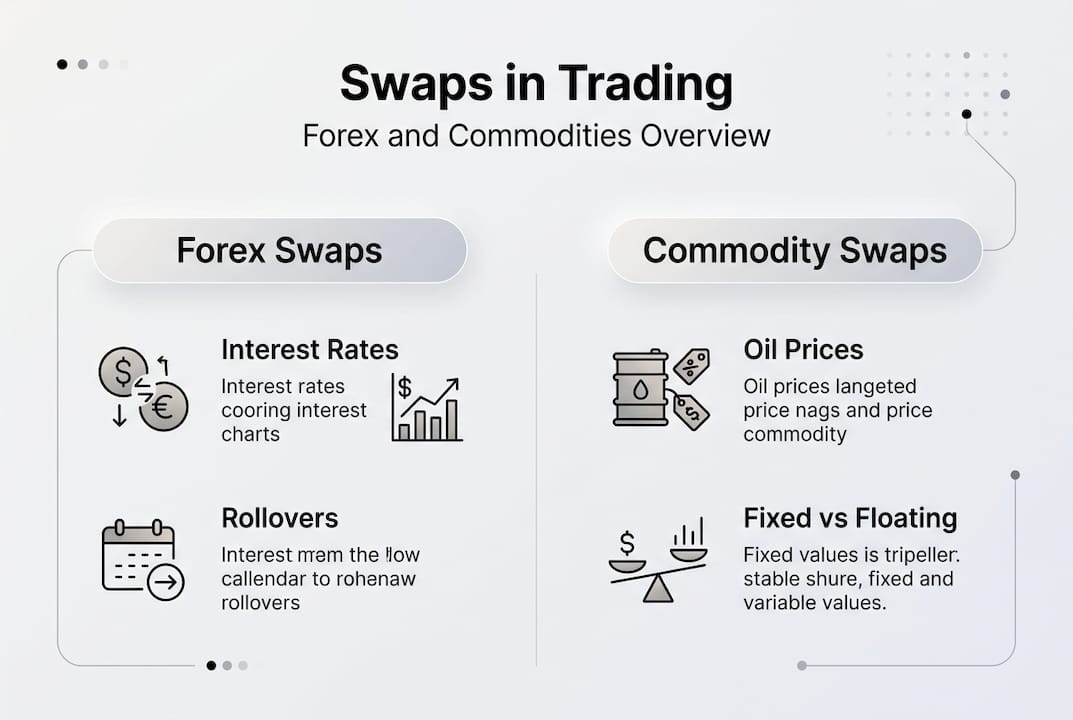
Two swap categories matter most to forex and commodities traders: interest rate-based forex swaps and commodity swaps. Each operates differently and serves distinct purposes.
Forex swaps (retail rollovers)
For retail traders, a forex swap is the daily interest rate differential charged or credited when you hold a position overnight past the broker cutoff. If you’re long EUR/USD and the euro’s interest rate is lower than the dollar’s, you pay the differential. If it’s higher, you receive it.
How forex swaps work in practice:
- You open a long EUR/USD position at 4:55 PM New York time
- The position rolls over at 5:00 PM
- Your broker calculates the interest differential between EUR and USD rates
- A swap charge or credit is applied to your account
- This repeats every trading day the position stays open
Wednesday is special. Because forex markets settle on a T+2 basis, Wednesday’s rollover covers the weekend, so you’re charged or credited three days’ worth of swap in one night. This is the triple swap rule, and it catches many traders off guard.
Commodity swaps
Commodity swaps exchange fixed versus floating cash flows based on commodity prices. A classic example: an airline locks in a fixed oil price through a swap with a bank. The bank pays the floating market price; the airline pays fixed. If oil spikes, the airline is protected. If oil drops, the bank benefits.

Retail traders don’t access commodity swaps directly. Instead, CFDs on oil, gold, or natural gas carry their own financing costs that reflect similar principles.
Pro Tip: If you’re holding CFD positions on commodities overnight, check your broker’s financing rate schedule. These costs compound quickly on leveraged positions and can erode profits on trades that look good on paper.
| Swap type | Who uses it | How it works | Retail access |
|---|---|---|---|
| Forex rollover | Retail traders | Interest differential applied daily | Direct (via broker) |
| Interest rate swap | Institutions | Fixed vs floating rate exchange | No direct access |
| Commodity swap | Producers, consumers, banks | Fixed vs floating commodity price | Via CFDs only |
| Currency swap | Corporations, banks | Exchange principal + interest in two currencies | No direct access |
For traders who want to see how trading strategies with swaps interact with position timing, the differences between these types become very practical, very fast. You can also compare swap features across account types to find the best fit for your style.
Understanding swap and rollover mechanics at the broker level also reveals how liquidity providers pass costs down to retail clients.
How swaps are calculated and settled
Knowing a swap exists is one thing. Knowing exactly what you’ll pay or receive is what separates informed traders from those who get surprised at month-end.
The standard forex swap formula is:
(Interest differential + broker markup) x position size x days held
Breaking that down:
- Interest differential: The gap between the two central bank rates for the currency pair
- Broker markup: The spread your broker adds on top, which is where they profit
- Position size: Measured in lots (1 standard lot = 100,000 units)
- Days held: Each overnight hold adds another day’s swap
For institutional swaps, settlement works differently. Two counterparties agree on a notional principal, then periodically exchange only the net difference between their obligations. No actual principal changes hands, only the cash flow difference. This is called net settlement and keeps transaction costs low for large positions.
| Factor | Retail forex swap | Institutional OTC swap |
|---|---|---|
| Calculation basis | Interest differential + markup | Agreed fixed vs floating rate |
| Settlement | Daily credit/debit to account | Periodic net cash flow exchange |
| Transparency | Broker-controlled, often opaque | Negotiated, contractually defined |
| Markup | Yes, broker adds spread | Negotiated directly |
| Minimum size | Any lot size | Typically millions in notional |
Broker markups are where hidden costs often live. Two brokers quoting the same currency pair can have very different swap rates because each applies its own markup on top of the interbank rate. Regularly monitoring your swap fees is one of the most underrated ways to protect profitability. Understanding how spread and swap costs interact also helps you evaluate your true cost per trade.
For a technical breakdown of how swaps are settled at the institutional level, the mechanics reveal why these instruments are so widely used for risk management.
Edge cases, special rules, and institutional vs retail access
Swap mechanics have several nuances that can significantly affect your positions if you’re not prepared for them.
Key edge cases to know:
- Triple swap Wednesdays: Three days of interest applied in one rollover to account for the weekend settlement gap
- Holiday shifts: When major financial centers are closed, rollover dates shift, and swaps may be applied on unexpected days
- Quanto swaps: Institutional tools that hedge both commodity price risk and currency risk simultaneously, useful for cross-border commodity exposure
- Broker-specific cutoffs: Not all brokers use 5 PM New York time; some use server time, which can differ
The access gap between retail and institutional traders is significant. Retail traders are limited to broker-controlled spot rollovers with markups baked in. Institutions negotiate OTC swap terms directly with counterparties, access a wider range of instruments, and can structure swaps to match specific hedging needs.
For context on how institutional traders operate and why their swap access differs so dramatically, the scale and regulatory framework they operate under explains most of it.
Pro Tip: If you trade around Wednesdays or major holidays, check your broker’s swap schedule in advance. A position that looks cost-neutral can suddenly carry three times the expected overnight charge.
For traders curious about quanto hedge mechanics, these instruments show how sophisticated the swap market becomes at the institutional level.
Swaps in trading strategies: Impact, risks, and practical use
Swaps aren’t just a cost to minimize. For some strategies, they’re a source of income. For others, they’re a silent profit killer.
1. Carry trades
A carry trade involves buying a high-interest currency and selling a low-interest one to collect the positive swap daily. AUD/JPY is a classic example: Australia’s rates have historically been higher than Japan’s near-zero rates, generating a daily credit for long holders. But positive carry in high-differential pairs is vulnerable to sudden rate changes and market reversals that can wipe out months of swap income overnight.
2. Swing trading
Swing traders hold positions for days to weeks. Negative swaps compound over that period and directly reduce net profit. A trade that shows a 50-pip gain might net only 30 pips after swap costs on a week-long hold. Understanding swing trading strategies in the context of swap costs helps you set realistic profit targets.
3. Swap-free accounts
For traders who can’t pay or receive interest for religious reasons, swap-free accounts replace daily swap charges with flat administrative fees. These accounts are widely available but require careful comparison since flat fees can sometimes exceed standard swap costs on short holds.
4. Commodity hedging
Producers and large consumers use commodity swaps to lock in prices and remove uncertainty from their cost structures. A gold miner might swap floating spot prices for a fixed rate, guaranteeing revenue regardless of market moves.
5. Avoiding swap traps
The biggest risk is holding a position through a high-swap period without accounting for the cost. Swap fee examples across brokers show how dramatically rates vary, reinforcing why broker selection matters as much as strategy.
Stat callout: Carry trades in pairs like AUD/JPY can generate meaningful daily credits, but broker costs and market shifts erode the edge quickly. Most professionals use carry as a hedge component, not a standalone strategy.
The impact on strategies is clear: swaps reward traders who plan around them and punish those who ignore them.
Explore swap-friendly trading with Olla Trade
Understanding swaps is one thing. Having the right platform to manage them is another. At Olla Trade, we give traders full visibility into swap rates, financing costs, and account structures so there are no surprises at rollover time.
Whether you’re exploring forex trading for the first time or refining a multi-instrument strategy, our platform is built to support both. You can compare account types to find swap-free options or standard accounts with competitive rates. And if you want to build a stronger foundation before trading, our forex trading guide covers everything from market structure to execution. Tight spreads, fast execution, and transparent fee structures make Olla Trade a practical choice for traders who take costs seriously.
Frequently asked questions
What is the difference between a swap and a rollover in forex trading?
A rollover is the process of extending an open position’s settlement date, while a swap is the interest cost or credit applied during that extension. For retail traders, the two terms are often used interchangeably, but true swaps are institutional OTC instruments with far more complexity.
How does a triple swap on Wednesday affect forex positions?
Wednesday’s rollover covers Saturday and Sunday settlement since markets are closed on weekends, so three days of interest are applied in a single overnight charge or credit. This can be three times your normal daily swap cost.
Can retail traders access commodity swaps?
Not directly. Commodity swaps are OTC institutional contracts. Retail traders access similar exposure through CFDs on oil, gold, or other commodities, which carry their own financing costs that reflect commodity swap principles.
How are swap costs calculated for retail forex traders?
The formula is: (interest differential + broker markup) x position size x days held. Broker markups vary widely, so the same currency pair can carry different swap costs at different brokers.
What are swap-free accounts and who uses them?
Swap-free accounts replace interest-based overnight charges with flat administrative fees, designed for traders who can’t pay or receive interest for religious reasons. They’re available at most major brokers but require careful cost comparison before use.