












TL;DR:
- Negative balance protection prevents retail traders’ accounts from owing money after extreme market events. It activates only when margin calls and stop-outs fail, with brokers absorbing losses beyond deposits. Traders should rely on sound risk management practices, not NBP, as their primary safeguard.
Negative balance protection is defined as a regulatory and contractual safeguard that prevents a trader’s account from falling below zero, ensuring losses never exceed deposited funds. Retail traders using leveraged products like Forex and CFDs face this risk constantly. A single extreme market event can wipe out an account faster than any stop-loss can react. NBP guarantees traders cannot owe money to their broker beyond what they deposited, making it one of the strongest retail capital protections regulators have introduced worldwide. Ollatrade applies this protection for retail clients, reflecting the standard now expected across regulated markets.
What is negative balance protection and how does it work?

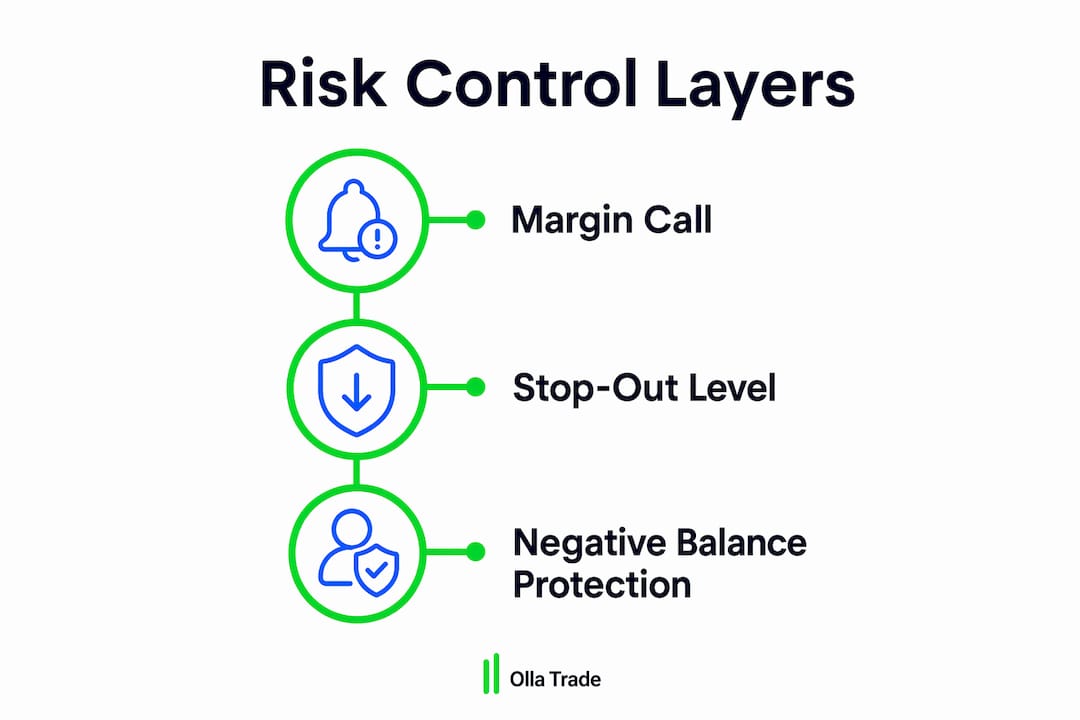
Negative balance protection (NBP) is the last line of defense in a layered risk control system. It activates only after two earlier controls, margin calls and automatic stop-outs, have already failed to prevent a negative account balance.
The three layers of risk control
Understanding NBP requires understanding the full sequence. A margin call warns you when your equity drops near the minimum required to hold open positions. If you do not act, the broker’s system triggers an automatic stop-out, closing your positions at the margin threshold. Under normal conditions, this process keeps your balance at or above zero.
The problem arises during extreme market events. Weekend gaps, flash crashes, and sudden central bank decisions can cause prices to jump so far, so fast, that stop-outs execute at prices far worse than the threshold. Your account goes negative before the system can react. NBP is the mechanism that zeros out that deficit, with the broker absorbing the loss.
| Risk control layer | When it activates | What it does |
|---|---|---|
| Margin call | Equity approaches minimum margin | Warns trader to deposit funds or close positions |
| Automatic stop-out | Equity hits margin threshold | Closes open positions automatically |
| Negative balance protection | Account goes below zero | Broker absorbs the deficit; balance reset to zero |
Pro Tip: Check your broker’s stop-out level before trading with high leverage. A stop-out set at 50% of margin gives NBP far less work to do than one set at 20%.
NBP does not reimburse any losses within your deposited amount. If you deposited $5,000 and your account drops to $200, that $4,800 loss is yours. NBP only covers trading-related debt that pushes your balance past zero. That distinction matters enormously for how you think about risk.
Who qualifies for negative balance protection?
The regulatory landscape for NBP is not uniform. Jurisdiction, account type, and broker classification all determine whether you actually have this protection.
Regulatory bodies in several major markets have made NBP mandatory for retail clients. The UK’s Financial Conduct Authority (FCA) requires it for retail CFD and Forex traders. The European Securities and Markets Authority (ESMA) extended similar requirements across the European Union. These rules exist because retail traders are presumed to lack the experience and capital buffers that professional traders carry.
Key jurisdictions with mandatory NBP for retail traders
- United Kingdom: FCA mandates NBP for all retail leveraged product accounts.
- European Union: ESMA product intervention measures require NBP for retail CFD traders across member states.
- Australia: The Australian Securities and Investments Commission (ASIC) enforces NBP for retail clients trading CFDs.
- Other regulated markets: Several additional jurisdictions have adopted similar retail protections, though enforcement strength varies.
Professional traders are almost universally excluded from NBP. Regulators assume professional classification signals sufficient risk capacity and experience to manage potential debts beyond account equity. If you hold a professional account, you accept that your losses can exceed your deposit.
Pro Tip: If your broker offers to upgrade you to professional status, read the full terms first. You gain higher leverage but lose mandatory NBP coverage. That trade-off is significant.
The legal robustness of NBP varies by jurisdiction. In some regions, it is a hard regulatory requirement with enforcement teeth. In others, it is a discretionary broker policy, meaning the broker can apply it selectively or include conditions in the contract that limit its scope. Always read the contractual language, not just the marketing copy.
What are the benefits and limitations of negative balance protection?
NBP delivers a specific, narrow benefit. It prevents you from owing your broker money after a catastrophic market event. That is genuinely valuable. NBP represents a zero-cost protection for retail traders, since brokers absorb the excess loss without charging a premium for the coverage.
Where NBP actually helps
Consider the Swiss franc crisis of january 2015. The Swiss National Bank removed its currency peg without warning. Forex traders holding CHF positions saw prices gap by thousands of pips in seconds. Stop-outs executed at prices far below margin thresholds. Without NBP, many retail traders would have owed their brokers significant sums. With NBP in place, those accounts were reset to zero rather than going into debt.
The same logic applies to flash crashes in equity indices, sudden commodity price collapses, and crypto market dislocations. Extreme events trigger NBP precisely because normal risk controls cannot move fast enough.
Where NBP does not help
NBP does not protect you from losing your entire deposit through poor trading decisions. A trader who consistently overtrades, ignores stop-losses, or uses maximum leverage on every position will lose their full deposit long before NBP becomes relevant. The protection covers only the scenario where the market moves so fast that your balance crosses zero.
Traders who treat NBP as a substitute for risk management are taking on far more risk than they realize. Here are the practices that actually protect your capital day to day:
- Set stop-loss orders on every trade. A stop-loss limits your loss on any single position before it compounds.
- Control position size. Risk no more than 1–2% of your account on any single trade.
- Monitor margin levels actively. Know your broker’s margin call and stop-out thresholds before you open a position.
- Avoid maximum leverage. High leverage amplifies both gains and losses. Lower leverage gives stop-outs more room to work.
- Stay informed about scheduled risk events. Central bank decisions and major economic releases create the volatility that can trigger NBP scenarios.
Pro Tip: NBP is your airbag, not your seatbelt. Wear the seatbelt first. Use sound risk management strategies as your primary protection on every trade.
How should traders integrate NBP with broader risk management?
NBP works best when it sits at the end of a well-built risk management framework, not at the center of it. NBP is not standalone protection. Relying on it as your primary safety net means you have already let every other control fail.
The practical integration looks like this:
- Understand margin and leverage mechanics before trading any leveraged product. Knowing how margin requirements change with position size prevents most margin call scenarios.
- Learn how margin calls work so you can respond before stop-outs trigger. A margin call is an opportunity to act, not a signal to ignore.
- Monitor market volatility around major events. The conditions that activate NBP, gaps and flash crashes, are most likely during high-volatility periods.
- Include NBP status in your broker selection criteria. A broker with mandatory regulatory NBP offers a structurally different risk profile than one with a discretionary policy.
- Review your trading plan regularly. NBP knowledge should inform how you size positions and set leverage, not just how you choose a broker.
Traders who understand where NBP fits in this sequence make better decisions at every level. They do not overtrade because they think NBP will catch them. They use it as context for understanding their true worst-case exposure.
What to verify about your broker’s NBP policies?
Confirming that your broker actually provides NBP requires more than reading a homepage claim. Verifying broker licensing and contractual NBP terms is the only way to know whether your protection is real or just marketing language.
Use this checklist before opening a funded account:
- Regulatory license: Confirm the broker holds a license from a recognized authority such as the FCA, ESMA-regulated national regulator, or ASIC. Check the regulator’s public register directly.
- Account classification: Confirm whether your account is classified as retail or professional. NBP eligibility depends on this classification in most jurisdictions.
- Contractual language: Read the client agreement for the exact NBP terms. Look for conditions, exclusions, or language that makes NBP discretionary rather than guaranteed.
- Jurisdiction of incorporation: A broker licensed in a jurisdiction with weak NBP enforcement provides less protection than one regulated in the UK or EU.
- Customer support transparency: Ask the broker directly how NBP applies to your account type. A broker that cannot answer clearly is a red flag.
Pro Tip: Check your broker’s account verification process carefully. Proper KYC and account classification procedures are a signal that the broker takes regulatory compliance seriously across the board.
The legal force of NBP depends heavily on broker jurisdiction and how the contract is written. Two brokers can both claim to offer NBP while providing very different levels of actual protection. Due diligence here is not optional.
Key Takeaways
Negative balance protection guarantees retail traders cannot owe their broker money beyond their deposit, but it only activates after margin calls and stop-outs have already failed during extreme market events.
| Point | Details |
|---|---|
| NBP definition | Prevents account balances from going below zero; broker absorbs any deficit beyond deposited funds. |
| Activation conditions | Triggers only when margin calls and stop-outs fail during extreme events like flash crashes or market gaps. |
| Retail vs. professional | Retail traders receive mandatory NBP in regulated markets; professional accounts are almost always excluded. |
| Key limitation | NBP does not protect against losses within your deposit; sound risk management remains your primary defense. |
| Broker verification | Always confirm NBP is a regulatory requirement, not a discretionary policy, before funding an account. |
NBP is a floor, not a strategy
I have watched traders treat negative balance protection as a reason to trade recklessly. The logic goes: “I can’t lose more than I deposit, so I’ll use maximum leverage.” That reasoning is exactly backwards.
NBP activates in scenarios so extreme that your entire account is already gone. The Swiss franc event, the 2020 oil price collapse into negative territory, the crypto flash crashes. These are not recoverable situations for your trading capital. NBP simply means you do not also owe your broker a debt on top of losing everything.
What I have found consistently is that traders who understand NBP deeply end up trading more conservatively, not less. They recognize that the protection covers a catastrophic tail risk, not everyday volatility. That understanding pushes them toward proper position sizing, lower leverage, and genuine stop-loss discipline.
Regulatory standardization of NBP is increasing. More jurisdictions are moving toward mandatory retail protections modeled on FCA and ESMA frameworks. That is a positive development. But regulation will never replace individual trader responsibility. Stay current on your broker’s policies, especially if you trade across multiple jurisdictions or switch platforms. The protection you think you have and the protection you actually have can differ significantly.
— FX
Trading safely with Ollatrade’s built-in protections
Ollatrade applies negative balance protection for retail clients, so your maximum loss on any trade is limited to your account balance. That structural protection pairs with the platform’s full suite of risk management tools, including real-time margin monitoring, fast execution on MetaTrader 4, and access to key platform features designed to keep you in control of your exposure.
Ollatrade also provides educational resources covering forex trading step by step, from account setup through active risk management, so you build the habits that make NBP a last resort rather than a regular occurrence. Retail traders who want a regulated environment with transparent protections and practical tools will find Ollatrade built for exactly that purpose.
FAQ
What is negative balance protection in simple terms?
Negative balance protection means your trading account cannot go below zero. If extreme market conditions push your balance into negative territory, the broker absorbs the loss and resets your account to zero.
How does negative balance protection work during a market crash?
When a sudden price gap causes your positions to close at prices worse than your stop-out level, your balance can go negative before the system reacts. NBP covers that deficit, with the broker taking the loss beyond your deposited funds.
Does negative balance protection apply to professional traders?
Professional traders are almost universally excluded from NBP. Regulators classify professional accounts as having sufficient risk capacity to accept potential debts beyond their account equity.
Is negative balance protection a substitute for stop-loss orders?
NBP is not a substitute for stop-loss orders or any other risk management tool. It only activates after all other controls have failed in extreme scenarios. Stop-losses, position sizing, and margin monitoring remain your primary defenses.
How do I know if my broker actually provides negative balance protection?
Check your broker’s regulatory license with the relevant authority, read the client agreement for the exact NBP terms, and confirm your account is classified as retail. A mandatory regulatory requirement provides stronger protection than a discretionary broker policy.