











要約:
- Online trading has significantly lowered costs and increased access to multiple asset classes through user-friendly platforms. These advancements enable faster trade execution, clearer control, and greater diversification for individual investors. However, disciplined use of tools and understanding fee structures remain essential for successful trading outcomes.
The advantages of online trading have reshaped how individuals participate in financial markets. A decade ago, buying a share of stock meant calling a broker, waiting for confirmation, and paying a commission that ate into your returns before you even started. Today, you can open an account in minutes, trade dozens of asset classes from your phone, and pay nothing in commissions. Understanding what these platforms actually deliver, and where they fall short, is the difference between choosing a setup that works for you and stumbling into one that costs you more than you expected.
目次
- 重要なポイント
- 1. Lower costs and fees compared to traditional trading
- 2. Accessibility and convenience via digital platforms
- 3. Diverse asset class availability and portfolio diversification
- 4. Speed and efficiency: faster execution and settlement
- 5. Transparency and control over your own trades
- 6. Access to tools and data previously reserved for professionals
- My take on where online trading actually delivers
- Start trading smarter with Ollatrade
- よくある質問
重要なポイント
| ポイント | 詳細 |
|---|---|
| Lower costs change the math | Zero-commission trading reduces friction, but the full fee picture includes spreads, subscriptions, and options fees. |
| Mobile access equals market access | Modern apps deliver live data, charting, and execution from anywhere, removing geography as a barrier. |
| One platform, many asset classes | Stocks, ETFs, forex, commodities, and crypto can now be managed within a single trading interface. |
| T+1 settlement speeds up your capital | Regulatory changes mean most trades clear in one business day, so your funds are available faster. |
| Fractional shares democratize investing | You can build a diversified portfolio with as little as $1 per position, regardless of share price. |
1. Lower costs and fees compared to traditional trading
The most immediate benefit of digital trading is what you stop paying. Traditional full-service brokers charged $25 to $75 per trade as recently as the early 2010s. Today, zero-commission trading is standard across leading online brokers, with low or no minimum account balances and platforms built for both beginners and experienced traders.
That cost reduction is not just cosmetic. Lower commissions change which trades are actually worth making. When a round trip costs $50 in commissions, a $500 position has to gain 10% before you break even on fees alone. At zero commission, smaller trades and higher-frequency strategies become viable.
That said, the headline of “free trading” requires some scrutiny. Zero-commission brokers often apply fees beyond commissions including subscription tiers, options contract fees, and fund expense ratios that impact your real cost of trading. Evaluating a platform means looking at the full fee picture, not just the commission line.
プロのヒント: Before committing to any platform, run a quick calculation using your expected trade frequency, account size, and asset types. A free stock trading account with a $0.65 per options contract fee will cost you more than a subscription-based platform if you trade options regularly.
その hidden costs and spreads across leading platforms vary enough to meaningfully affect your net returns over a year of active trading. Knowing where to look makes you a smarter consumer before you deposit a single dollar.
2. Accessibility and convenience via digital platforms
Three things used to limit market participation: geography, time, and capital. Online platforms have addressed all three.
Account opening within minutes via smartphone or browser has replaced the traditional process of visiting a branch, submitting paperwork, and waiting days for approval. No minimum balance restrictions on most modern platforms mean you can start with whatever amount fits your situation.
Here is what that accessibility actually looks like in practice:
- Download a trading app or visit a broker’s website
- Complete identity verification digitally, usually under 10 minutes
- Fund your account via bank transfer, card, or other supported method
- Access live markets across multiple asset classes immediately
Mobile trading apps provide live market data, order execution, and advanced charting capabilities in real time, enabling you to act on market moves from anywhere. That last point matters more than most new traders realize. A position you cannot monitor is a risk you cannot manage. Mobile access closes that gap.
プロのヒント: Turn on price alerts for your open positions the moment you place a trade. Most apps let you set notifications for specific price levels, which means you stay informed without staring at charts all day.
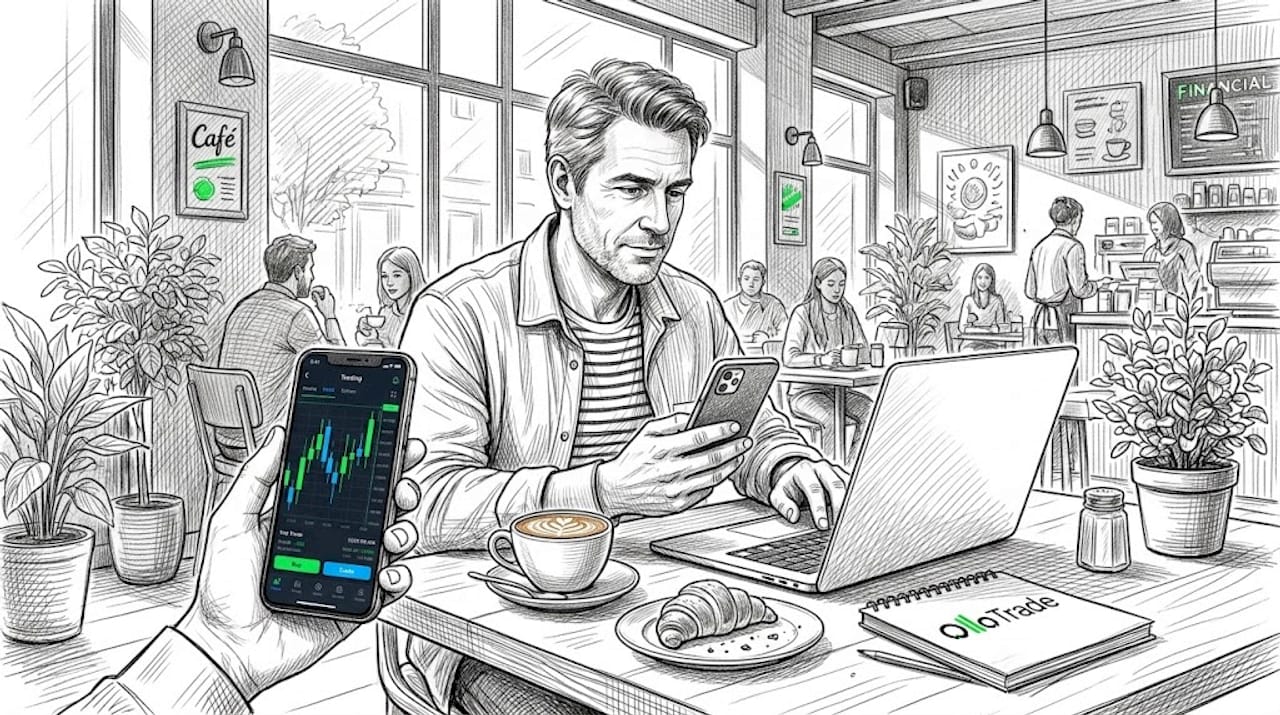
The convenience factor extends beyond just execution. Online platforms deliver economic calendars, news feeds, and research tools directly in the interface, so your research and your trading happen in the same place.
3. Diverse asset class availability and portfolio diversification
One of the most underappreciated advantages of trading online is the breadth of what you can actually trade. Where traditional brokers often specialized in stocks or bonds, modern online platforms offer multi-asset access including stocks, ETFs, mutual funds, bonds, commodities, and digital assets within a single interface.
That matters for diversification in a direct way. When equity markets drop, commodities like gold often move differently. When inflation rises, certain bond positions and energy contracts respond in their own direction. Having all of these available on one platform means you can respond to changing conditions without opening new accounts or transferring funds between services.
| 資産クラス | Example instruments | Typical access method |
|---|---|---|
| Equities | Individual stocks, ETFs | Direct purchase or fractional shares |
| 外国為替 | Currency pairs (EUR/USD, GBP/JPY) | CFDs or spot trading |
| 商品 | Gold, oil, natural gas | CFDs or futures contracts |
| 暗号 | ビットコイン、イーサリアム | Direct or CFD |
| Fixed income | Government bonds, corporate bonds | Direct purchase or bond ETFs |
Fractional shares allow you to purchase portions of expensive stocks for as little as $1, which removes price per share as a barrier to diversification. You do not need to save up $200 to buy a single share of a company when you can allocate $20 and hold a meaningful position relative to your portfolio size.
For traders exploring multiple instruments for portfolio growth, the ability to hold positions across asset classes within one account also simplifies tracking. Your overall exposure is visible in one place rather than scattered across multiple logins.
4. Speed and efficiency: faster execution and settlement
Electronic order routing processes trades in milliseconds. That speed of execution matters when market prices are moving, and it represents a real operational edge over the phone-based systems it replaced.
The bigger structural shift in recent years has come from regulation rather than technology. The T+1 settlement rule from the SEC accelerates trade settlement to one business day for most applicable securities transactions. Previously, standard settlement took two business days (T+2). Shortening that window by one business day means your proceeds from a sale are available for reinvestment or withdrawal a full day sooner.
| Settlement standard | Time to fund availability | Practical impact |
|---|---|---|
| T+2 (old standard) | 2 business days | Capital locked longer after a sale |
| T+1 (current SEC rule) | 1 business day | Faster reinvestment or withdrawal |
| Real-time gross settlement | Immediate (select contexts) | Used in some crypto and forex markets |
Faster confirmations enabled by electronic execution complement the T+1 rule, minimizing the total time between placing a trade and having your capital free again. For active traders who rotate positions frequently, that difference compounds over dozens of trades per month.
One important nuance: despite faster execution technology, order routing rules impose inherent minimum timeframes for trade clearing. Even in a T+1 environment, settlement is not instantaneous. Planning your capital allocation around realistic timelines, not best-case scenarios, keeps you from overextending.
5. Transparency and control over your own trades
Traditional brokers made decisions on your behalf. You called, described what you wanted, and trusted that the execution matched your intent. Online trading removes that layer entirely.
You place the order. You set the price. You choose the order type, whether that is a market order, limit order, or stop-loss. That control is not just about ego. It means you can execute exactly the strategy you have planned without depending on a third party to interpret your instructions correctly.
Transparent fee structures online also help you compare platforms objectively. When costs are published and searchable, you can evaluate プラットフォームの機能 against what they actually charge rather than taking a broker’s word for it.
6. Access to tools and data previously reserved for professionals
Retail traders in the 1990s had access to delayed quotes and basic charts. Professional traders had Bloomberg terminals, real-time data, and proprietary analysis tools. That gap has closed dramatically.
Today’s online platforms integrate AI and machine learning to generate personalized investment recommendations, optimize portfolios, and flag risk exposures in ways that would have required a team of analysts a generation ago. Advanced charting, technical indicators, backtesting tools, and economic calendars are standard features on most platforms.
For traders who want to go deeper, trading education from reputable sources teaches you to use these tools effectively rather than just having access to them. Tools without understanding are just noise. Education turns platform features into real edges.
My take on where online trading actually delivers
I have watched this industry transform over 15 years. What strikes me most is not the obvious stuff like lower commissions or mobile access. Those are table stakes now. The real shift is in who gets to play.
When I started paying attention to retail trading, a serious trading setup required capital, connections, and expensive data subscriptions. The advantages of online trading today have redistributed all three. A trader with $500 and a smartphone has access to real-time data, multiple asset classes, and fractional positions across markets that were genuinely inaccessible to retail participants not long ago.
What I have learned from watching beginners succeed and fail is this: the platform advantages matter far less than how consistently you use them. The speed of execution does not help you if you are trading on impulse. The asset variety does not help you if you hold 15 positions you cannot analyze. The benefits of digital trading are real, but they amplify your habits, good and bad, rather than replacing skill.
My honest advice is to pick one or two asset classes you understand, use the tools your platform provides to track them systematically, and treat the low-cost structure as an invitation to trade with discipline rather than frequency. The traders I have seen build real results online are not the ones who use every feature. They are the ones who use a few features very well.
— FX
Start trading smarter with Ollatrade
If the online trading pros covered in this article sound like what you have been looking for, Ollatrade puts those advantages into practice through a platform built for serious traders at every level.
Ollatrade offers access to 外国為替市場, CFDs on metals, indices, stocks, energies, and cryptocurrencies through a MetaTrader 4 integrated platform with tight spreads and fast execution. Whether you are exploring your first position or managing an active multi-asset portfolio, the platform gives you the tools and transparency to trade with confidence. Account creation takes minutes, and multiple deposit options mean you can fund and start trading without unnecessary delays. Explore CFDとは何か and see how Ollatrade’s instrument range supports the kind of diversified, cost-aware trading strategy this article describes.
よくある質問
What are the main advantages of online trading?
The core advantages include zero or low-commission structures, 24/7 access to markets via mobile apps, multi-asset trading within one platform, and faster trade settlement under the SEC’s T+1 rule. Together, these reduce costs and increase flexibility compared to traditional brokerage methods.
Is online trading worth it for beginners?
Yes, particularly because modern platforms allow account opening in minutes with no minimum balance, provide access to fractional shares from as little as $1, and include educational tools and real-time data that were previously available only to professional traders.
How does T+1 settlement benefit online traders?
The SEC’s T+1 settlement rule means most securities trades clear within one business day, so your funds from a completed sale are available faster for reinvestment or withdrawal compared to the previous two-day standard.
Are zero-commission platforms really free to use?
Not entirely. While headline commissions are zero on most leading platforms, you should account for options contract fees, subscription tiers, fund expense ratios, and bid-ask spreads that all contribute to your real trading costs.
What assets can I trade on online platforms?
Most online platforms give you access to stocks, ETFs, bonds, forex currency pairs, commodities like gold and oil, and cryptocurrencies within one account. Platforms like Ollatrade also offer CFDs across indices, metals, and energies alongside forex trading.