










要約:
- Account verification is a crucial, ongoing safeguard that prevents fraud, money laundering, and unauthorized withdrawals in online trading. Traders must understand that verification is required beyond onboarding for large transactions, personal info changes, and regulatory compliance, ensuring safe and smooth trading experiences. Maintaining current documents and responding promptly to verification requests protect your funds, improve limits, and foster trust with regulated platforms.
Account verification is one of those things traders almost universally underestimate. Most people treat it like a one-time checkbox, something you power through during sign-up and never think about again. That mindset can cost you real money. Whether you’re trading 外国為替, CFDs on metals, or cryptocurrencies, the verification process is an active, ongoing layer of protection that determines whether you can withdraw funds, execute large trades, and maintain full account access when it matters most. This article breaks it all down in plain terms.
目次
- What is account verification and why does it matter?
- How account verification works: The standard process
- More than onboarding: When else is verification required?
- Security, compliance, and your experience: The lasting impact
- The truth most traders miss about account verification
- Ready to trade securely? Explore verified trading solutions
- よくある質問
重要なポイント
| ポイント | 詳細 |
|---|---|
| Verification is continuous | It’s an ongoing process that protects your funds and the trading community. |
| Multiple verification steps | Identity, address, and sometimes risk assessment are standard during sign-up and certain actions. |
| Choose compliance-first platforms | Platforms that value strong verification offer greater safety and reliability. |
| Prepare documents in advance | Having your ID, proof of address, and banking details ready speeds up account approval. |
What is account verification and why does it matter?
At its core, account verification in online trading refers to KYC, which stands for Know Your Customer. In practice, KYC processes confirm your identity, your residential address, and often your financial risk profile before a platform fully enables trading and withdrawals. It’s not just a formality. It’s the mechanism that stands between your funds and a range of serious threats including fraud, money laundering, and identity theft.

Platforms are legally required to run these checks under financial regulations that apply across most jurisdictions. If a broker skips this step, it risks losing its license and exposing its users to enormous financial and legal risk. For you as a trader, understanding the KYC and AML policy at your platform is as important as understanding spreads or leverage ratios.
Here’s what account verification actually protects against:
- Fraud and impersonation: Verifying your identity prevents bad actors from opening accounts in your name.
- Money laundering: Financial regulators require brokers to confirm the source of funds for large transactions.
- Unauthorized withdrawals: A verified account requires matching credentials before funds can leave.
- Platform instability: Unverified platforms attract bad actors, which ultimately harms every legitimate trader on the platform.
“Account verification is the foundation of a trustworthy trading environment. Platforms that take it seriously protect not just regulators, but every genuine trader on their books.”
One subtle but important point: verification is not a one-time badge you earn at sign-up. Platforms continuously review accounts as online trading basics evolve and regulatory environments tighten. Good account management practices include keeping your submitted documents current so verification never becomes a barrier at the worst possible moment.
How account verification works: The standard process
Understanding exactly what happens during verification removes most of the anxiety around it. The process typically follows a clear sequence, and knowing it in advance helps you get through it faster with fewer errors.
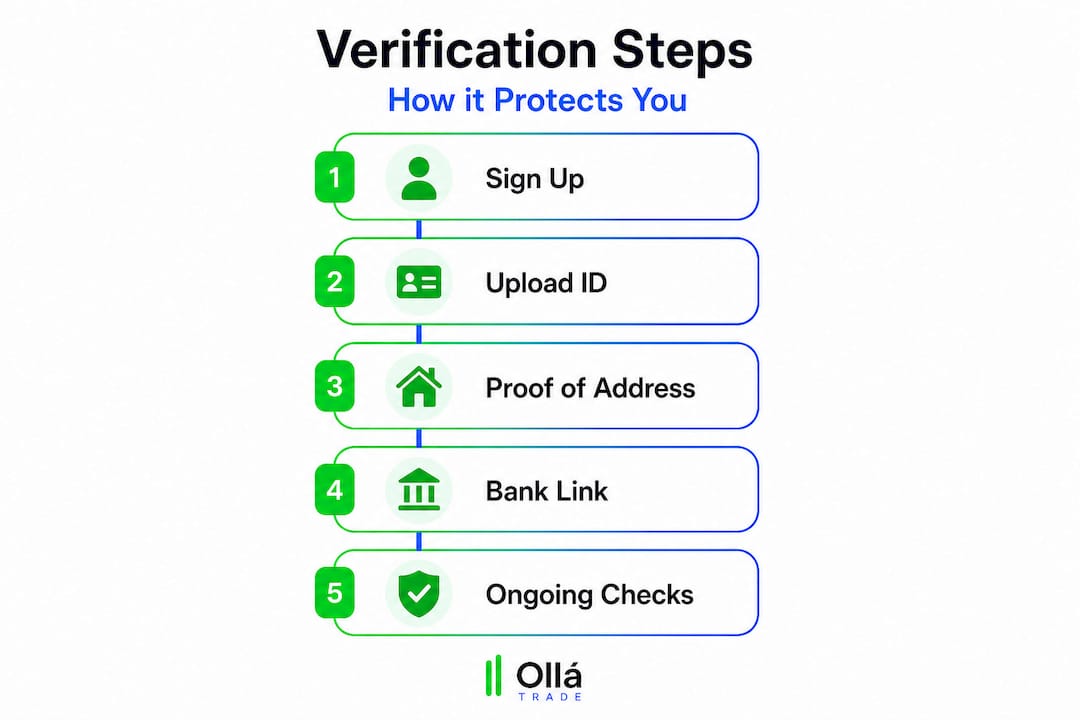
Here are the standard steps in order:
- Create your account. You register with basic personal information including your full legal name, date of birth, email address, and country of residence.
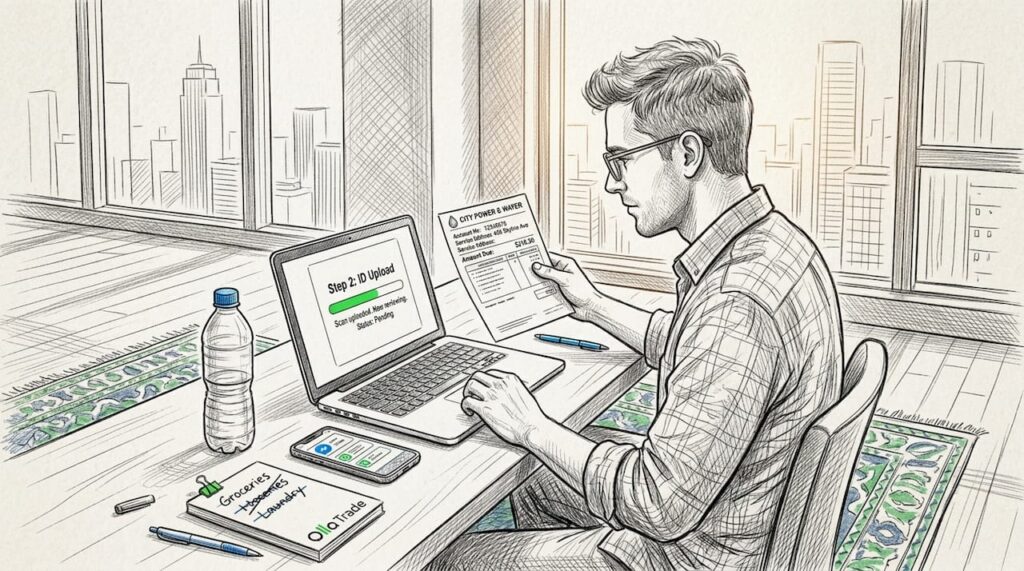
- Submit a government-issued photo ID. This is usually a passport or national identity card. Some platforms accept a driver’s license. The document must be valid and show your full name and date of birth clearly.
- Provide proof of address. A utility bill, bank statement, or government letter dated within the last three months that shows your name and residential address.
- Complete a financial risk assessment. Many regulated platforms ask about your trading experience, income range, and investment goals. This is part of suitability testing required by regulators.
- Verify your funding source. When you add a bank account or payment method, the platform confirms you own or have authorized access to it.
- Wait for approval. Most platforms complete identity verification instantly or within one to two business days for manual reviews.
Bank account verification works slightly differently from identity verification. As account verification methods show, platforms typically use either credential-based instant verification, where you log in to your bank through a secure interface, or the micro-deposit fallback method, where the platform sends one or two tiny deposits to your account and you confirm the amounts. Instant verification takes seconds. Micro-deposits take one to two business days.
| Verification method | Speed | User effort | 最適な用途 |
|---|---|---|---|
| Credential-based instant | Seconds | 低い | Most retail traders |
| Micro-deposit | 1–2 business days | 中くらい | Traders without instant access |
| Manual document review | 1–2 business days | 中高 | New accounts, complex cases |
| Enhanced due diligence | 3–5 business days | 高い | High-value or flagged accounts |
When you’re setting up your trading account, the biggest delays almost always come from avoidable mistakes. Blurry document photos, expired IDs, and address documents that don’t match the registered name are the top culprits. Understanding withdrawal conditions ahead of time also helps, since many platforms tie withdrawal access directly to completed verification levels.
Pro Tip: Scan your ID documents in good lighting against a plain dark background. Platforms use automated document readers, and contrast makes a significant difference in instant approval rates.
If you’re new to the process of setting up a bank account for trading purposes, treat that step with the same seriousness as the identity check itself. A mismatched bank account name and trading account name is a common reason for delayed or blocked withdrawals.
More than onboarding: When else is verification required?
This is the part that catches most traders off guard. You completed your verification when you signed up, everything worked smoothly, and you assumed you were done. Then, months later, you try to make a large withdrawal and your account gets flagged for additional review. This is not a malfunction. It’s the system working exactly as designed.
Identity verification is required beyond onboarding at specific trigger points, including high-value deposits or withdrawals, changes to personal information, and periodic regulatory reviews. These triggers exist because risk signals change over time. A trader who deposited small amounts for a year and suddenly withdraws a six-figure sum presents a different risk profile than they did at sign-up.
Here are the common events that can trigger additional verification:
- Large transactions: Platforms set internal thresholds. Crossing them automatically flags an account for enhanced review.
- Address or name changes: Updating personal information requires re-verification to prevent unauthorized account takeovers.
- Payment method changes: Adding a new bank account or card triggers a fresh ownership verification.
- Regulatory audits: Platforms periodically review all accounts to maintain compliance with current rules.
- Dormant account reactivation: If you haven’t traded in a long time, reactivating your account may require updated documents.
| Trigger event | Type of verification | Typical resolution time |
|---|---|---|
| Large withdrawal | Enhanced due diligence | 1–5 business days |
| Personal info update | Identity re-verification | 1–2 business days |
| New payment method | Bank account verification | Instant to 2 days |
| Regulatory review | Full KYC refresh | 2–7 business days |
Pro Tip: Set a personal reminder every 12 months to check that your submitted documents are still valid and up to date. This takes five minutes and can prevent a multi-day freeze during an active trade.
The risks of ignoring repeat verification requests are significant. Your account can be limited or suspended, and in some cases, platforms are legally required to freeze funds until compliance is satisfied. Use the trading account safety checklist to stay ahead of these requirements, and compare account types at account comparison pages to understand which tier of verification applies to your trading level.

One thing that surprises many traders: failing to keep your documents current is one of the most common ways people fall victim to investment scams, since fraudulent platforms often exploit gaps in identity verification to move funds illegally.
Security, compliance, and your experience: The lasting impact
Robust account verification does more than satisfy regulators. It actively protects your funds, your data, and your ability to trade without disruption. The relationship between verification quality and platform trustworthiness is direct and measurable.
“Verification is not a one-time ‘badge’; effective compliance relies on ongoing risk controls and customer due diligence as profiles and behavior can change over time.”
This insight from the identity management world applies perfectly to trading. Platforms that run continuous monitoring catch suspicious behavior early, whether that’s an unauthorized login attempt from an unusual location or a sudden pattern of unusual transactions. That monitoring is only possible because verified identity data exists in the first place.
Here’s how strong ongoing verification directly benefits you:
- Faster withdrawals: Fully verified, compliant accounts process withdrawals with fewer friction points.
- Higher transaction limits: Platforms increase limits for users who have completed enhanced verification tiers.
- Account recovery: If you ever lose access, a verified identity is the fastest path back in.
- Fraud protection: Verified accounts are significantly harder to hijack because every change requires matching credentials.
- Regulatory confidence: Trading with a compliant broker reduces your exposure to platform closures or asset freezes.
Platforms that maintain strong legal and compliance policies invest heavily in the infrastructure that makes this ongoing monitoring possible. It is not cheap to run, and that cost reflects a real commitment to user security. Traders who understand this see verification not as a barrier but as evidence that a platform is worth their trust.
From an operational standpoint, keeping dedicated accounts for compliance and trading separate helps both individuals and businesses maintain clear financial records, which makes future verification reviews faster and more straightforward. Secure trading tools complement the verification layer by adding real-time monitoring and alerts that keep you informed of any account activity.
The truth most traders miss about account verification
Here’s an uncomfortable reality: the traders who complain most loudly about verification requirements are often the same ones who panic when they can’t access their funds. The process feels like friction until the moment it becomes a lifeline.
Most people frame verification as something the platform requires of them. That framing is backward. Verification is something you should want for yourself. A platform that lets you deposit funds without confirming your identity is not making your life easier. It’s exposing your capital to extraordinary risk by attracting the kind of activity that invites regulatory shutdown or outright fraud.
We’ve seen this pattern repeat consistently. Traders who rush through verification, upload blurry documents, or use a slightly different name variation from their legal ID are the ones who face freezes during volatile market conditions. The account suspension arrives at the worst possible moment, right when they need to close a position or move funds quickly.
There’s also a trust dimension here that most traders overlook. When you compare a brokerage versus an online trading account, one of the real differentiators is how seriously the platform takes compliance. A verified, monitored platform has skin in the game. Unverified platforms can vanish with your funds and face minimal legal consequences because they never confirmed who you were in the first place.
Treating verification as a trading strategy rather than a bureaucratic hurdle changes how you approach it entirely. You submit accurate documents promptly, you keep them updated, and you respond to platform requests quickly. In return, you get smoother withdrawals, higher limits, and the confidence that your funds are sitting in a compliant, regulated environment. That’s not a small thing. That’s the foundation of a sustainable trading career.
Ready to trade securely? Explore verified trading solutions
If this article has clarified anything, it’s that great trading starts with a solid foundation of trust, security, and compliance. At Olla Trade, we’ve built the verification process to be as clear and frictionless as possible, so you spend less time waiting and more time trading.

Our platform gives you access to Forex markets along with CFDs on metals, indices, energies, and cryptocurrencies, all within a secure, fully compliant environment. We walk you through exactly what to expect in our 取引プラットフォームガイド, and our transparent KYC and AML policies mean no surprises. Start trading with confidence, knowing that every layer of security is already working in your favor.
よくある質問
What documents do I need for trading account verification?
Usually, you’ll need a government-issued photo ID (passport, national ID card, or driver’s license), proof of your current residential address dated within three months, and sometimes evidence of your income source or financial background, as KYC requirements confirm identity, address, and risk profile together.
How long does bank account verification usually take?
It can be instant using credential-based methods, but micro-deposit verification typically takes one to two business days while the platform waits for you to confirm the small amounts sent to your account.
Will I have to verify my account again after signing up?
Yes. Verification is triggered at multiple points beyond initial sign-up, including high-value transactions, personal information updates, new payment methods, and periodic compliance reviews.
What happens if my verification fails?
Your account access will likely be restricted to read-only or limited functionality until you resubmit correct documents. As KYC processes confirm identity before enabling withdrawals, a failed verification means those features remain locked until the platform approves your updated submission.