












সংক্ষেপে:
- Regulatory compliance is essential for trading firms because it reduces security breaches and enforces operational maturity. It also facilitates faster onboarding and secures large enterprise contracts, supporting risk management and revenue growth.
- A proactive compliance framework involves continuous monitoring, strong vendor oversight, and governance as a strategic asset, not just a legal obligation.
Regulatory compliance is the ongoing process by which financial firms and trading organizations meet established laws, industry regulations, and standards to operate legally and ethically. In financial markets, this process goes far beyond checking boxes. It defines how a firm manages risk, earns client trust, and positions itself for growth. The role of regulatory compliance in trading covers everything from internal policies and employee training to third-party audits and board-level governance. Frameworks like SOC 2 and ISO 27001 set the benchmark, and firms that meet them operate with measurably stronger defenses and better business outcomes.
Why is regulatory compliance important for financial professionals?
Regulatory compliance protects trading firms from two categories of damage: financial loss and reputational collapse. Both are expensive. Both are avoidable with the right program in place.
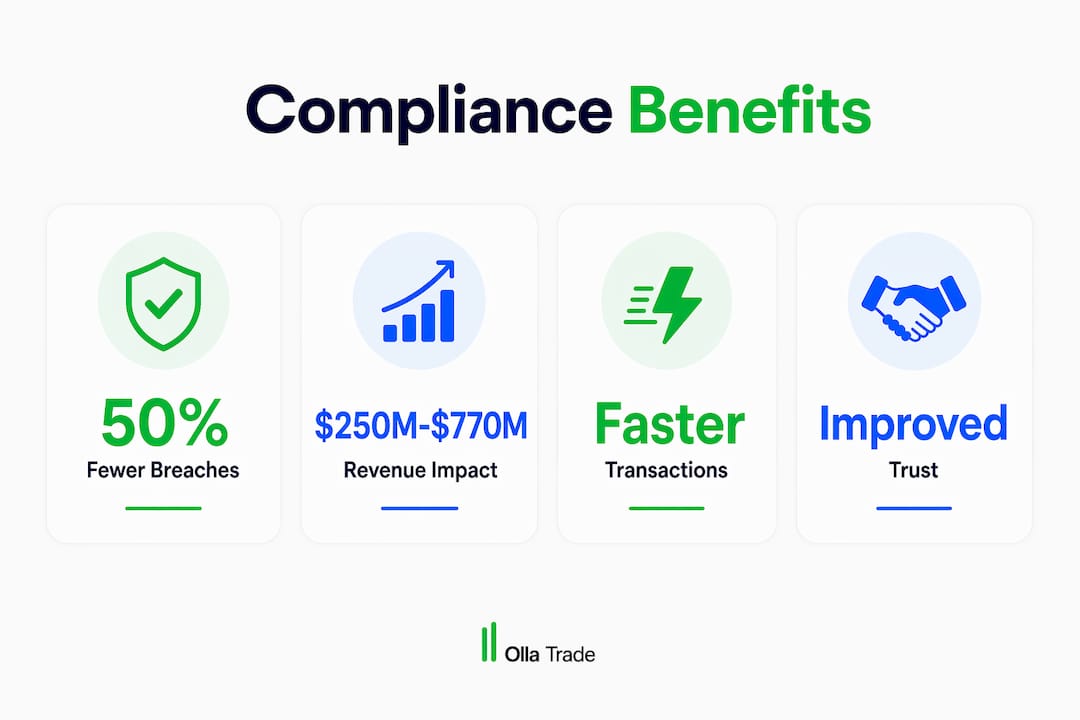
The numbers make the case clearly. Organizations certified under SOC 2 or ISO 27001 experience 50% fewer security breaches, with average breach costs sitting at $4.4 million per incident. That gap between compliant and non-compliant firms is not marginal. It represents the difference between a firm that survives a security event and one that does not.
Beyond breach prevention, compliance shapes how regulators treat a firm when things go wrong. A mature and well-documented Compliance Management System, commonly called a CMS, reduces penalties during enforcement investigations and can influence resolution terms. Regulators evaluate the quality and maturity of a firm’s CMS as the first step in any investigation. A firm that has invested in its compliance infrastructure walks into that process with a measurable advantage.
“The quality and maturity of Compliance Management Systems are the first evaluated aspect by regulators during investigations, directly affecting penalties.” — Holland & Knight
The importance of regulatory compliance also extends to client relationships. Enterprise clients, institutional counterparties, and large fund managers routinely require proof of compliance certifications before signing contracts. A trading firm without documented compliance credentials loses deals before negotiations even begin.
How does regulatory compliance work in trading and investment?
A Compliance Management System is the operational backbone of any compliant trading firm. It is not a single document or annual review. It is a living program with interconnected components that run continuously.
The core elements of an effective CMS for trading firms include:
- Written policies and procedures that define acceptable conduct, trading limits, conflict-of-interest rules, and data handling standards.
- Employee training programs that keep staff current on regulatory changes, internal controls, and reporting obligations.
- Ongoing monitoring and surveillance of trading activity to detect anomalies, insider trading signals, or policy violations in real time.
- Internal auditing that tests whether controls actually work, not just whether they exist on paper.
- Complaint management processes that document client grievances and demonstrate responsiveness to regulators.
- Third-party and vendor oversight that extends compliance standards to external partners, data providers, and technology vendors.
The board of directors carries direct responsibility for this system. Board oversight of CMS development and organization-wide adherence is not optional. It sets the tone that determines whether compliance is taken seriously at every level of the firm.
Third-party vendor oversight deserves particular attention in trading environments. A firm’s compliance posture is only as strong as its weakest external partner. If a data vendor or execution provider fails a regulatory standard, the trading firm bears exposure. Documented vendor due diligence is a non-negotiable component of any serious CMS.

প্রো টিপ: Map every third-party vendor in your trading infrastructure against your compliance certification requirements annually. Gaps in vendor coverage are the most common blind spot regulators find during examinations.
Compliance certifications also affect transaction speed. Firms with documented SOC 2 or ISO 27001 status move through institutional onboarding faster. Counterparties skip lengthy due diligence when certifications are already on file. That acceleration has direct revenue implications.
Traditional vs. modern approaches to compliance in finance
The traditional view of compliance treated it as a cost center. Legal and compliance teams existed to prevent fines, not to create value. Controls were reactive. Audits happened annually. The mindset was defensive.
That model is now a competitive liability.
| বৈশিষ্ট্য | Traditional compliance | Modern compliance |
|---|---|---|
| Primary goal | Avoid penalties | Create business value |
| Timing | Reactive, after incidents | Proactive, embedded in operations |
| মালিকানা | Legal and compliance team only | Board, operations, and technology teams |
| Audit approach | Annual checkbox review | Continuous monitoring and testing |
| Business impact | Cost center | Revenue enabler |
| Risk posture | Defensive | Anticipatory |
Financial institutions that treat compliance as a strategic asset embedded in governance, data, and decision-making outperform those that treat it as an obligation. The difference shows up in deal flow, client retention, and regulatory relationships.
The revenue impact of this shift is substantial. Compliance initiatives unlock between $250 million and $770 million in new revenue on average, because enterprise clients require proof of certifications before signing contracts. Compliance is not just protecting existing revenue. It is generating new revenue.
Modern compliance also accelerates innovation. Firms that document data sovereignty and governance for compliance purposes build the foundation needed to deploy AI-driven trading tools and analytics under complex regulations like NIS2 and DORA. Compliance embedded with data architecture enables faster movement of AI and trading projects without regulatory roadblocks. That is a direct operational advantage over competitors still treating compliance as paperwork.
প্রো টিপ: When evaluating new trading technology or AI tools, run a regulatory readiness check before deployment. Firms that document compliance alignment upfront avoid the costly process of retrofitting controls after launch.
What is the impact of compliance regulations on trading risk and growth?
Compliance directly reduces the financial losses that trading firms absorb from security events, regulatory actions, and failed deals. The impact of compliance regulations shows up across three operational areas.
Risk reduction:
- Certified firms experience significantly fewer breaches, cutting exposure to the $4.4 million average breach cost.
- Documented CMS programs reduce the severity of enforcement penalties when violations do occur.
- Continuous monitoring catches trading anomalies before they become regulatory events.
- ওলাট্রেডের risk disclosure framework reflects the kind of documented transparency that regulators and institutional clients expect.
Deal quality and speed:
- Enterprise clients require compliance certifications as a condition of contract. Firms without them lose deals at the qualification stage.
- Audit quality determines whether certifications are accepted or rejected. Low-cost audit providers frequently produce reports that enterprise clients reject. Each rejection costs between $70,000 and $100,000 in remediation and adds roughly three months of delay.
- Investing in a qualified auditor is not a premium expense. It is the cheaper option when measured against rejection costs.
Reputation and client trust:
- Non-compliance events damage client relationships in ways that are difficult to quantify and nearly impossible to reverse.
- Firms with strong compliance records attract institutional capital more easily because counterparties conduct their own due diligence.
- Documented complaint management processes signal operational maturity to both clients and regulators.
Best practices for compliance in trading firms center on three priorities: invest in audit quality, maintain continuous monitoring rather than annual reviews, and treat the CMS as a board-level responsibility rather than a back-office function. Firms that follow a structured approach to ট্রেডিং ঝুঁকি ব্যবস্থাপনা alongside compliance obligations build more durable operations than those treating the two as separate concerns.
কী Takeaways
Regulatory compliance is a direct driver of risk reduction, revenue growth, and competitive positioning for trading firms, not a passive legal obligation.
| বিন্দু | বিস্তারিত |
|---|---|
| Compliance reduces breach risk | SOC 2 and ISO 27001 certified firms experience 50% fewer breaches, cutting average $4.4M breach costs. |
| CMS quality affects penalties | Regulators evaluate CMS maturity first during investigations, directly influencing enforcement outcomes. |
| Compliance unlocks revenue | Certified firms access enterprise contracts worth $250M–$770M that non-certified competitors cannot reach. |
| Audit quality matters | Rejected audit reports cost $70,000–$100,000 each and delay deals by approximately three months. |
| Modern compliance enables innovation | Embedding compliance in data architecture accelerates AI and trading technology deployment under NIS2 and DORA. |
The mindset shift that separates compliant firms from resilient ones
I have watched compliance teams at trading firms spend enormous energy on annual audit preparation, then go quiet for eleven months. That cycle produces documentation, not protection. The firms that actually benefit from compliance are the ones that treat it as an operating discipline, not an annual event.
The most common mistake I see is treating the CMS as a legal department product. When compliance lives only in legal, it never reaches the trading desk, the technology team, or the vendor relationships where the actual risk lives. The board sets the tone, but the controls have to run at the operational level to mean anything.
Low-quality audits are a particular trap. The appeal of a cheaper audit provider is obvious, especially for smaller trading firms managing tight budgets. But a rejected SOC 2 report does not save money. It costs six figures and three months of delay, which is far more damaging than the original audit fee differential. Spend on quality once. The alternative is paying for quality twice, plus the cost of the delay.
The firms I respect most in this space have stopped asking “are we compliant?” and started asking “does our compliance program create advantage?” That question leads to better investments, faster deals, and a regulatory relationship built on demonstrated maturity rather than reactive remediation.
— এফএক্স
Ollatrade’s approach to compliant trading environments
Ollatrade operates within a framework designed to meet the standards that financial professionals and compliance officers expect from a trading platform. The platform’s legal and compliance structure reflects the documentation and transparency requirements that institutional clients and regulators look for.
For traders who want to operate in markets where compliance and risk management intersect, Ollatrade provides access to ফরেক্স ট্রেডিং alongside educational resources covering risk disclosure, account verification, and market conduct. The platform’s tools are built for traders who take both performance and regulatory responsibility seriously. Explore Ollatrade’s trading environment and see how a compliant infrastructure supports better trading decisions.
প্রায়শই জিজ্ঞাসিত প্রশ্নাবলী
What is the role of regulatory compliance in financial trading?
Regulatory compliance defines how trading firms meet legal and industry standards to operate ethically and avoid penalties. It covers policies, monitoring, auditing, and reporting as an ongoing program, not a one-time event.
How does a Compliance Management System work?
A CMS combines written policies, employee training, continuous monitoring, internal audits, and complaint management into a single operational framework. Regulators evaluate CMS maturity as the first step in any enforcement investigation.
What are the main regulatory compliance benefits for trading firms?
Certified firms experience 50% fewer security breaches, access enterprise contracts worth hundreds of millions in new revenue, and reduce enforcement penalties through documented compliance maturity.
What are the biggest regulatory compliance challenges in trading?
The most common challenges are maintaining continuous monitoring rather than relying on annual audits, extending compliance standards to third-party vendors, and investing in audit quality to avoid costly report rejections.
Why does audit quality matter for compliance certifications?
Low-quality audit reports are frequently rejected by enterprise clients, costing firms $70,000–$100,000 per rejection and adding approximately three months of delay to contract timelines.