

You’ve probably heard that forex trading is profitable, but the reality is harsh. Nearly 80% of retail forex traders lose money within their first year due to poor preparation, emotional trading, and lack of risk management. The difference between winning and losing traders isn’t luck or secret knowledge. It’s following a structured approach that combines strategy, discipline, and the right tools. This guide provides actionable steps to help you navigate forex markets with confidence and improve your odds of consistent profitability.
Table of Contents
- Prerequisites: Setting Up For Forex Trading
- Step 1: Developing An Effective Trading Strategy
- Step 2: Risk Management Practices
- Step 3: Maintaining Discipline And Tracking Progress
- Using Trading Tools And Technologies
- Common Mistakes And How To Avoid Them
- Expected Outcomes And Success Metrics
- Trade Smarter With Olla Trade’s Advanced Forex Platform
Key Takeaways
| Point | Details |
|---|---|
| Prerequisites Matter | Stable internet, regulated broker, and platform knowledge are essential before trading. |
| Strategy Development | Backtesting strategies on historical data can boost win ratios by up to 20%. |
| Risk Management | Limit losses to 1-2% per trade to protect capital and survive market volatility. |
| Discipline Wins | Trading journals and emotional control separate profitable traders from consistent losers. |
| Technology Edge | Advanced platforms like MetaTrader 4 and 5 provide tools for precision execution. |
Prerequisites: Setting Up for Forex Trading
Before you risk a single dollar, ensure your trading foundation is solid. Many beginners jump straight into live trading without proper preparation, which accelerates losses.
You need a stable internet connection and a reliable device. Forex markets move fast, and a dropped connection during a trade can cost you hundreds or thousands of dollars. Test your setup during peak market hours to ensure consistency.
Choose a regulated broker that protects your funds and provides transparent pricing. Check withdrawal policies and read broker terms and conditions carefully before depositing money. Regulatory oversight reduces the risk of fraud and ensures fair treatment when disputes arise.
Understanding forex market basics is non-negotiable. You must know:
- Currency pair notation (EUR/USD, GBP/JPY) and how pricing works
- Pip values, lot sizes, and margin requirements for position sizing
- Trading sessions (London, New York, Tokyo) and their volatility patterns
- Order types (market, limit, stop) and when to use each one
Access to advanced trading platforms gives you a competitive edge. MetaTrader 4 and MetaTrader 5 offer charting tools, technical indicators, and automated trading capabilities that simplify analysis and execution.
Step 1: Developing an Effective Trading Strategy
A winning strategy combines technical analysis, fundamental awareness, and rigorous testing. Without a proven plan, you’re gambling, not trading.
Start with technical indicators that complement each other. Moving averages identify trends, RSI shows overbought or oversold conditions, and Fibonacci retracements help pinpoint entry and exit levels. Combining multiple indicators reduces false signals and improves accuracy.
Integrate fundamental analysis by tracking economic calendars and major news events. Interest rate decisions, employment reports, and geopolitical developments move currency prices dramatically. Knowing when these events occur helps you avoid unexpected volatility or capitalize on predictable price swings.
Backtesting strategies on historical data before live trading can increase win ratios by up to 20% by revealing weaknesses in your approach. Use your broker’s platform or specialized software to test different parameters. Record win rates, average gains, maximum drawdowns, and risk-reward ratios. This data-driven approach transforms guesswork into evidence-based decisions.

Diversify across currency pairs to spread risk and capture different market conditions. Major pairs like EUR/USD offer tight spreads and liquidity, while exotic pairs provide higher volatility and profit potential. Compare trading platform comparisons to find brokers supporting your preferred pairs.
| Strategy Component | Purpose | Example Tools |
|---|---|---|
| Technical Analysis | Identify entry/exit points | Moving averages, RSI, MACD |
| Fundamental Analysis | Anticipate market-moving events | Economic calendar, news feeds |
| Backtesting | Validate strategy effectiveness | Historical data, demo accounts |
| Diversification | Reduce correlation risk | Multiple currency pairs |
Pro Tip: Test your strategy across different market conditions (trending, ranging, volatile) to ensure it performs consistently. A strategy that only works in strong trends will fail during sideways markets.
Step 2: Risk Management Practices
Risk management is what keeps you in the game long enough to profit. Even the best strategy fails without proper capital protection.
Limit risk per trade to 1-2% of your total account balance. If you have $10,000, risk no more than $100-$200 per trade. This conservative approach allows you to survive 20 consecutive losses before depleting half your capital, giving your strategy time to prove itself.
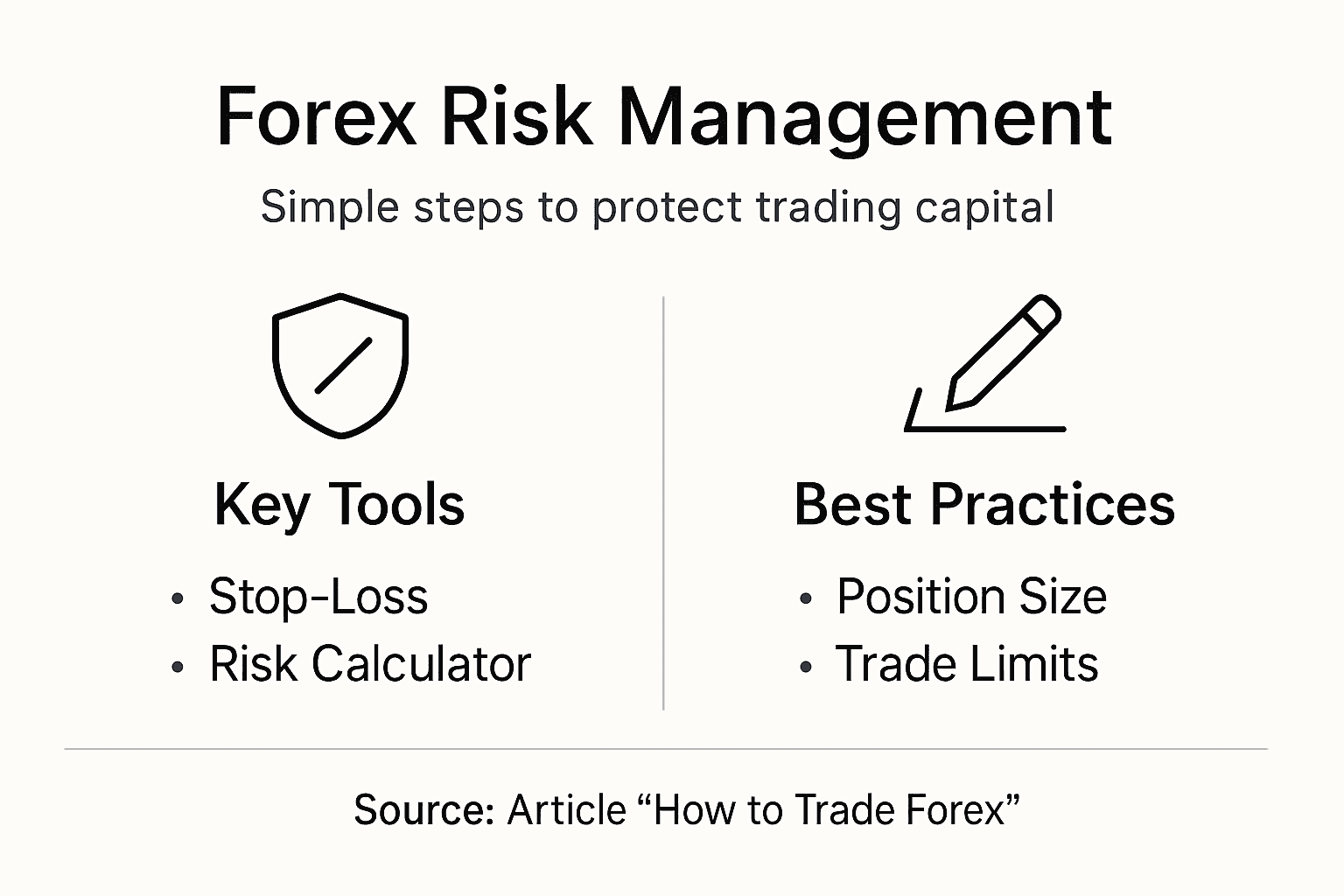
Always use stop-loss orders to prevent catastrophic losses. Set your stop based on technical levels (support/resistance) or volatility (ATR multiplier), not arbitrary percentages. A stop-loss removes emotion from exit decisions and protects you when markets move against your position unexpectedly. Review order execution policies to understand how your broker handles stops during volatile conditions.
Avoid overleveraging by keeping leverage below 10:1 for most trades. High leverage magnifies gains but also accelerates losses. A 5% adverse move with 20:1 leverage wipes out your entire position. Conservative leverage preserves capital and reduces stress during drawdowns.
Key risk management rules:
- Never risk more than you can afford to lose completely
- Calculate position sizes based on stop-loss distance and account balance
- Avoid correlated trades that multiply your exposure to the same event
- Review and adjust risk parameters as your account grows or shrinks
Pro Tip: Use a risk calculator before every trade to determine exact position size based on your stop-loss level and maximum risk tolerance. This simple habit prevents emotional position sizing.
Step 3: Maintaining Discipline and Tracking Progress
Psychological discipline separates profitable traders from the majority who fail. Markets test your emotions constantly, and preparation is your defense.
Keep a detailed trading journal recording every trade, including entry price, exit price, position size, reasoning, and emotional state. Over time, patterns emerge showing which setups work best and which biases sabotage your performance. Successful traders use journals to identify psychological triggers and refine their approach systematically.
Avoid revenge trading after losses by following strict rules and taking breaks. When you lose, the temptation to immediately recoup losses leads to oversized positions and reckless decisions. Step away from your screen, review what went wrong, and only return when you’re calm and objective.
Regularly review your journal to adapt your strategy based on real performance data. Calculate your win rate, average risk-reward ratio, and maximum drawdown monthly. If your results don’t match backtesting expectations, investigate whether execution errors, changing market conditions, or psychological factors are responsible.
Commit to continuous education and skill development. Markets evolve, and yesterday’s winning strategy may fail tomorrow. Read trading books, take courses, and study successful traders’ approaches. Practice new techniques on demo accounts before risking real capital.
Discipline checklist:
- Follow your trading plan without exception, even during winning streaks
- Set daily or weekly loss limits to prevent emotional spirals
- Avoid trading during high-stress personal situations
- Celebrate small wins and learn from losses without dwelling
Using Trading Tools and Technologies
Advanced trading platforms and tools give you faster execution, better analysis, and reduced emotional interference.
MetaTrader 4 and MetaTrader 5 are the industry standards for forex trading. MT4 offers simplicity, extensive indicator libraries, and widespread broker support. MT5 provides additional timeframes, more order types, and built-in economic calendar integration. Choose based on your needs: MT4 for straightforward trading, MT5 for advanced features and multi-asset strategies. Download MetaTrader 4 on Windows أو MetaTrader 4 on Android to start.
| ميزة | ميتاتريدر 4 | MetaTrader 5 |
|---|---|---|
| Timeframes | 9 standard | 21 extended |
| Order Types | 4 basic types | 6 advanced types |
| Technical Indicators | 30+ built-in | 38+ built-in |
| التقويم الاقتصادي | Plugin required | Integrated |
| Multi-Asset Trading | Forex, CFDs | Forex, CFDs, stocks |
Expert advisors (EAs) automate trading strategies, removing emotional decision-making and executing trades 24/7. EAs follow predefined rules based on technical indicators, price action, or custom algorithms. They’re ideal for high-frequency strategies or traders unable to monitor markets constantly. Test EAs thoroughly on demo accounts before live deployment to verify performance.
Economic calendars help anticipate market-moving events like central bank announcements, GDP releases, and employment data. Knowing when volatility spikes occur allows you to either avoid trading or position yourself to profit from predictable price swings.
Broker quality matters as much as strategy. Look for tight spreads (under 1 pip on majors), fast execution speeds (under 50 milliseconds), and minimal slippage during news events. These factors directly impact profitability on every trade.
Common Mistakes and How to Avoid Them
Even experienced traders fall into predictable traps. Recognizing these mistakes helps you avoid costly errors.
Overleveraging is the fastest way to blow up your account. Using 50:1 or 100:1 leverage feels exciting during wins but destroys capital during losses. A 2% adverse move with 50:1 leverage means a 100% account loss. Limit leverage to 10:1 or lower and focus on consistent gains rather than home-run trades.
Revenge trading after losses compounds mistakes and accelerates account depletion. When you lose, your brain craves immediate recovery, leading to larger positions and abandoning your strategy. Combat this by setting daily loss limits and walking away when you hit them. Return only after reviewing what went wrong and confirming emotional stability.
Ignoring stop-loss orders dramatically increases loss probability and exposes you to unlimited downside. Some traders move stops further away when prices approach, hoping for a reversal. This behavior turns small losses into account-ending disasters. Set your stop when entering the trade and honor it without exception.
Not backtesting means trading unvalidated strategies with higher failure risk. You wouldn’t launch a business without a plan, yet many traders risk real money on untested ideas. Spend weeks testing strategies on demo accounts before going live.
Mistakes to avoid:
- Trading without a written plan that defines entry, exit, and risk rules
- Checking trades constantly and micromanaging positions based on emotions
- Ignoring transaction costs (spreads, commissions) when calculating profitability
- Copying other traders’ strategies without understanding the underlying logic
Expected Outcomes and Success Metrics
Setting realistic expectations prevents frustration and keeps you committed during inevitable rough patches.
Consistent profitability typically requires 6 to 12 months of disciplined practice. During this period, focus on executing your strategy flawlessly rather than maximizing profits. Most beginners lose money initially while learning. Your goal in the first year is capital preservation and skill development, not wealth accumulation.
Measure success using these metrics:
- Win rate above 50% (or positive risk-reward ratio offsetting lower win rates)
- Maximum drawdown under 20% of peak account balance
- Average monthly return between 2-5% (sustainable long-term)
- Risk per trade consistently at 1-2% without exceptions
- Emotional control improving as evidenced by journal entries
Winning trade rates improve through diversification and rigorous backtesting forex strategies. A 55% win rate with 2:1 risk-reward ratio generates consistent profits over time. Focus on quality setups rather than trade frequency.
Capital drawdown per trade should stay below 5% consistently. If you’re risking more than this, your position sizing is too aggressive. Drawdowns are inevitable, but limiting their size ensures you can recover quickly when your strategy starts working again.
Use trading journal reviews to track improvement and adapt strategies. Review your journal weekly to identify patterns: Do you perform better during specific sessions? Which currency pairs yield the best results? Are certain emotional states correlated with losses? This feedback loop transforms raw data into actionable insights.
Trade Smarter with Olla Trade’s Advanced Forex Platform
Applying these principles requires the right tools and support. Olla Trade offers a regulated, reliable forex trading platform designed for traders at every experience level, from beginners testing strategies to professionals executing complex trades.
Access advanced tools like MetaTrader 4 and 5 with integrated charting, expert advisors, and one-click execution. Use Olla Trade’s economic calendar tool to time your trades around market-moving events and avoid unexpected volatility. The platform combines tight spreads, fast execution, and transparent pricing to maximize your edge on every trade.
Leverage Olla Trade’s professional forex education resources to sharpen your skills continuously. Whether you’re mastering technical analysis, refining risk management, or learning advanced strategies, the educational content supports your journey from novice to consistently profitable trader. Start with a demo account to practice risk-free, then transition to live trading when your results prove your strategy works.
FAQ
What is the best starting capital for forex trading?
Start with capital sufficient to allow risking only 1-2% per trade, often $500 or more depending on broker requirements. Smaller amounts limit position sizes but protect against large losses while you develop skills. Building your account through consistent gains is more sustainable than starting with large capital before you’re ready.
How long does it take to become consistently profitable in forex?
Typically 6 to 12 months of disciplined practice and strategy refinement are needed to achieve consistent profitability. This timeline assumes you’re dedicating serious effort to learning, journaling, and backtesting rather than casual experimentation. Consistency improves with rigorous journaling, systematic backtesting, and emotional control development.
Why is risk management important in forex trading?
Risk management limits your exposure on each trade to protect your capital from catastrophic losses. Without it, a few bad trades can quickly wipe out your entire trading account, ending your trading career before it begins. Proper risk controls let you survive losing streaks and stay in the game long enough for your strategy to prove profitable.
What are common psychological traps traders face?
Revenge trading after losses leads to bigger mistakes and compounds losses as you chase recovery. Overtrading and ignoring stop-losses stem from emotional bias, fear, and greed, causing rapid account depletion. Successful traders recognize these patterns early and implement strict rules to prevent emotional decision-making from sabotaging their results.