












TL;DR:
- Most traders fail to apply risk management effectively, risking account blowouts instead of protecting capital. Implementing a structured, six-step process based on ISO 31000 and ERM frameworks can embed risk discipline into daily trading decisions. Using tools like portfolio heat limits, ATR-based stops, and strict rules ensures consistent risk control, critical for long-term success.
Most traders know they should manage risk. Far fewer actually do it well. The common misconception is that risk management means avoiding losses, but that framing misses the point entirely. What is risk management, in its truest sense, is a structured, continuous process that defines how much you are willing to lose, under what conditions, and exactly what you will do when things go wrong. For Forex, CFD, and cryptocurrency traders, where leverage can amplify losses as fast as it amplifies gains, this discipline is not optional. It is the difference between a trading career and a blown account.
Table of Contents
- Understanding the fundamentals of risk management
- Core risk management principles for Forex, CFDs, and cryptocurrency traders
- Integrating risk management into strategic trading decisions with ERM frameworks
- Applying risk management tactics to your trading strategy
- Why most traders misunderstand risk management — and how to fix it
- How Olla Trade supports your risk management journey
- Frequently asked questions
Key Takeaways
| Point | Details |
|---|---|
| Risk management defined | Risk management is a continuous, structured process that identifies, analyzes, and treats risks aligned with trading objectives. |
| Position sizing rules | Risk no more than 1-2% of account equity per trade using position size formulas to limit losses. |
| Stop loss strategy | Set adaptive ATR-based stops at 1.5 to 2 times average true range to reduce premature stop-outs. |
| Risk limits | Cap total portfolio risk exposure (portfolio heat) at 5-6% to survive correlated market moves. |
| Strategic integration | Embedding risk management into strategy and decision-making improves consistency and long-term success. |
Understanding the fundamentals of risk management
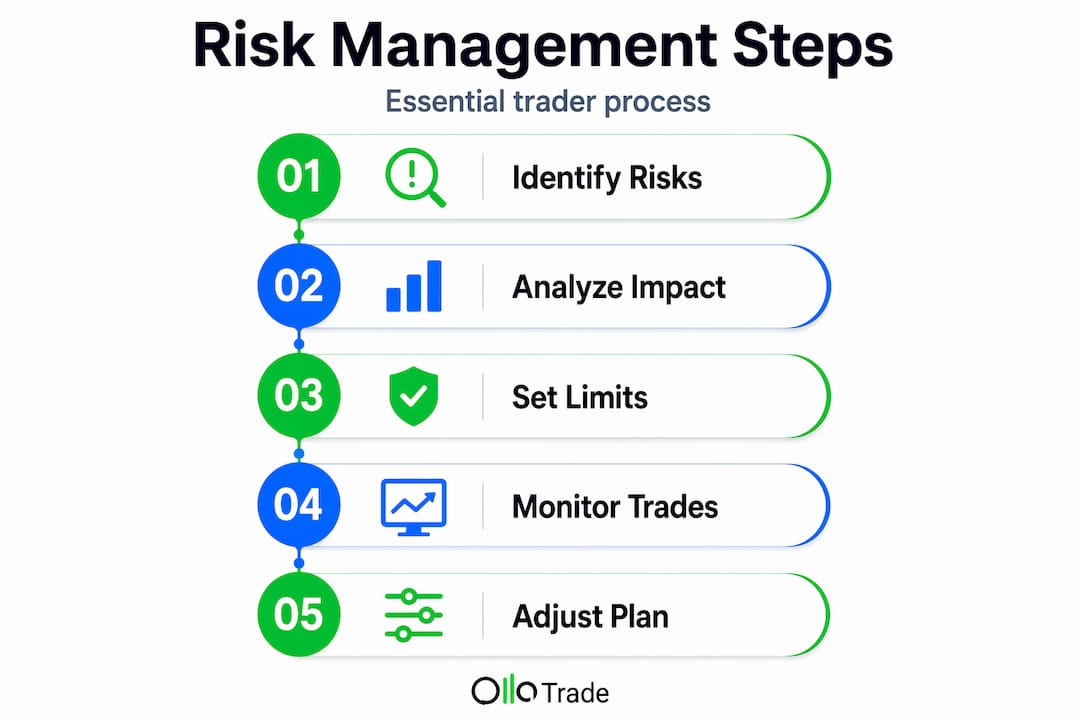
A solid risk management definition starts with structure. According to ISO 31000 risk management guidelines, risk management is a coordinated set of activities covering identification, analysis, evaluation, treatment, monitoring, and review. That is a six-step process, not a one-time checklist. Many traders treat it like a checklist. That is the first mistake.
The ISO 31000 framework is internationally recognized and applies just as cleanly to individual traders as it does to large financial institutions. Whether you are trading EUR/USD on a $5,000 account or managing a multi-asset CFD portfolio, the same logic holds. You identify what could go wrong, analyze how likely and severe that outcome is, decide how to handle it, and then keep watching. Markets shift. Your process needs to shift with them.
Here is what that looks like in practice for traders:
- Identify risks: Market volatility, leverage exposure, liquidity gaps, and correlated positions all qualify.
- Analyze risks: How much capital is at stake? What is the probability of a stop being hit?
- Evaluate risks: Is this trade worth the exposure given your current account size and open positions?
- Treat risks: Apply position sizing, set stops, or reduce exposure before entering.
- Monitor risks: Track drawdown, portfolio heat, and live P&L against your predefined limits.
- Review: After every trade or week, assess whether your process is working and adjust accordingly.
When you build managing trading risk effectively into your daily routine rather than treating it as an afterthought, consistency follows. The risk management process is not a cage. It is a framework that lets you trade with confidence because you know exactly where your floor is.
Core risk management principles for Forex, CFDs, and cryptocurrency traders
This is where theory becomes money. The importance of risk management becomes obvious the first time you watch a single trade wipe out three weeks of gains because you sized in too large. Let us get specific.
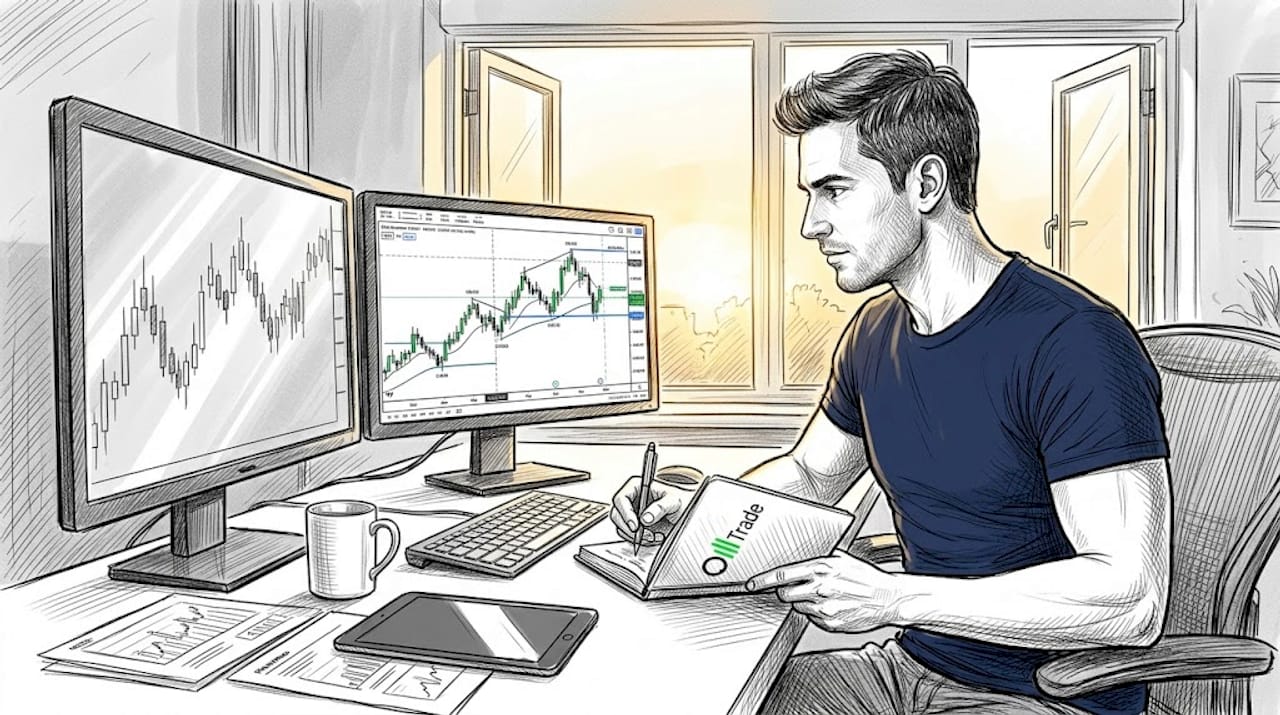
Professional standards recommend risking no more than 1-2% of account equity per trade, with daily loss limits of 2-3% and weekly drawdown caps of 4-6%. These numbers feel conservative until you consider what they protect you from. On a $10,000 account, a 2% risk cap means your maximum loss per trade is $200. Lose five in a row and you are down $1,000, which is painful but recoverable. Without a cap, five bad trades can erase your account.
Here is a basic position sizing formula for Forex traders:
- Define your risk in dollars: Account size x risk percentage (e.g., $10,000 x 2% = $200).
- Determine your stop distance: How many pips between your entry and stop-loss level.
- Calculate pip value: Depends on currency pair and lot size.
- Calculate position size: Dollar risk divided by (stop distance x pip value per standard lot).
For crypto and CFD traders, the same logic applies using contract sizes and point values instead of pip values. The math changes slightly. The principle does not.
Stop-loss placement matters as much as size. ATR-based stop losses at 1.5-2x Average True Range reduce premature stop-outs by up to 35%, with a minimum 2:1 reward-to-risk ratio recommended. An ATR-based stop accounts for a market’s natural daily movement, so you are not getting stopped out by normal noise. If Bitcoin’s 14-day ATR is $1,800, placing a stop $900 away is almost guaranteed to trigger, while $2,700 to $3,600 gives the trade room to breathe while still defining your maximum loss.
Key principles to apply immediately:
- Risk no more than 1-2% per trade, no exceptions.
- Set daily loss limits (2-3%) and weekly drawdown caps (4-6%).
- Use ATR-based stops rather than round-number or arbitrary levels.
- Target a minimum 2:1 reward-to-risk on every trade.
- Calculate position size before entering, not after.
Pro Tip: Before entering any trade, write down your entry, stop-loss, target, and the exact dollar amount at risk. If you cannot fill in all four, you are not ready to trade it. This one habit, applied consistently, will change how you manage trading positions consistently across every session.
The trading risk management playbook treats these numbers as non-negotiable. And after seeing what happens to accounts that ignore them, it is hard to argue otherwise.
Integrating risk management into strategic trading decisions with ERM frameworks
Most retail traders have never heard of enterprise risk management, or ERM. That is a missed opportunity. Understanding what is enterprise risk management and how it applies to trading firms gives you a framework that goes far beyond individual trade rules.
ERM embeds risk thinking into overall strategy and governance, not just execution. The COSO framework, one of the most widely used ERM structures, organizes risk management across five components: governance and culture, strategy and objective-setting, performance, review and revision, and information and communication. For trading firms or serious retail traders, this translates directly into how you set your trading goals, define your risk appetite, measure performance, and report results to yourself or stakeholders.
COSO’s 2026 ERM Framework integrates risk management into strategy across governance, performance review, and information components, improving decision confidence. That phrase, “decision confidence,” matters. Traders who have embedded risk into their strategy do not freeze at the moment of execution or second-guess their stops mid-trade. They have already made those decisions in advance.
Here is the uncomfortable reality: over 50% of risk leaders globally view ERM programs as primarily compliance-focused, yet 98% believe it should play a more strategic role. The same gap exists in trading. Traders set rules because a mentor or article told them to, but they do not truly integrate those rules into their trading identity or strategy.
“Risk management is most powerful when it is embedded in how you make decisions, not applied after the fact as a filter.”
The practical application for traders:
- Define your risk appetite explicitly: what maximum drawdown triggers a trading pause?
- Set performance benchmarks tied to risk, not just profit.
- Build a reporting habit, even a simple weekly journal, to review risk versus outcome.
- Treat hedging strategies in trading as a strategic tool within your ERM approach, not a reaction to fear.
- Integrate security in trading risk management into your governance layer, protecting both capital and account access.
Applying risk management tactics to your trading strategy
Now for the nuts and bolts. The benefits of risk management only materialize when you move from principles to daily habits.
Portfolio heat is a concept most retail traders have never been taught, and it might be the single most valuable addition to your risk process. Portfolio heat measures your total open risk across all active trades as a percentage of your account. If you have five trades open and each risks 2%, your portfolio heat is 10%. If all five correlate (for example, long EUR/USD, GBP/USD, and AUD/USD), a single dollar move wipes them all simultaneously. Traders must cap portfolio heat at 5-6% total open risk to survive correlated losses and enforce no exceptions on immediate stop placement.
Here are the core tactical rules to follow:
- Place your stop-loss the moment you enter a trade, before price moves.
- Never move a stop wider to avoid being taken out. That is not discipline, that is hope.
- Never average down on a losing position. Your original risk assessment was based on one entry. Adding to a loser multiplies exposure, not just position size.
- After three consecutive losses, stop trading for the session. Review your entries before you come back.
- Track portfolio heat before adding any new position.
Pro Tip: Build a simple spreadsheet that auto-calculates your portfolio heat as you add positions. Include entry price, stop-loss, position size, and dollar risk per trade. When the total exceeds 5%, you do not open the next trade, period. This takes five minutes to build and saves accounts.
| Risk parameter | Conservative | Standard | Aggressive |
|---|---|---|---|
| Risk per trade | 0.5-1% | 1-2% | 2-3% |
| Daily loss limit | 1-2% | 2-3% | 3-5% |
| Weekly drawdown cap | 2-3% | 4-6% | 6-10% |
| Max portfolio heat | 3-4% | 5-6% | 8-10% |
| Min reward-to-risk | 2:1 | 2:1 | 1.5:1 |
Moving stops wider after entry violates risk rules, and pausing after three consecutive losses is a discipline practice the best traders treat as automatic, not optional.
For managing trading positions for success, the table above gives you a practical starting point based on your risk tolerance. Most retail traders belong in the standard column. Be honest with yourself about where you fit. Aspiring to the conservative column is not weakness. It is how accounts survive long enough to compound.
Why most traders misunderstand risk management — and how to fix it
Here is the hard truth. After years of observing how traders approach the markets, the biggest failure is not poor entries, bad timing, or the wrong indicators. It is treating risk management as a box to check rather than the actual foundation of a trading career.
Organizations without a formal risk management plan essentially leave their success to chance. That sentence was written for businesses, but it describes most retail traders perfectly. You cannot manage what you have not defined. If your risk rules only exist in your head, they will disappear the moment fear or greed shows up, and both will show up.
The emotional barrier is real. Confirmation bias leads traders to skip stops on trades they “believe in.” Loss aversion leads them to hold losers longer than winners. Overconfidence follows a winning streak. None of these are character flaws. They are documented human tendencies in high-stakes environments. The solution is not to feel less. It is to build a system that does not require you to feel differently in the moment.
COSO’s 2026 guidance on effective ERM notes that it embeds risk thinking into everyday decision-making. For traders, that means your risk rules should be so automatic they require no willpower to execute. Write them down. Review them before each session. Log every trade against them. The goal is to remove real-time decision-making from the highest-stakes moments.
Capital preservation is not a defensive strategy. It is what keeps you in the game long enough to let your edge play out. A trader with a 55% win rate and a 2:1 reward-to-risk ratio will compound wealth over hundreds of trades. The same trader, with no risk rules, can blow their account on trade number twelve. Knowing your proven ways to manage trading risk is what separates the traders still in the market a year from now from those who are not.
How Olla Trade supports your risk management journey
Knowing the principles is one thing. Having the right platform to execute them is another.
Olla Trade is built for traders who take risk management seriously. Whether you are trading Forex on Olla Trade with tight spreads and fast execution, exploring CFD trading basics across metals, indices, and energies, or going after opportunity in cryptocurrency markets on Olla Trade, the platform gives you the tools to manage exposure at every level. Set stops at entry, monitor live P&L against your risk limits, and access real-time market data that supports disciplined execution. Thousands of traders use Olla Trade’s integrated resources, including educational guides on position sizing and drawdown management, to back every trade with a plan.
Frequently asked questions
What are the basic steps of risk management in trading?
The basic steps include identification, analysis, evaluation, treatment, and continuous monitoring, following a six-step process designed to control exposure and protect capital at every stage.
How much of my trading account should I risk per trade?
Professional standards recommend risking no more than 1-2% of account equity per trade, which allows you to absorb losing streaks without permanent damage to your capital base.
Why is a 2:1 reward-to-risk ratio important?
A 2:1 ratio means targeting twice the profit relative to your risk, and a 2:1 reward-to-risk ratio requires winning only about 34% of trades to break even, making long-term profitability achievable even with an imperfect win rate.
What is portfolio heat and why should I care?
Portfolio heat is the total percentage of your account at risk across all open trades at once, and capping it at 5-6% prevents correlated market moves from causing simultaneous catastrophic losses.
How does enterprise risk management (ERM) help trading organizations?
COSO’s 2026 ERM Framework aligns risk with strategic objectives across governance, performance, and review components, giving trading firms and serious traders a structure that improves decision confidence and prevents compliance-only thinking.