











Many traders assume spreads are fixed or negligible costs, but that misconception can erode profitability over time. The spread is the difference between the bid and ask price, representing a key cost for traders. Whether you trade Forex, CFDs, or cryptocurrencies, understanding spreads helps you make smarter decisions, optimize entry and exit points, and ultimately improve your bottom line. This guide breaks down what spreads are, how they vary across markets, and practical strategies to manage them effectively in 2026.
Table of Contents
- What Is Spread In Trading: A Foundational Overview
- Types Of Spreads And How They Impact Your Trading Costs
- How Spreads Differ Across Forex, Cfds, And Cryptocurrency Markets
- Practical Strategies To Manage And Optimize Trading Spreads
- Frequently Asked Questions About Trading Spreads
Key takeaways
| Point | Details |
|---|---|
| Definition and role | Spreads represent the difference between bid and ask prices, acting as an implicit cost that affects every trade you execute. |
| Spread types | Fixed spreads offer consistency while variable spreads fluctuate with market conditions, each suited to different trading styles. |
| Market variations | Forex typically features tighter spreads due to high liquidity, while crypto markets often show wider spreads from volatility. |
| Cost management | Choosing brokers with competitive spreads and timing trades during high liquidity periods reduces transaction costs. |
| Strategic advantage | Understanding spread dynamics helps you select optimal entry points and avoid costly slippage during volatile periods. |
What is spread in trading: a foundational overview
The spread is the gap between two prices that matter most when you execute a trade: the bid price and the ask price. The bid represents what buyers are willing to pay for an asset, while the ask shows what sellers demand. When you buy, you pay the ask price. When you sell, you receive the bid price. That difference is the spread, and it represents an immediate cost the moment you enter a position.
Spreads function as hidden costs and spreads that brokers use to facilitate trades without charging explicit commissions. This cost structure appears across Forex, CFDs, and cryptocurrency markets, though the size and behavior of spreads vary significantly by asset class. In highly liquid Forex pairs like EUR/USD, spreads can be as tight as 0.1 pips during peak trading hours. Cryptocurrency markets, by contrast, often display spreads of 0.5% or more due to lower liquidity and higher volatility.
Every time you open a trade, you start at a small loss equal to the spread. If you buy EUR/USD at 1.1005 with a 0.5 pip spread, you need the price to move to at least 1.1010 just to break even. This dynamic affects scalpers and day traders most severely, as frequent entries and exits multiply spread costs. Position traders feel the impact less acutely, but spreads still influence overall profitability.
Key factors that determine spread width include:
- Market liquidity: Higher trading volume leads to tighter spreads as more buyers and sellers compete
- Volatility: Sudden price swings cause spreads to widen as market makers protect against risk
- Trading hours: Spreads narrow during peak sessions when major financial centers overlap
- Asset popularity: Major currency pairs and blue chip stocks typically offer tighter spreads than exotic instruments
- Broker business model: Some brokers markup spreads as their primary revenue source
Understanding spreads as an implicit trading cost alongside commissions and fees helps you calculate the true cost of each trade. A broker advertising zero commissions might charge wider spreads that ultimately cost more than a competitor with transparent commission structures and tight spreads. Smart traders compare total transaction costs, not just headline fees.
Types of spreads and how they impact your trading costs
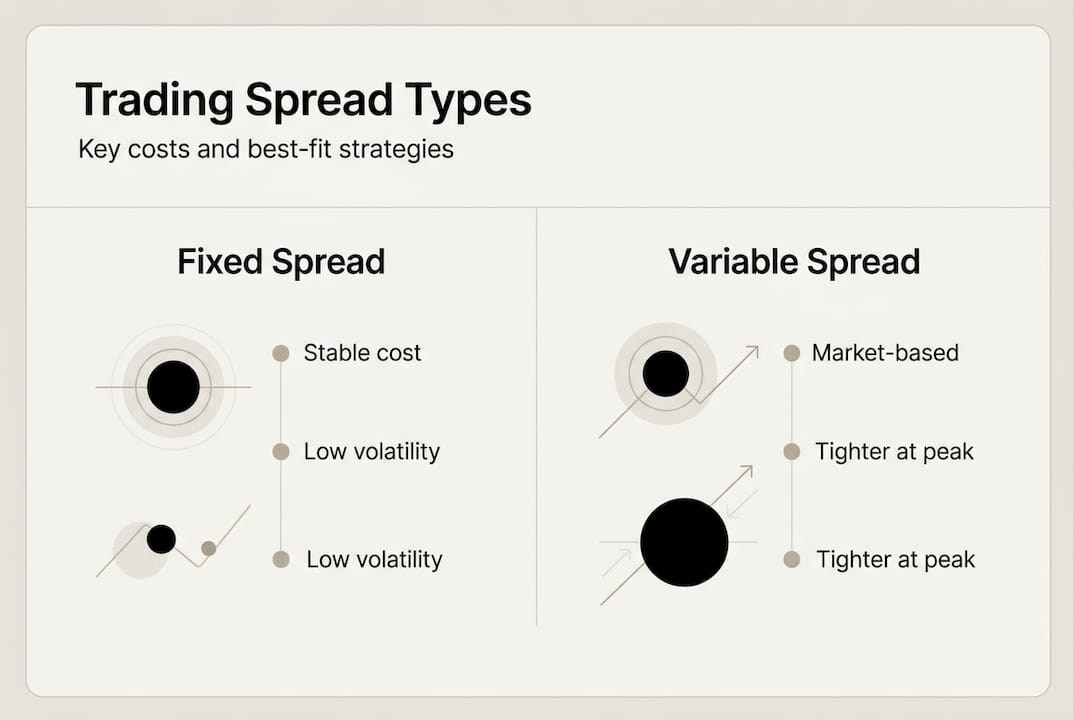
Traders encounter two primary spread structures: fixed and variable. Each model serves different trading styles and risk tolerances. Fixed spreads remain constant regardless of market conditions, offering predictability in your cost calculations. You know exactly what you will pay per trade, making it easier to plan strategies and calculate profit targets. Brokers offering fixed spreads typically act as market makers, taking the opposite side of your trades.
Variable spreads fluctuate depending on market conditions whereas fixed spreads remain constant, each with pros and cons. Variable spreads narrow during periods of high liquidity and widen when volatility spikes or liquidity dries up. This dynamic reflects real market conditions more accurately. During major economic announcements, variable spreads can balloon from 1 pip to 10 pips or more within seconds. Brokers using variable spreads often operate as ECN or STP providers, routing your orders to liquidity providers.

The distinction between spreads and commissions matters when evaluating total trading costs. Some brokers charge tight spreads plus a fixed commission per lot traded. Others offer wider spreads with zero commissions. A broker charging a 0.2 pip spread plus $7 commission per lot might actually cost less than one advertising a 1.2 pip spread with no commission, depending on your trade size and frequency.
| Feature | Fixed Spreads | Variable Spreads |
|---|---|---|
| Cost predictability | High, remains constant | Low, changes with market |
| Typical width | Wider on average | Tighter during normal conditions |
| Best for | News traders, beginners | Scalpers, high frequency traders |
| Risk during volatility | Protected from widening | Can spike significantly |
| Broker model | Market maker | ECN/STP |
Pro Tip: Match your spread types and fees to your trading style. Scalpers benefit from variable spreads during liquid sessions, while swing traders might prefer the predictability of fixed spreads to avoid unexpected costs when holding positions overnight.
Your choice between fixed and variable spreads should align with when you trade and how often. If you execute trades during major session overlaps like London and New York, variable spreads will likely save you money. If you trade during off hours or hold positions through major news events, fixed spreads provide cost certainty. Calculate your average spread costs over 20 trades with each model to determine which structure suits your actual trading patterns.
How spreads differ across Forex, CFDs, and cryptocurrency markets
Market structure fundamentally shapes spread behavior across asset classes. Forex spreads tend to be tighter due to high liquidity, while crypto spreads can be wider from market volatility. The Forex market processes over $7 trillion in daily volume, creating deep liquidity that keeps spreads compressed. Major pairs like EUR/USD, GBP/USD, and USD/JPY regularly trade with spreads under 1 pip during London and New York sessions.
CFD spreads vary dramatically based on the underlying asset. Stock CFDs mirror the bid ask spreads of their underlying shares, which can range from a few cents on large cap stocks to several percentage points on small cap names. Index CFDs like S&P 500 or DAX typically offer spreads of 0.5 to 2 points. Commodity CFDs such as gold or crude oil show spreads that widen during inventory reports or geopolitical events affecting supply.
Cryptocurrency markets present the widest and most volatile spreads among these three asset classes. Bitcoin might trade with a 0.1% spread on major exchanges during calm periods, but that can explode to 2% or more during flash crashes or regulatory announcements. Altcoins with lower market caps often display spreads of 1% to 5% even in normal conditions. The 24/7 nature of crypto markets means spreads never fully compress like Forex does during peak hours.
| Market | Typical Spread Range | Peak Liquidity Hours | Volatility Impact |
|---|---|---|---|
| Forex (Major Pairs) | 0.1 to 1.0 pips | London/NY overlap | Moderate widening |
| Forex (Exotic Pairs) | 5 to 50 pips | Regional sessions | Significant widening |
| CFDs (Indices) | 0.5 to 2.0 points | Market open/close | Moderate widening |
| CFDs (Stocks) | 0.1% to 0.5% | Regular trading hours | High during earnings |
| Cryptocurrency (BTC) | 0.05% to 0.5% | No specific peak | Extreme during events |
| Cryptocurrency (Altcoins) | 0.5% to 5.0% | Varies by exchange | Severe during selloffs |
Market hours and scheduled events create predictable spread patterns you can exploit. Forex spreads tighten between 8am and 11am EST when London and New York overlap. They widen significantly during Asian session hours when major liquidity providers are offline. Economic calendar events like Non Farm Payrolls or central bank decisions cause temporary spread expansion across all markets as participants pull liquidity ahead of announcements.
Pro Tip: Crypto traders should always check current spread width before entering positions, especially on altcoins or during weekend trading when liquidity thins. A 2% spread means you need a 4% favorable price move just to break even after entry and exit, making many short term strategies unprofitable before you even begin. Compare spreads across multiple exchanges to find the best execution venue for your trading opportunities in Forex and CFDs.
Understanding these market specific spread characteristics helps you choose optimal trading times and asset classes that match your strategy requirements. Day traders might focus exclusively on major Forex pairs during peak liquidity, while position traders can tolerate wider crypto spreads since the cost becomes negligible over longer holding periods.
Practical strategies to manage and optimize trading spreads
Managing spread costs requires deliberate choices about broker selection, trade timing, and order types. Choosing brokers with competitive spreads and using limit orders can help reduce spread costs. Your first decision point is broker comparison. Request spread histories for the instruments you trade most frequently. Some brokers advertise tight spreads but only offer them on a handful of pairs while marking up everything else significantly.
Timing your trades around liquidity patterns cuts spread costs immediately. Avoid trading major Forex pairs during the Asian session when spreads can double or triple. Wait for the London open at 3am EST or the New York open at 8am EST when liquidity floods back into the market. For stock CFDs, trade during the first and last hours of regular market hours when volume peaks. Cryptocurrency traders should compare spreads across exchanges in real time, as the decentralized nature of crypto means significant spread variation between venues.
Limit orders give you control over entry prices and effectively let you set your own spread. Instead of hitting the market with a buy order at the ask price, place a limit buy between the current bid and ask. You might not get filled immediately, but when you do execute, you have saved a portion of the spread. This strategy works best in ranging markets where prices oscillate within defined levels.
Step by step spread cost management:
- Calculate your average spread cost per trade by tracking the bid ask difference at entry across 20 trades
- Multiply that average by your typical monthly trade count to determine total monthly spread expenses
- Compare that figure against alternative brokers offering tighter spreads or different fee structures
- Test limit orders on 25% of your trades to measure fill rates versus spread savings
- Adjust your trading schedule to focus on peak liquidity hours for your chosen instruments
- Review spread costs quarterly as market conditions and broker pricing evolve
Best practices for minimizing spreads across market types:
- Monitor economic calendars and avoid trading 15 minutes before and after high impact news releases
- Use demo accounts to observe how your broker’s spreads behave during different market conditions
- Consider ECN or STP brokers that offer raw spreads plus commission rather than marked up spreads
- Diversify across brokers if you trade multiple asset classes, using specialists for each market
- Set maximum acceptable spread thresholds in your trading plan and skip trades when spreads exceed those levels
- Leverage features of trading platforms that display real time spread data and historical spread charts
Regularly auditing your spread costs as part of overall trading expenses reveals optimization opportunities. Many traders focus obsessively on win rates and average profit per trade while ignoring that spread costs might be consuming 20% to 30% of their gross profits. A trader making 100 trades per month with an average 1 pip spread on EUR/USD pays roughly $100 in spread costs per standard lot traded. Over a year, that compounds to $1,200 per lot, a significant drag on returns that tighter spreads could reduce by half.
Position sizing also interacts with spread costs in ways many traders overlook. Larger positions pay the same percentage spread but a higher absolute dollar cost. If you trade 5 mini lots instead of 1 standard lot, you pay 5 times the spread cost. This reality makes spread optimization even more critical for traders who scale position sizes or use aggressive leverage. Every pip of spread reduction multiplies across your position size.
Explore tools to master spreads with Olla Trade
Now that you understand how spreads impact your trading costs and profitability, having the right platform makes all the difference. Olla Trade offers advanced trading platforms features designed specifically to help you monitor and minimize spread costs across all your trades. Our platform provides real time spread displays, historical spread data, and execution analytics that show exactly what you paid on every trade.
Access forex trading options with some of the tightest spreads in the industry, starting from 0.1 pips on major pairs during peak liquidity. Trade cryptocurrency trading with transparent pricing and no hidden markups. Our ECN execution model routes your orders directly to liquidity providers, ensuring you receive genuine market spreads without broker interference. Combine that with our comprehensive educational resources, and you have everything needed to trade smarter and keep more of your profits in 2026.
Frequently asked questions about trading spreads
What is the difference between spread and commission?
Spreads represent the difference between bid and ask prices, functioning as an implicit cost built into every trade. Commissions are explicit fees charged per trade or per lot, separate from the spread. Some brokers charge both, others use only spreads or only commissions. Compare total transaction costs across both models to find the most economical structure for your trading volume and style.
How do economic news releases affect spreads?
Major economic announcements cause spreads to widen dramatically as liquidity providers pull quotes to avoid adverse selection risk. Non Farm Payrolls, central bank decisions, and GDP releases can expand spreads from 1 pip to 20 pips or more within seconds. This widening typically begins 10 to 15 minutes before the announcement and normalizes within 5 minutes after, though high volatility can keep spreads elevated longer.
Can I avoid paying spreads altogether?
No, spreads are inherent to market structure and represent the cost of immediate execution. However, you can minimize spread costs by trading during peak liquidity, using limit orders instead of market orders, and selecting brokers with competitive pricing. Some advanced traders use maker rebate programs on certain exchanges, earning small credits for providing liquidity, but these strategies require sophisticated order flow management.
Why do crypto spreads tend to be wider than Forex spreads?
Cryptocurrency markets have lower overall liquidity, more fragmented trading venues, and higher volatility compared to Forex. The 24/7 trading schedule means there are no concentrated liquidity periods like Forex session overlaps. Additionally, many crypto exchanges lack the sophisticated market making infrastructure that keeps Forex spreads tight, resulting in spreads that can be 10 to 50 times wider than major currency pairs.
How can I tell if my broker is widening spreads unfairly?
Compare your broker’s spreads against multiple competitors during the same time periods using demo accounts. Track spreads during both calm and volatile conditions. If your broker’s spreads are consistently 50% wider than competitors or widen excessively during news events compared to other providers, they may be adding unnecessary markup. Reputable brokers publish average spread statistics and allow you to review historical spread data through their platforms.
Do spreads affect long term position traders as much as day traders?
Spreads impact day traders and scalpers more severely because they pay the spread cost on every entry and exit, often multiple times per day. Position traders holding for weeks or months pay the spread only once per position, making it a smaller percentage of overall profit or loss. However, even position traders should optimize spreads, as a 5 pip difference on a position held for three months still represents real cost that compounds across multiple trades throughout the year.