












TL;DR:
- Metals trading relies on speculating on price movements across various instruments without income generation.
- Successful traders understand macroeconomic factors, physical market signals, and use a tiered approach to instrument selection, emphasizing risk management.
Metals markets reward the prepared and punish the impulsive. If you’ve tried to learn how to trade metals and walked away more confused than when you started, you’re not alone. These markets move on a complex mix of macroeconomic data, global industrial demand, currency shifts, and geopolitical risk. The good news is that once you understand the mechanics, metals offer genuine portfolio opportunities that stocks and bonds simply can’t replicate. This guide covers everything from what metals trading actually is, to how you execute trades, manage risk, and measure results.
Table of Contents
- Key takeaways
- How to trade metals: understanding the basics first
- Choosing your instruments and platform
- Executing trades and managing risk step by step
- Common mistakes traders make with metals
- Verifying your progress and adjusting strategy
- My take on what metals trading actually demands
- Start trading metals with Ollatrade
- FAQ
Key takeaways
| Point | Details |
|---|---|
| Metals trade on price movement | Metals generate no dividends, so profit comes entirely from speculating on price direction. |
| Use the tiered instrument approach | Match futures, ETFs, or CFDs to your time horizon and risk tolerance, not just convenience. |
| Risk 1 to 3% per trade maximum | Keep position sizes small relative to capital to survive volatility in metal markets. |
| Inventory data is a price signal | Exchange inventory draws signal tightening supply; ignoring this data is a costly beginner mistake. |
| Track performance consistently | Use trade journals and COT reports to refine your strategy over time, not just gut feel. |
How to trade metals: understanding the basics first
Before you place a single trade, you need to know what metals trading actually is. Unlike stocks, metals don’t pay dividends. Unlike bonds, they don’t generate interest. You profit entirely by speculating on price movements, buying low and selling high, or shorting when you expect prices to fall.
Metals fall into three broad categories, and each behaves differently.
- Precious metals: Gold, silver, and platinum. These attract safe-haven demand during uncertainty and act as inflation hedges. Gold in particular correlates inversely with the US dollar.
- Industrial metals: Copper, aluminum, and nickel. These track economic cycles closely because factories and construction projects consume them at scale. Copper is often called “Dr. Copper” because its price signals global economic health.
- Specialized and strategic metals: Lithium, cobalt, and rare earths. These are increasingly relevant due to electric vehicle and battery demand.
Understanding the role of metals in trading portfolios matters as much as understanding price drivers. A measured 5 to 10% allocation balances volatility exposure without over-concentrating your book in assets that produce no income.
Several forces move metal prices consistently. Supply and demand fundamentals top the list, particularly production disruptions from major mining countries. Currency movements matter enormously because most metals price in US dollars. A weaker dollar makes metals cheaper for foreign buyers, which pushes demand and prices up. Chinese industrial data is another critical factor since China consumes more than half of global base metal output.
Metals rarely move on a single catalyst. The traders who last are the ones who understand which combination of factors is actually driving price at any given moment.
Choosing your instruments and platform
Knowing why to trade metals is one thing. Knowing how to trade metals online through the right instrument is where preparation separates profitable traders from frustrated ones.
Here’s how the main instruments compare:
| Instrument | Leverage | Cost | Best for |
|---|---|---|---|
| Spot/CFDs | High | Low spreads | Short to medium-term trading |
| Futures | High | Commissions + roll costs | Tactical and directional bets |
| ETFs | None to low | Management fees | Long-term strategic exposure |
| Mining equities | None | Brokerage fees | Leveraged equity exposure to metals |
| Options | Variable | Premiums | Hedging and defined-risk positions |
The tiered instrument approach is what experienced traders use: futures for tactical positions, ETFs for strategic exposure, and mining stocks for leveraged equity upside. Beginners often make the error of picking one vehicle and sticking to it regardless of their time horizon, which creates a mismatch between risk and reward.
Futures traders need to understand one technical reality that rarely gets explained clearly. When futures markets are in contango (where later-dated contracts are priced above the front month), you lose value every time you roll your position forward. Calendar spreads reduce roll costs by trading the front month against a deferred contract, capturing the term structure difference instead of paying it.
CFDs through a platform like Ollatrade let you access metals markets with tight spreads and no need to manage futures rollovers, which makes them practical for retail traders who want clean directional exposure. The platform integrates with MetaTrader 4, giving you charting, expert advisors, and fast execution across devices.
Pro Tip: Before you fund a live account, run at least two to four weeks of practice trades in a demo environment. Metals can gap sharply on news events, and you want to understand how your platform behaves under those conditions before real money is at risk.
For account setup, check your broker’s margin requirements and always hold a reserve above that minimum. Maintain margin reserves at least 25% above exchange requirements to absorb sharp intraday swings without getting stopped out by a margin call.
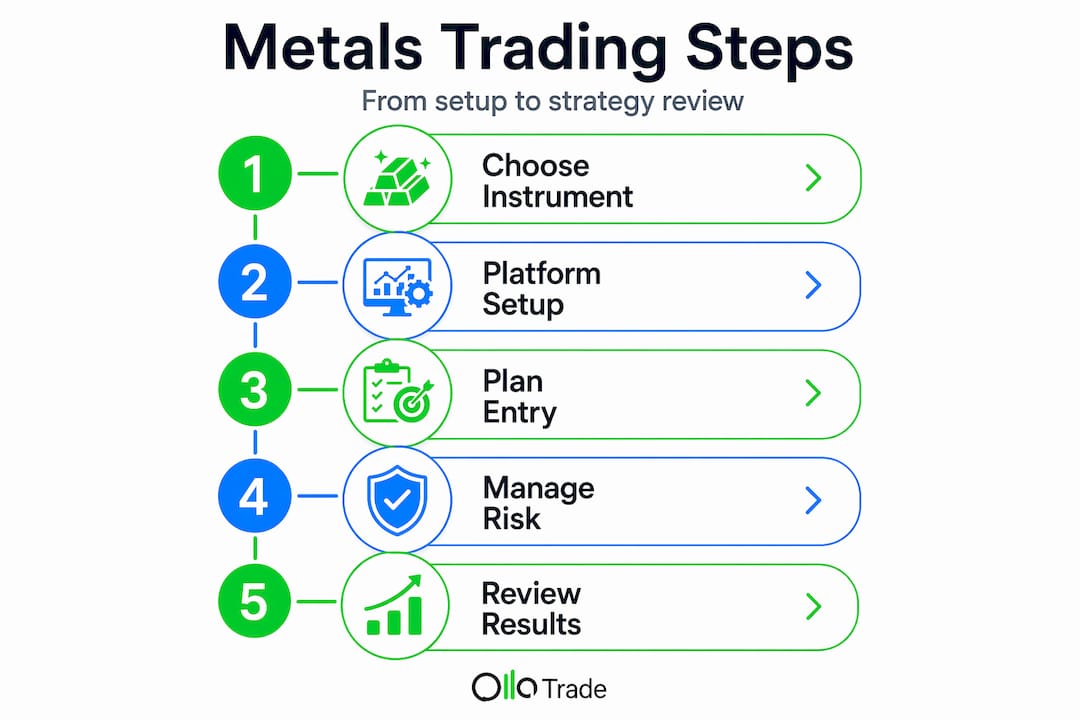
Executing trades and managing risk step by step
This is where metals trading either works or it doesn’t. A clear process prevents the emotional decisions that destroy accounts.
-
Conduct your market analysis. Start with the macro picture. Check the US Dollar Index, recent Chinese manufacturing data, and any supply-side news from major producers. Then move to technical analysis: identify the trend on a daily chart before zooming into a four-hour chart for entry signals.
-
Check exchange inventory levels. This step is skipped by most beginners and it’s a serious mistake. Sharp inventory draws signal bullish tightness; inventory builds signal oversupply. The London Metal Exchange publishes these figures daily, and they move copper and aluminum prices meaningfully.
-
Define your position size. Limit any single metals trade to 1 to 3% of your total trading capital. If you have $10,000 in your account, your maximum risk per trade is $100 to $300. Most traders who blow up accounts violated this rule, not their analysis.
-
Set your stop-loss before you enter. Stop-loss placement of 1.5 to 2% below entry works well for day trades in metals. For swing trades, give the position more room to breathe, typically below a key support level or recent swing low.
-
Set a take-profit target with a minimum 2:1 reward to risk ratio. If you’re risking $150, your target should be at least $300. This math means you can be wrong more than half the time and still make money over a series of trades.
-
Execute and monitor the trade. Don’t watch the tick-by-tick price action obsessively. Set alerts for key levels and check in at defined intervals. Adjusting stops based on price getting uncomfortably close is how small losses become large ones.
-
Review after close. Note what your analysis said, what price actually did, and why. This review loop is what builds a real edge over time.
You can strengthen any entry by using the proven risk management techniques that account for leverage, drawdown limits, and cash buffer management together.
Pro Tip: Never enter a metals position just before a major data release like non-farm payrolls or a Fed rate decision unless you specifically understand how that release historically affects the metal you’re trading. Surprise moves can trigger stops before the real trend develops.

Common mistakes traders make with metals
Most metals trading losses trace back to a short list of recurring errors. Knowing them in advance is your best defense.
- Over-leveraging on volatile metals. Industrial metals like nickel can move 5% in a session. Applying maximum leverage to a position that size turns a normal market fluctuation into a wipeout.
- Chasing news without macro context. Correlating prices with the US Dollar Index and Chinese data matters far more than reacting to a single headline. News creates a spike; macro fundamentals create a trend.
- Ignoring physical market signals. Sophisticated trading integrates both financial and physical market data. Most beginners only look at price charts.
- Overtrading during low-conviction setups. Trading for the sake of being in the market when you have no clear edge burns capital through spreads and commissions with nothing to show for it.
- Failing to account for roll costs in futures. If you’re holding a long-dated futures position in a contango market, your position is losing value slowly even if spot prices stay flat.
The traders who last in metals markets aren’t the ones with the best predictions. They’re the ones who understand that capital preservation is the actual job.
Improving your results comes from combining technical and fundamental signals rather than leaning entirely on one. A technical breakout in gold means more when the US dollar is weakening and real yields are falling. Without that context, you’re trading noise.
Verifying your progress and adjusting strategy
Trading metals without tracking performance is like driving without a speedometer. You need data on how you’re actually doing, not how you feel you’re doing.
| Metric | What it tells you | How often to review |
|---|---|---|
| Win/loss ratio | Whether your trade selection process works | Weekly |
| Average reward to risk | Whether your position sizing is disciplined | Weekly |
| Maximum drawdown | How much of your account you’ve risked in a losing streak | Monthly |
| Exposure by metal | Whether you’re too concentrated in one market | Monthly |
Weekly COT reports reveal trader sentiment across commercial and non-commercial participants. When commercial hedgers (the people who actually use metals) shift their positioning significantly, that often precedes major price moves. Most retail traders never look at this data.
A trade journal doesn’t need to be elaborate. Date, instrument, entry and exit price, the reason you entered, and what actually happened. Patterns in your losses will become obvious within a few months. The LME averaged approximately 760,000 lots daily in early 2026, reflecting surging demand from electrification and renewable energy buildouts. Knowing which macro themes are driving volume helps you understand when your strategy is aligned with institutional flow versus fighting it.
Rebalancing your metals exposure matters too. If copper has run 20% and now represents 15% of your portfolio when you originally sized it at 5%, trim it back. Letting winners drift into oversized positions is how a metals trading checklist turns into a concentration risk problem.
My take on what metals trading actually demands
I’ve watched a lot of traders approach metals the way they approach stocks: buy what’s moving, hold until it stops, and repeat. That approach works occasionally in equities. In metals, it’s a way to lose money with impressive consistency.
What I’ve found is that the markets reward people who treat them as multi-dimensional. Price alone tells you almost nothing. The traders who perform well over time check inventory levels, read COT reports, understand what the dollar is doing, and know which metal they’re in and why. They also use instruments that match their time horizon, and the tiered instrument approach is the clearest framework I’ve seen for that.
My biggest caution is about leverage. Most platforms offer leverage that would let you control $100,000 in copper with $1,000 in margin. That’s not an opportunity. That’s a trap for anyone without strict position sizing rules. I’ve seen accounts built over months destroyed in two sessions because someone sized a nickel position without accounting for how much that metal can move.
If you’re serious about managing trading positions in metals for the long term, treat your first six months as a learning period. Your goal isn’t profit; it’s understanding. Profit follows understanding. It rarely precedes it.
— FX
Start trading metals with Ollatrade
Ollatrade gives you direct access to metals CFD trading alongside forex, indices, and cryptocurrencies on a single platform. The MetaTrader 4 integration means you get professional-grade charting, expert advisors, and fast execution whether you’re on desktop or mobile.
If you’re working through how to invest in metals for the first time, start with a demo account to test your strategy without risking capital. For traders ready to go live, Ollatrade offers tight spreads, multiple deposit options, and a straightforward account setup process. You can also explore CFD trading fundamentals to understand how contracts for difference work before you commit real money to a position.
FAQ
What is metals trading exactly?
Metals trading means speculating on the price movements of metals like gold, copper, or silver through instruments such as CFDs, futures, ETFs, or mining stocks. Unlike stocks, metals generate no income, so all returns come from price changes.
What are the best metals to trade for beginners?
Gold and silver are generally the most accessible metals for beginners because they have deep liquidity and clear macro drivers like dollar strength and inflation expectations. Industrial metals like copper offer strong signals too, but require understanding of Chinese economic data.
How much capital do I need to start trading metals?
You can start with a few hundred dollars using CFDs or leveraged instruments, but position sizing rules matter more than account size. Risking only 1 to 3% per trade means even small accounts can survive learning curves without being wiped out early.
How do I manage risk when trading metals?
Set a stop-loss before every trade, limit position sizes to 1 to 3% of total capital, and hold margin reserves at least 25% above your broker’s minimum requirements. These three rules, applied consistently, prevent a single bad trade from becoming an account-ending event.
Why do inventory levels matter for metals prices?
Exchange inventory levels reflect real-world supply tightness or oversupply in physical markets. Sharp inventory draws signal that buyers are consuming metal faster than it’s being delivered, which pushes prices higher. Ignoring this data means missing one of the most reliable price signals available.