











TL;DR:
- A spread in finance is a measurable difference between two related financial values, indicating market costs, risks, or sentiments. Understanding bid-ask, options, and yield spreads helps traders assess liquidity, risk management, and macroeconomic conditions accurately. Mastering spread literacy is essential for making informed trading decisions, reducing costs, and avoiding costly misinterpretations.
A spread in finance is defined as the measurable difference between two related financial values, such as the bid and ask prices of a currency pair, the yields of two bonds, or the strike prices of two options contracts. This definition of spread holds across every market, from forex to fixed income to derivatives. The concept shifts in meaning depending on context, which is exactly where most traders get tripped up. Understanding the three core types of spreads, including bid-ask, options, and yield, gives you a direct read on trading costs, risk exposure, and market sentiment before you place a single trade.

What is spread in finance and why does it matter?
A spread measures the gap between two financial values, and that gap carries real economic meaning in every market where it appears. The core idea stays constant: a quantifiable difference between two numbers. What changes is what those numbers represent and what the spread tells you about the market.
In forex trading, the spread is the difference between the price a broker will sell a currency pair to you (the ask) and the price they will buy it back (the bid). On a bond desk, the spread is the yield difference between two debt instruments. In options trading, the spread is a deliberate structure where you buy one contract and sell another simultaneously. Spreads serve as leading indicators of market conditions and investor sentiment, which makes them far more than a line item on your trade confirmation.
Traders who treat spread as a single concept often make poor decisions. A forex trader who confuses bid-ask spread with an options spread strategy is comparing transaction cost to a risk management structure. These are fundamentally different tools. Recognizing which type of spread you are dealing with is the first step toward using it correctly.
What are the main types of spreads in finance?
Three categories of spreads dominate financial markets: bid-ask spreads, options spreads, and yield spreads. Each serves a distinct purpose and appears in a different context.
The bid-ask spread is the difference between the highest price a buyer will pay and the lowest price a seller will accept. It is both a direct transaction cost and a real-time measure of market liquidity. Tight bid-ask spreads signal active, liquid markets. Wide spreads signal thin liquidity or elevated uncertainty.
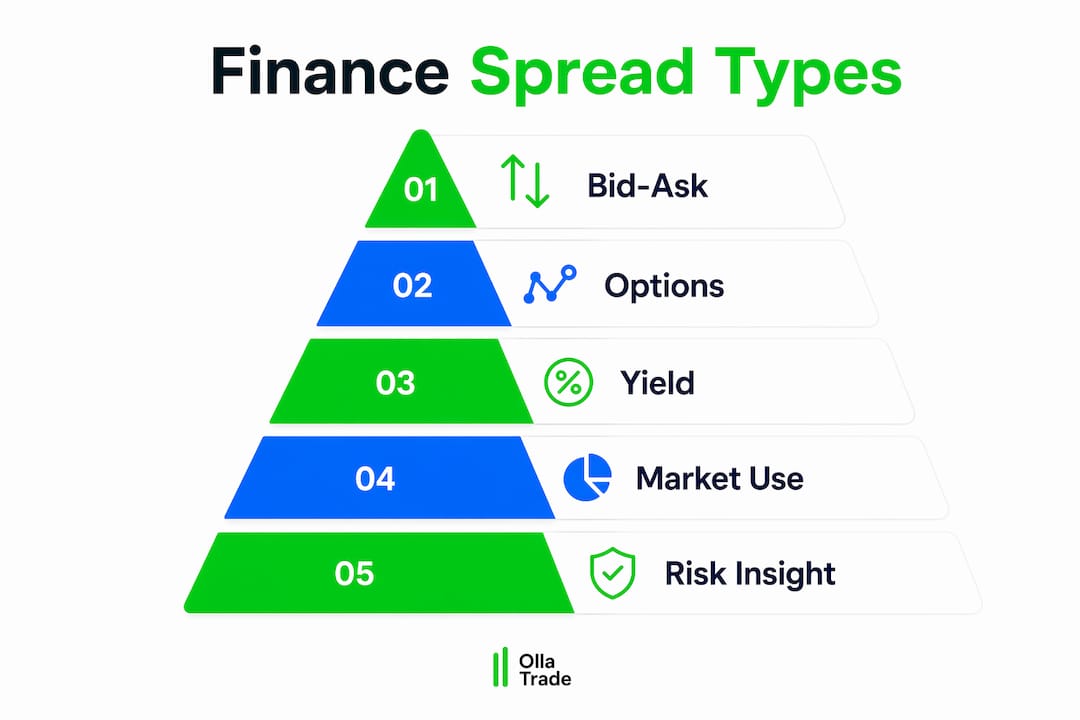
Options spreads combine buying and selling options on the same underlying asset with different strike prices or expiration dates. The structure defines maximum risk and maximum reward before the trade opens. This predictability is the primary reason traders use them.
Yield spreads measure the difference in yield between two bonds, most commonly a corporate bond versus a U.S. Treasury of the same maturity, or the 10-year Treasury versus the 2-year Treasury. The gap reflects credit risk, economic expectations, and investor confidence.
| Spread type | What it measures | Primary use |
|---|---|---|
| Bid-ask spread | Gap between buy and sell price | Transaction cost and liquidity signal |
| Options spread | Difference between two options legs | Risk definition and cost reduction |
| Yield spread | Gap between two bond yields | Credit risk and economic forecasting |
Each type requires a different analytical approach. Monitoring all three across your active markets gives you a more complete picture of conditions than price alone.
How to calculate and interpret the bid-ask spread in trading
The bid-ask spread formula is straightforward: subtract the bid price from the ask price. If EUR/USD shows a bid of 1.0850 and an ask of 1.0853, the spread is 3 pips. That 3-pip gap is the minimum cost you pay to enter the trade, before any commission.
Calculating the spread as a percentage of the ask price gives you a more useful comparison across instruments. Divide the spread by the ask price and multiply by 100. A 3-pip spread on EUR/USD at 1.0853 equals roughly 0.028%, which is tight. A 30-pip spread on an exotic currency pair at 1.2000 equals 2.5%, which is expensive.
Several factors determine how wide or narrow the spread runs at any given moment:
- Market liquidity: Major forex pairs like EUR/USD and USD/JPY carry the tightest spreads because trading volume is enormous.
- Volatility: Bid-ask spreads widen in volatile markets, increasing your transaction costs precisely when you may feel most urgency to trade.
- Time of day: Spreads narrow during peak trading hours when London and New York sessions overlap, and widen during off-hours when liquidity thins.
- Broker model: Market makers set fixed or variable spreads. ECN brokers pass through raw interbank spreads plus a commission.
Understanding when spreads widen helps you plan entry and exit points more effectively. Entering a trade during a news release when spreads triple is a cost most traders underestimate until they see it on their statement.
Pro Tip: Watch the spread before you watch the price. If the bid-ask spread on your intended trade has widened significantly from its average, that is a signal of low liquidity or elevated risk. Either wait for conditions to normalize or reduce your position size to account for the higher cost.
What are options spreads and how do traders use them to manage risk?
An options spread is a multi-leg strategy where you buy one option and sell another on the same underlying asset. The sold option offsets part of the premium you paid for the bought option, reducing your net cost. In exchange, you cap your maximum profit. The trade-off is deliberate: lower cost and defined risk in exchange for limited upside.
The three main structures are vertical, horizontal, and diagonal spreads. A vertical spread uses the same expiration date but different strike prices. A horizontal spread (also called a calendar spread) uses the same strike price but different expiration dates. A diagonal spread combines both: different strikes and different expirations.
Traders use options spreads for several practical reasons:
- Capped risk: You know your maximum loss before the trade opens, which makes position sizing straightforward.
- Reduced premium cost: Selling one leg offsets the cost of buying the other, making directional bets cheaper than buying outright options.
- Tailored market views: Vertical spreads work well for moderate directional moves. Calendar spreads profit from time decay. Diagonal spreads allow adjustments as market conditions evolve.
Assignment risk and liquidity concerns are the two most common pitfalls in options spreads. Early assignment on the short leg can force you to hold an unwanted position. Wide bid-ask spreads on individual legs compound your entry and exit costs, particularly on less liquid underlyings. Traders consistently underestimate how much the bid-ask spread on each leg erodes the theoretical edge of the strategy.
Pro Tip: When building a multi-leg options spread, calculate the total bid-ask cost across all legs before entering. On illiquid options, the combined spread cost can consume a significant portion of the strategy’s maximum profit. Stick to liquid options strategies on high-volume underlyings to keep execution costs manageable.
What do yield spreads reveal about market conditions?
Yield spreads measure the difference in yield between two bonds, and that difference tells you what the market collectively believes about risk and economic direction. The most widely watched yield spread is the 10-year minus 2-year U.S. Treasury spread, which functions as a barometer of economic expectations.
Yield spreads like the 10-year minus 2-year Treasury have historically predicted recessions when they invert, meaning short-term yields rise above long-term yields. An inverted yield curve signals that investors expect economic conditions to deteriorate, pushing them toward long-duration bonds and driving long-term yields down. Every U.S. recession since 1955 has been preceded by an inverted yield curve, which makes this spread one of the most reliable macro indicators available to traders.
Narrowing spreads between corporate bonds and Treasuries indicate rising investor confidence and a willingness to accept lower compensation for credit risk. Widening spreads signal stress, higher perceived default risk, and a flight to safety. During the 2008 financial crisis, investment-grade corporate spreads widened dramatically as investors demanded far higher yields to hold anything other than government debt.
| Yield spread scenario | What it signals | Practical implication |
|---|---|---|
| Narrowing corporate spread | Rising confidence, lower credit risk | Risk-on environment; equities often rally |
| Widening corporate spread | Market stress, higher default risk | Risk-off signal; consider defensive positioning |
| Inverted Treasury curve | Recession expectations | Historically precedes economic contraction |
| Steep Treasury curve | Growth expectations | Favorable for cyclical assets and banks |
Portfolio managers use yield spreads to rotate between asset classes. When corporate spreads widen sharply, it often precedes equity market weakness by several weeks, giving attentive traders an early warning signal that price charts alone do not provide.
Key takeaways
Spread meaning in finance covers three distinct concepts, and confusing them costs traders money, time, and missed opportunities.
| Point | Details |
|---|---|
| Spread definition | A spread is the measurable gap between two financial values: prices, yields, or option strikes. |
| Bid-ask spread | Subtract bid from ask to find your direct transaction cost; wider spreads mean higher costs and lower liquidity. |
| Options spreads | Buying and selling options simultaneously caps risk and reduces premium cost, but adds assignment and liquidity risk. |
| Yield spreads | The gap between bond yields signals credit risk and economic expectations, with inversion predicting recessions. |
| Context is everything | Always identify which type of spread applies before making a trading decision to avoid costly misinterpretation. |
Why spread literacy is the most underrated trading skill
Most trading education focuses on entries, exits, and chart patterns. Spreads get a footnote. That is a mistake I have seen cost traders real money, and it is one of the clearest gaps between novice and experienced market participants.
New traders frequently confuse the three meanings of spread, treating a bid-ask cost as if it were a strategic structure, or misreading a yield spread signal as a price action cue. The confusion is understandable because the word “spread” appears in broker interfaces, options chains, and financial news without any label distinguishing which type is meant. Experts consistently advise clarifying context before acting, and that advice is more practical than it sounds.
What I have found is that traders who master spread literacy make better decisions at every stage of a trade. They choose instruments with tighter bid-ask spreads to reduce friction. They use options spreads to define risk on uncertain setups rather than buying naked options. They watch yield spreads to gauge macro conditions before committing to a directional bias. These are not advanced techniques. They are foundational habits that compound over time.
The uncomfortable truth is that ignoring spreads does not make them go away. Every trade you place in a wide-spread instrument costs you more than you realize. Every options strategy you build without checking leg liquidity leaks edge. Every macro call you make without consulting yield spreads misses a signal that institutional traders watch daily. Spread knowledge is not optional for serious traders. It is the baseline.
Combine that knowledge with sound risk management practices and you have a framework that holds up across market conditions, not just trending environments where almost any approach looks smart.
— FX
Start trading smarter with Ollatrade
Understanding spreads is the foundation. Applying that knowledge in live markets is where it counts.
Ollatrade gives retail and professional traders access to forex, CFDs on metals, indices, stocks, energies, and cryptocurrencies through a platform built for real execution. Tight spreads, fast order processing, and MetaTrader 4 integration mean you spend less on transaction costs and more time focused on your strategy. Whether you are learning how spreads affect your forex trading costs or building multi-leg options strategies, Ollatrade’s educational resources and market tools support every stage of your development. Explore the platform and put your spread knowledge to work.
FAQ
What is the simplest definition of spread in finance?
A spread is the difference between two financial values, such as the bid and ask price of an asset, the yields of two bonds, or the strike prices of two options. The specific meaning depends entirely on the market context.
How do you calculate the bid-ask spread?
Subtract the bid price from the ask price. If a stock has a bid of $50.00 and an ask of $50.05, the spread is $0.05, which represents your minimum cost to enter the trade.
What does a widening spread indicate?
A widening bid-ask spread signals lower liquidity or higher volatility in a market. A widening yield spread between corporate bonds and Treasuries signals rising credit risk and investor stress.
Why do options traders use spreads instead of single options?
Options spreads reduce the net premium cost of a position by pairing a bought option with a sold option. The trade-off is a capped maximum profit, but the defined risk and lower cost make spreads more capital-efficient for many setups.
How does the yield curve spread predict recessions?
When the 2-year Treasury yield rises above the 10-year Treasury yield, the spread inverts. This inversion has preceded every U.S. recession since 1955, signaling that investors expect near-term economic conditions to worsen relative to the long-term outlook.