












TL;DR:
- Equity reflects your account’s real-time value, fluctuating with open trades’ gains or losses.
- Monitoring equity ensures proper margin use, risk management, and prevents margin calls or stop-outs.
- Traders should prioritize current equity over balance for informed decisions and long-term trading safety.
Most traders check their account balance and assume that number tells the whole story. It doesn’t. Equity is the figure that actually controls whether your positions stay open, whether you receive a margin call, and whether your broker forces a stop-out. Confusing equity with balance is one of the most common and costly mistakes retail traders make, especially when trading with leverage or holding multiple open positions at once. This guide breaks down exactly what equity means in trading, how it’s calculated with real numbers, and how you can use it to make smarter, safer decisions every time you trade.
Table of Contents
- What is equity in trading?
- How equity is calculated: Real-world examples
- Why equity matters: Margin, risk, and broker actions
- Equity vs balance: Key differences and strategic uses
- The deeper truth: What most traders get wrong about equity
- Next steps for mastering trading equity
- Frequently asked questions
Key Takeaways
| Point | Details |
|---|---|
| Equity vs balance | Equity shows your real-time account value, unlike balance which updates only after trades close. |
| Essential for risk | Monitoring equity helps you avoid margin calls and manage risk more effectively. |
| Calculation factors | Equity includes your initial balance plus current profits or losses and subtracts fees. |
| Brokers use equity | Equity decides if you can open new positions or if your broker will close trades to prevent losses. |
What is equity in trading?
Equity in trading is the real-time value of your trading account at any given moment. It’s not a fixed number like your balance. It moves constantly as your open positions gain or lose value in the market. Think of it as a live snapshot of what your account is actually worth right now, not just what you deposited or what you earned after closing trades.
The formula is straightforward:
Equity = Account Balance + Floating Profit/Loss – Fees
If you have no open trades, your equity equals your balance exactly. The moment you open a position, equity starts fluctuating with every tick of the market. A winning trade pushes equity above your balance. A losing trade pulls it below.
Here’s why this matters so much in practice:
- Margin calculation: Your broker uses equity, not balance, to determine how much free margin you have available to open new trades.
- Risk control: Equity tells you in real time how exposed you are across all open positions.
- Margin calls and stop-outs: Brokers use equity to calculate free margin (Equity minus Used Margin), margin levels, trigger margin calls, and stop-outs.
- Position sustainability: If equity drops too low relative to your used margin, your broker can close your positions automatically.
You can find definitions for equity and related terms in our forex glossary if you want to build your vocabulary alongside your understanding.
Pro Tip: Never rely on your account balance alone when you have open trades. Always watch your equity, especially during high-volatility events like central bank announcements or major economic data releases. A single sharp move can swing your equity dramatically in seconds.
Equity is also the metric that separates traders who manage risk well from those who blow accounts. Experienced traders treat equity like a vital sign. They monitor it continuously, not just when a trade is going wrong.
How equity is calculated: Real-world examples
With the definition in mind, let’s walk through exactly how equity is calculated in live trading scenarios. Numbers make this concept click faster than any abstract explanation.
The core formula stays the same:
- Start with your account balance.
- Add any floating profit from open positions.
- Subtract any floating losses from open positions.
- Subtract any applicable fees or swap charges.
Here’s a quick table showing three common situations traders face:
| Scenario | Balance | Floating P/L | Fees | Equity |
|---|---|---|---|---|
| Winning trade open | $10,000 | +$500 | -$50 | $10,450 |
| Losing trade open | $10,000 | -$300 | -$0 | $9,700 |
| No open trades | $10,000 | $0 | $0 | $10,000 |
As shown in this breakdown, with a balance of $10,000 and a floating profit of $500 minus a $50 fee, equity equals $10,450. If that trade turns into a $300 loss instead, equity drops to $9,700. With no open trades, equity matches balance exactly.

Swap charges are worth paying attention to here. If you hold positions overnight, your broker applies a swap fee (or credit, depending on direction and instrument). These fees quietly chip away at equity over time, especially on longer-term trades. Use our forex calculator to estimate swap costs and factor them into your equity projections before holding positions overnight.
The distinction between equity and balance becomes especially sharp in CFD trading basics, where leverage amplifies both gains and losses. A 1% move in the underlying asset can translate into a 10% or larger swing in equity when you’re trading on margin. That’s not a warning to avoid CFDs. It’s a reason to understand equity deeply before you use leverage.
For traders comparing instruments, understanding how equity behaves in forex vs CFDs is a practical step toward building a consistent risk framework across different markets.
Why equity matters: Margin, risk, and broker actions
Now that you understand how to calculate equity, it’s crucial to see why monitoring it is so important for your trading longevity.
Your broker doesn’t care about your account balance when assessing your open positions. They care about your equity. Brokers use equity to determine margin levels, margin calls, and stop-out thresholds. This distinction has real consequences.
Here’s how the risk ladder typically works:
| Equity level vs. used margin | Broker action |
|---|---|
| Above 100% | Normal trading, positions maintained |
| Around 100% | Margin call warning issued |
| Below 50% (varies by broker) | Stop-out triggered, positions closed |
Key insight: Margin level is calculated as (Equity / Used Margin) x 100. When this percentage falls below your broker’s threshold, automatic position closures begin, starting with the most losing trade.
Here are practical steps to keep your equity above danger zones:
- Size positions conservatively. Never risk more than 1-2% of your equity on a single trade.
- Use stop-loss orders. They cap your downside and protect equity from sudden market moves.
- Avoid overloading on correlated positions. Multiple trades in the same direction on correlated assets multiply your risk.
- Monitor equity in real time. Don’t set a trade and walk away, especially in volatile markets.
Understanding leverage in trading is directly tied to equity management. Higher leverage means smaller moves cause larger equity swings. The risks involved in leveraged trading are manageable when you track equity actively, but they can escalate fast when ignored. Solid trading risk controls start with knowing your equity number at all times.
Pro Tip: Use a demo account to practice watching equity move in real time before committing real capital. It builds the habit of equity awareness without financial risk.
Equity vs balance: Key differences and strategic uses
Finally, let’s break down how equity and balance differ and why this matters to your trading decisions.
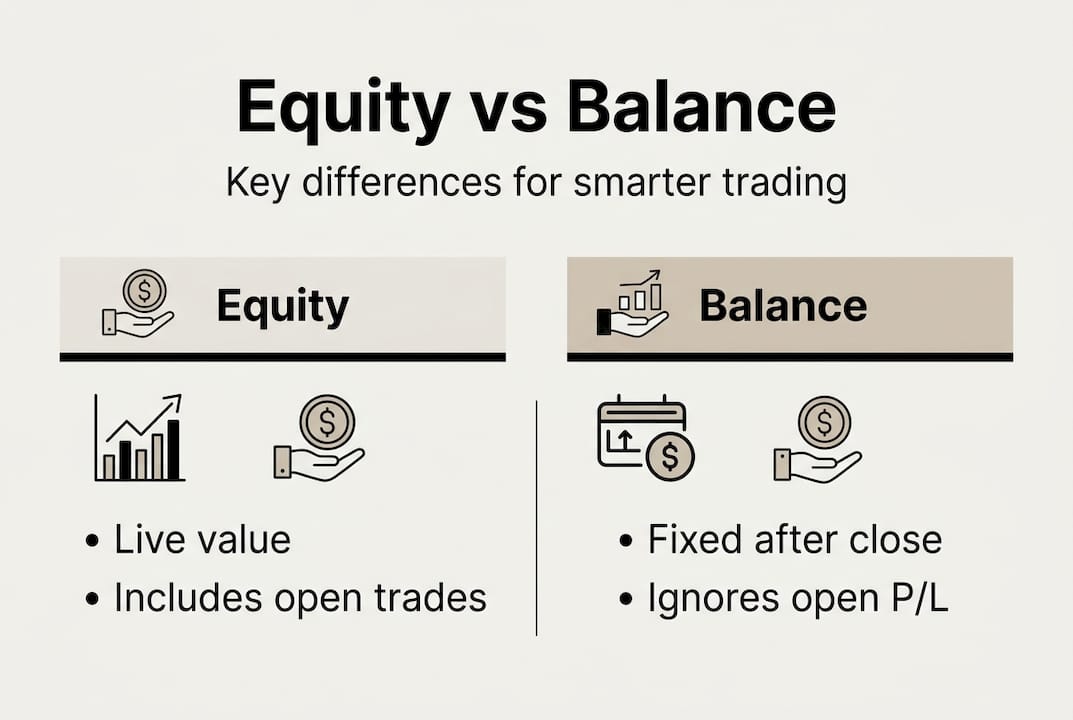
These two numbers look similar on paper but serve completely different purposes. Confusing them is where many traders make costly strategic errors.
Account balance:
- Updates only when you close a trade
- Reflects realized profits and losses
- Stays fixed while trades are open
- Useful for tracking long-term performance after the fact
Account equity:
- Updates in real time with every market tick
- Reflects both realized and unrealized profits and losses
- Changes constantly while trades are open
- The number your broker uses for all margin-related decisions
The broader definition of equity in finance refers to ownership value, but in trading specifically, it’s an account metric used to manage margin and risk in real time. That trading-specific focus is what makes it so actionable.
Here’s where the confusion gets expensive. Imagine your balance shows $10,000 and you feel comfortable. But you have three open losing trades with a combined floating loss of $3,500. Your equity is actually $6,500. If your used margin is $5,000, your margin level is only 130%, which is dangerously close to a margin call threshold at many brokers. Your balance told you everything was fine. Your equity told you the truth.
Strategic tip: Always base your trading decisions on current equity, not balance. Before opening a new trade, check your free margin (which is derived from equity) to confirm you have genuine capacity. This applies whether you’re trading forex, CFDs, or any other leveraged instrument.
The deeper truth: What most traders get wrong about equity
Having covered the mechanics, let’s dig into what the pros know and most retail traders ignore about equity.
The uncomfortable reality is that most retail traders treat equity like a background metric. They glance at it occasionally but anchor their decisions to balance. This is backwards. Balance is historical. Equity is present tense. When you’re in an active trade, balance is almost irrelevant for risk management purposes.
The traders who survive long-term don’t just know their equity number. They think in equity. They adjust position sizes based on current equity, not the balance they started the week with. They use hedging risk strategies to protect equity during uncertain market conditions rather than hoping positions reverse.
Here’s the harder truth: market prediction is unreliable. Equity discipline is not. You can be wrong about market direction and still protect your account if you manage equity well. You can be right about direction and still blow an account if you ignore equity and let losing positions run unchecked. Long-term profitability depends far more on equity discipline than on how accurately you read charts.
Next steps for mastering trading equity
Ready to put real equity knowledge to work? Here’s where to go next.
Understanding equity is only valuable when you can act on it with the right tools. A good trading platform shows you real-time equity, margin levels, and free margin at a glance, so you’re never trading blind. When you start trading forex with Olla Trade, these metrics are built directly into your dashboard, giving you full visibility into your account health at all times.
Explore our platform features to see how real-time equity tracking integrates with charting, risk tools, and execution speed. If you’re still building your foundation, our guide on CFDs explained is a practical next step for understanding how equity behaves across different instruments. Trade smarter, not just harder.
Frequently asked questions
How is equity different from balance in a trading account?
Equity changes with open positions in real time, while balance only updates after you close a trade. Equity is the live figure; balance is the historical one.
Why does equity matter for margin calls?
Brokers calculate free margin and margin levels using equity, not balance, so when equity drops, your margin level drops with it and triggers a warning or stop-out.
What happens if my trading equity drops to zero?
If equity hits zero, your broker will typically trigger a stop-out and close all open positions automatically to prevent your account from going into a negative balance.
Does equity affect all types of trading (forex, CFDs, stocks)?
Yes, equity is the core risk metric across forex, CFDs, and leveraged stock trading, because all of these instruments use margin-based position management where equity determines your capacity and safety.
Can I calculate equity automatically with a trading platform?
Most modern platforms, including MetaTrader 4, display real-time equity, margin level, and free margin in your account summary so you can monitor your risk without manual calculations.