












TL;DR:
- Asset classes are categories of financial instruments sharing common characteristics, market behavior, and regulations. They include equities, fixed income, cash equivalents, and real assets, which have distinct risk and return profiles and react differently to economic events. Diversification across these asset classes reduces portfolio risk by leveraging their varying responses to market conditions.
一个 asset class is defined as a category of financial instruments that share common characteristics, market behavior, and regulatory frameworks. The three foundational categories are equities, fixed income, and cash equivalents. Every serious investment strategy starts here. Resources like Investopedia and Pfolio Academy treat this definition as the baseline for understanding multi-asset portfolios. Knowing what separates one category from another is not academic trivia. It determines how you build a portfolio that can survive a market downturn, a rate hike cycle, or a commodity shock.
What is an asset class and how are they categorized?
Asset classes represent distinct economic exposures driven by fundamental factors such as corporate earnings, interest rates, and supply and demand cycles. That distinction matters because it explains why different categories react differently to the same economic event. When the Federal Reserve raises interest rates, bond prices typically fall while cash equivalents become more attractive. Equities may drop or hold depending on earnings expectations. These are not random movements. They reflect the underlying economic driver of each category.
The standard industry term for grouping investments this way is “asset class categorization,” and it forms the backbone of modern portfolio theory. Harry Markowitz formalized this thinking in his 1952 portfolio selection framework, which showed that combining assets with different return drivers reduces overall portfolio risk. That principle still governs how institutional investors at firms like BlackRock and Vanguard construct funds today.
One critical nuance: being in the same asset class does not guarantee similar performance among individual investments. Two stocks in the same equity category can deliver wildly different returns in the same year. Classification is a starting point for building a diversified portfolio, not a performance guarantee.
What are the main types of financial asset classes?
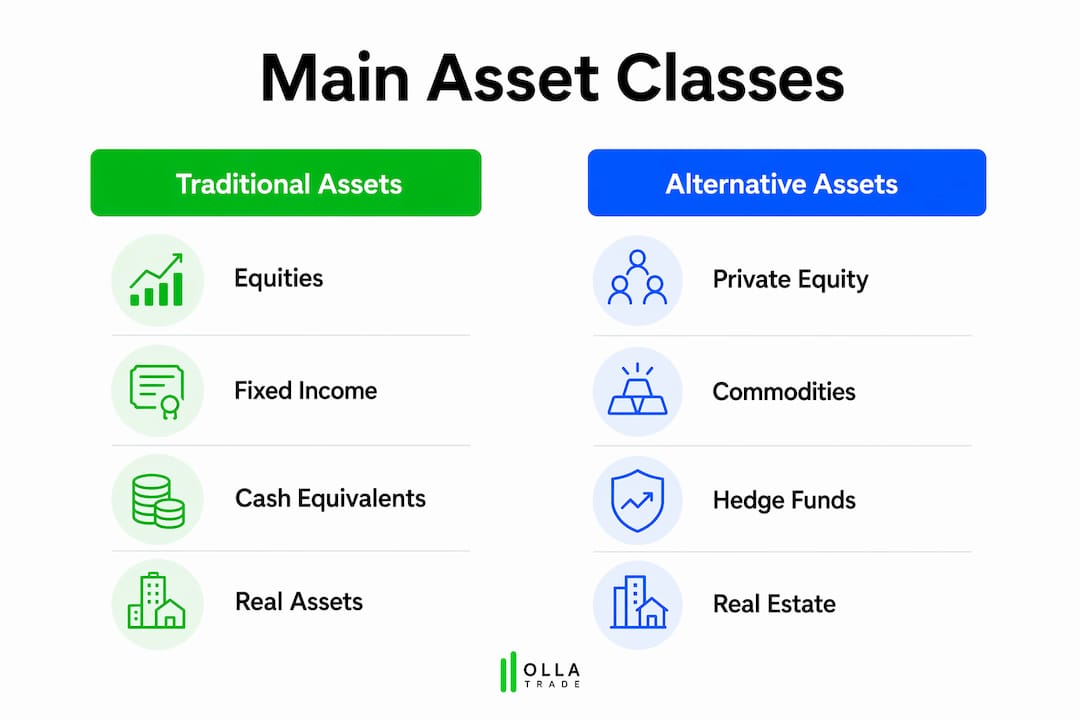
The four primary financial asset classes are equities, fixed income, cash equivalents, and real assets. Each carries a distinct risk and return profile.

Equities (Stocks)
Equities have historically been the primary growth engine in portfolios, delivering returns through price appreciation and dividends. The tradeoff is significant volatility and drawdown risk. The S&P 500 dropped over 30% in early 2020 before recovering. That kind of swing is normal for this category.
Fixed Income (Bonds)
Fixed income investments offer predictable income streams and carry less risk than equities, but they are susceptible to interest rate changes. When rates rise, existing bond prices fall. Government bonds from the U.S. Treasury and corporate bonds from companies like Apple or Microsoft both fall into this category, though their credit risk differs substantially.
Cash and Cash Equivalents
Cash and cash equivalents are low risk and highly liquid but generally offer lower returns than equities or bonds. Money market funds, Treasury bills, and savings accounts all qualify. They provide stability and purchasing power during market stress.
Real Assets
Real estate and commodities like gold, oil, and agricultural products are tangible assets. Their value ties to physical supply and demand rather than corporate earnings or interest rates. Gold, for example, often moves inversely to the U.S. dollar.
Here is a direct comparison across the four primary categories:
| Asset Class | 风险等级 | Typical Return | 流动性 | Key Driver |
|---|---|---|---|---|
| 股票 | 高的 | 高的 | 高的 | 企业收益 |
| Fixed Income | 中等的 | 中等的 | Medium to High | Interest rates |
| Cash Equivalents | 低的 | 低的 | 非常高 | Central bank policy |
| Real Assets | Medium to High | Medium to High | 低至中等 | Supply and demand |
专业提示: Check the correlation between your holdings, not just the category labels. Two assets in different categories can still move together during a crisis. Gold and equities both sold off sharply in March 2020 before gold recovered. Correlation data from sources like the Federal Reserve Economic Data (FRED) database gives you a clearer picture than category labels alone.
How do asset classes shape portfolio diversification and risk?
Diversification across asset classes with different return drivers reduces portfolio risk. This is the core principle behind Markowitz’s portfolio selection theory. The practical result is that a portfolio mixing equities, bonds, and real assets tends to experience smaller peak-to-trough losses than a portfolio concentrated in one category.
The reason this works is correlation. When equities fall sharply, U.S. Treasury bonds often rise because investors flee to safety. That negative correlation acts as a natural hedge. Commodities like oil respond to geopolitical events and supply cycles, which are largely independent of stock market earnings cycles. Understanding how indices shape portfolios through diversification and risk exposure adds another layer to this thinking.
Key diversification benefits of mixing asset classes include:
- Reduced volatility. A portfolio split between equities and bonds historically shows lower month-to-month swings than an all-equity portfolio.
- Smoother drawdowns. Fixed income tends to cushion losses during equity bear markets, as seen in 2008 and 2020.
- Exposure to multiple economic cycles. Commodities often outperform during inflationary periods when equities and bonds both struggle.
- Income stability. Bonds and dividend-paying stocks provide cash flow even when growth assets are flat.
- Capital preservation. Cash equivalents protect purchasing power during periods of extreme uncertainty.
Identifying asset classes helps individual investors understand their total market exposure, which is the foundation of effective diversification. A portfolio that looks diversified on the surface, say, 20 different stocks, may still carry concentrated equity risk. Adding a bond fund or a commodity ETF changes the risk profile in a meaningful way. Solid risk management strategies build directly on this understanding.
What are alternative asset classes and why do they matter?
Alternative assets are investment categories that fall outside the traditional equity, fixed income, and cash framework. They include real estate, private equity, commodities, hedge funds, and cryptocurrencies. Modern portfolios often include alternatives for their diversification benefits, particularly their lower correlation with traditional markets.
The appeal is straightforward. When stocks and bonds both decline, alternatives with independent return drivers can hold their value or even gain. Private equity, for example, is driven by operational improvements in private companies rather than public market sentiment. Real estate income depends on rental demand and property values, not the Nasdaq.
Common alternative asset types include:
- Real estate. Direct property ownership or REITs (Real Estate Investment Trusts) like Prologis or Simon Property Group.
- Private equity. Investments in private companies through funds managed by firms like KKR or Carlyle Group.
- Commodities. Physical goods including crude oil, natural gas, gold, silver, and agricultural products.
- Cryptocurrencies. Digital assets like Bitcoin and Ethereum, which trade on exchanges and carry high volatility. You can explore crypto trading benefits to understand how this category fits a modern portfolio.
- Hedge funds. Pooled investment vehicles using strategies like long/short equity, global macro, or arbitrage.
The challenges are real. Alternative assets carry liquidity premiums and less regulatory oversight, making them harder to value and trade than exchange-listed securities. Private equity funds often lock up capital for 7–10 years. Real estate requires significant capital and carries transaction costs. Cryptocurrency markets operate 24 hours a day with no circuit breakers.
专业提示: Before adding any alternative asset to your portfolio, check its liquidity terms carefully. A private equity fund with a 10-year lockup period is not a substitute for a bond fund you can sell tomorrow. Match the liquidity of your investment to your actual time horizon and cash needs.
How can you use asset classes to build a real portfolio?
Asset allocation is the method investors use to tailor their exposure to different asset categories based on personal goals and risk tolerance. It is the single most important decision in portfolio construction, outweighing individual security selection in its impact on long-term returns.
The process starts with two questions: What is your time horizon? What level of loss can you absorb without selling at the wrong time? A 30-year-old saving for retirement can tolerate more equity volatility than a 60-year-old protecting retirement savings. That difference in tolerance directly shapes the asset mix.
Simple portfolio models based on asset class categories include:
- Aggressive growth (80% equities / 20% bonds). Suited for long time horizons and high risk tolerance. Maximizes growth potential with significant short-term volatility.
- Balanced (60% equities / 40% bonds). The classic model used by many target-date funds. Balances growth and income with moderate volatility.
- Conservative (30% equities / 70% bonds and cash). Prioritizes capital preservation and income. Suited for investors near or in retirement.
- Diversified with alternatives (50% equities / 30% bonds / 20% alternatives). Adds real estate, commodities, or crypto for additional diversification. Requires more active monitoring.
A practical portfolio building guide can help you translate these models into actual investment choices. The key is reviewing your allocation at least once a year. Markets shift asset weights over time. A 60/40 portfolio after a strong equity year may drift to 70/30 without any action on your part.
要点总结
Understanding asset classes is the foundation of every sound investment decision, from basic diversification to advanced portfolio construction.
| 观点 | 细节 |
|---|---|
| 核心定义 | An asset class groups investments by shared characteristics, market behavior, and regulatory environment. |
| Four primary categories | Equities, fixed income, cash equivalents, and real assets each carry distinct risk and return profiles. |
| Diversification works through correlation | Mixing asset classes with different economic drivers reduces portfolio volatility and smooths drawdowns. |
| Alternatives add complexity | Real estate, private equity, and crypto offer diversification benefits but carry liquidity and valuation challenges. |
| Allocation drives outcomes | Matching your asset mix to your time horizon and risk tolerance is the most impactful portfolio decision you can make. |
Why most investors get asset classes wrong
Most people treat asset class labels as a checklist rather than a framework. They buy a bond fund and assume they are diversified. They add Bitcoin and think they have covered the alternatives category. The label is not the point. The underlying economic driver is.
What I have found after years of watching portfolios get built and rebuilt is that the biggest mistakes happen at the edges. Investors overweight the asset class they understand best, usually equities, and underweight everything else. Then a rate cycle or a commodity shock hits and they are exposed in ways they did not anticipate.
The other mistake is treating asset class categories as static. Cryptocurrencies did not exist as a recognized category 15 years ago. Private credit has grown into a multi-trillion-dollar market that sits between traditional fixed income and private equity. The categories evolve. Your understanding of them needs to keep pace.
The practical fix is simple. Review your portfolio’s actual economic exposures, not just its category labels, at least twice a year. Ask what each holding responds to: earnings, rates, inflation, or supply cycles. If everything responds to the same driver, you are not as diversified as you think.
— FX
Put your asset class knowledge to work with Ollatrade
Understanding asset classes is one thing. Applying that knowledge across live markets is another. Ollatrade gives you access to equities, forex, metals, indices, energies, and cryptocurrencies through a single platform built for both retail and professional traders.

The platform integrates MetaTrader 4 with advanced charting tools and expert advisors, so you can monitor multiple asset categories and act on allocation decisions in real time. Whether you are shifting exposure from equities to commodities or adding crypto to a traditional portfolio, Ollatrade’s execution speed and instrument range support the move. Start by exploring the 平台主要功能 that help you manage diverse asset exposure effectively. You can also use the 平台设置指南 to configure your workspace for multi-asset monitoring from day one.
常问问题
What is an asset class in simple terms?
An asset class is a group of investments that share similar characteristics, market behavior, and regulatory rules. Equities, bonds, and cash are the three foundational examples.
How many asset classes are there?
Traditional finance recognizes three to four primary asset classes: equities, fixed income, cash equivalents, and real assets. Modern portfolios often add alternatives like private equity, commodities, and cryptocurrencies as a fifth category.
Why does understanding asset classes matter for investors?
Understanding asset classes is the critical first step toward multi-asset investment strategies. It helps investors identify their true market exposure and build portfolios that can withstand different economic conditions.
Do all investments in the same asset class perform the same?
No. Being in the same asset class does not guarantee similar performance. Two stocks in the same equity category can deliver dramatically different returns depending on the company, sector, and market conditions.
What is the difference between traditional and alternative asset classes?
Traditional asset classes like equities and bonds trade on regulated exchanges with high liquidity. Alternative asset classes like private equity and real estate typically carry lower liquidity, less regulatory transparency, and higher barriers to entry for retail investors.